

AI isn’t something we’re waiting for anymore. It’s already here. Every time you check directions, talk to your phone instead of typing, or unlock your device with your face, AI is doing the work in the background.
The same shift is happening inside organizations. Companies and government agencies are using AI to answer questions faster, cut down manual tasks, support their teams, and improve how they serve people.
But the real question is,
Are U.S. states simply using AI, or have they actually become good at it?
Because there’s a big difference between trying AI and being mature with it.
A few things stand out:
- Most organizations say they’re using AI today, but only a small number see results across the entire organization.
- States are spending more on AI every year, yet outcomes look very different depending on where you are.
- Some states are building strong data foundations and clear AI policies. Others are still figuring out where to start.
So what does “AI maturity” really look like?
- Is it about launching tools, or making them work at scale?
- Is it innovation speed, strong governance, or real impact for citizens?
- And which states are turning AI investments into long-term value instead of short-term experiments?
For CXOs, this goes beyond technology. It’s about leadership choices, how you invest, how you manage risk, and how you turn AI into something that actually delivers results.
Understanding where U.S. states stand on AI maturity offers a useful lens for any organization trying to move from pilots to real, lasting impact.
Let’s take a look at the global AI use
Over the past few years, AI has moved beyond hype and early pilots. But 2026 feels like a turning point. This is the year AI clearly shifted from optional technology to something that’s becoming part of the operational backbone of modern organizations.
This isn’t just theory. You can see it in real usage data, workplace trends, adoption patterns, and emerging governance thinking. In other words, AI is becoming like an infrastructure. Now, let’s walk through what that really means.
- AI is embedding deeper into work
In the U.S., the number of employees reporting regular AI use at work has been steadily climbing. One major workforce survey shows that nearly 45% of U.S. workers now use AI at least a few times a year, with weekly and daily use growing too.
- Adoption has accelerated rapidly in just a couple of years
Another Gallup study shows that AI usage at work has nearly doubled since 2023, especially among knowledge workers like those in tech, finance, or professional services.
- Professionals are adopting AI at scale.
Industry surveys also report that roughly 72% of professionals across fields like accounting, consulting, legal, and finance now use AI in their work, up significantly from the prior year.
All of this tells us that AI use is no longer concentrated in isolated pockets. It’s spreading across roles, functions, and industries.
As AI becomes more embedded, it also nudges organizations toward new expectations about governance and risk. When AI is scattered in ad-hoc pockets, it’s hard to manage or measure. But as it becomes assumed infrastructure, leaders can no longer treat governance as an afterthought.
In 2026, this reality is showing up in policy discussions too. At the federal level, U.S. lawmakers and regulators have been actively debating frameworks that balance innovation with oversight, aiming to protect privacy, fairness, and safety without stifling growth. Experts argue that practical governance is becoming just as essential as technical capability.
For U.S. leaders, this moment matters. AI isn’t just a tool you try anymore. It’s becoming something you build with, a foundational component of how work gets done, decisions are made, and value is created.
Understanding where AI stands today through data, trends, and governance challenges gives CEOs and CXOs the context they need to lead, not just react.
But, what exactly is AI Maturity?
AI maturity isn’t just about using artificial intelligence tools or utilising AI development services. It’s about how well an organization is prepared to adopt, scale, and manage AI in a way that creates real value for the business, not just isolated pilots or experiments. A mature AI organization uses AI strategically, responsibly, and consistently across its processes, teams, and systems.
In practical terms, AI maturity measures an organization’s progress on several key fronts, including:
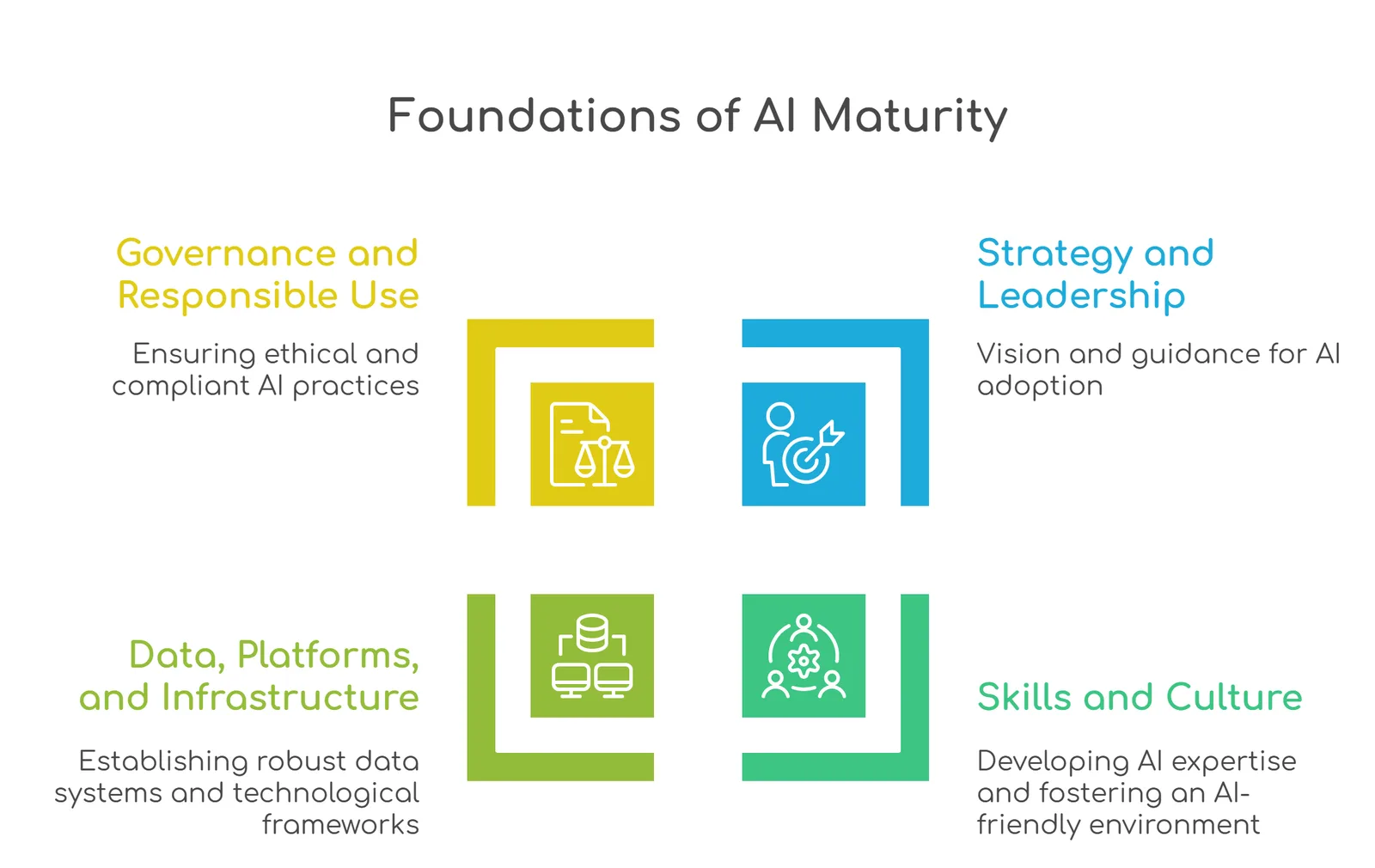
1. Strategy and Leadership
A mature organization has a clear AI strategy that aligns with business goals, not just technology tests. AI isn’t siloed within IT because leadership drives its adoption and supports scaling.
2. Skills and Culture
High AI maturity means teams understand AI’s possibilities and limitations. People across functions have the skills, training, and confidence to work with AI meaningfully, not just the tech specialists.
3. Data, Platforms, and Infrastructure
Data is a foundation for AI. Mature organizations have reliable, well-governed data systems and scalable infrastructure that allow AI models to work effectively across the business.
4. Governance and Responsible Use
Beyond deployment, mature AI practices include policies for ethical use, security, risk management, and compliance. These safeguards ensure AI delivers value while minimizing potential harms.
Put simply, being AI mature means AI is not just implemented, it’s integrated. Organizations at higher maturity levels use AI as a foundational part of business operations, decision-making, and innovation. Here’s what our AI leader thinks about it:
“AI maturity is about moving from isolated experiments to enterprise-wide practices that consistently deliver strategic value. It’s not just technology adoption, it’s responsible, scalable, and outcome-oriented transformation.”
- Arbind Kumar, VP - AI/ML, Data & Innovation, Antino
This means moving beyond early stages like awareness and testing, to stages where AI is systematically improving processes, enabling new capabilities, and creating measurable business impact. Mature organizations not only use AI, but they govern it, measure it, and optimize it as part of how they run their business.
Stages of AI maturity
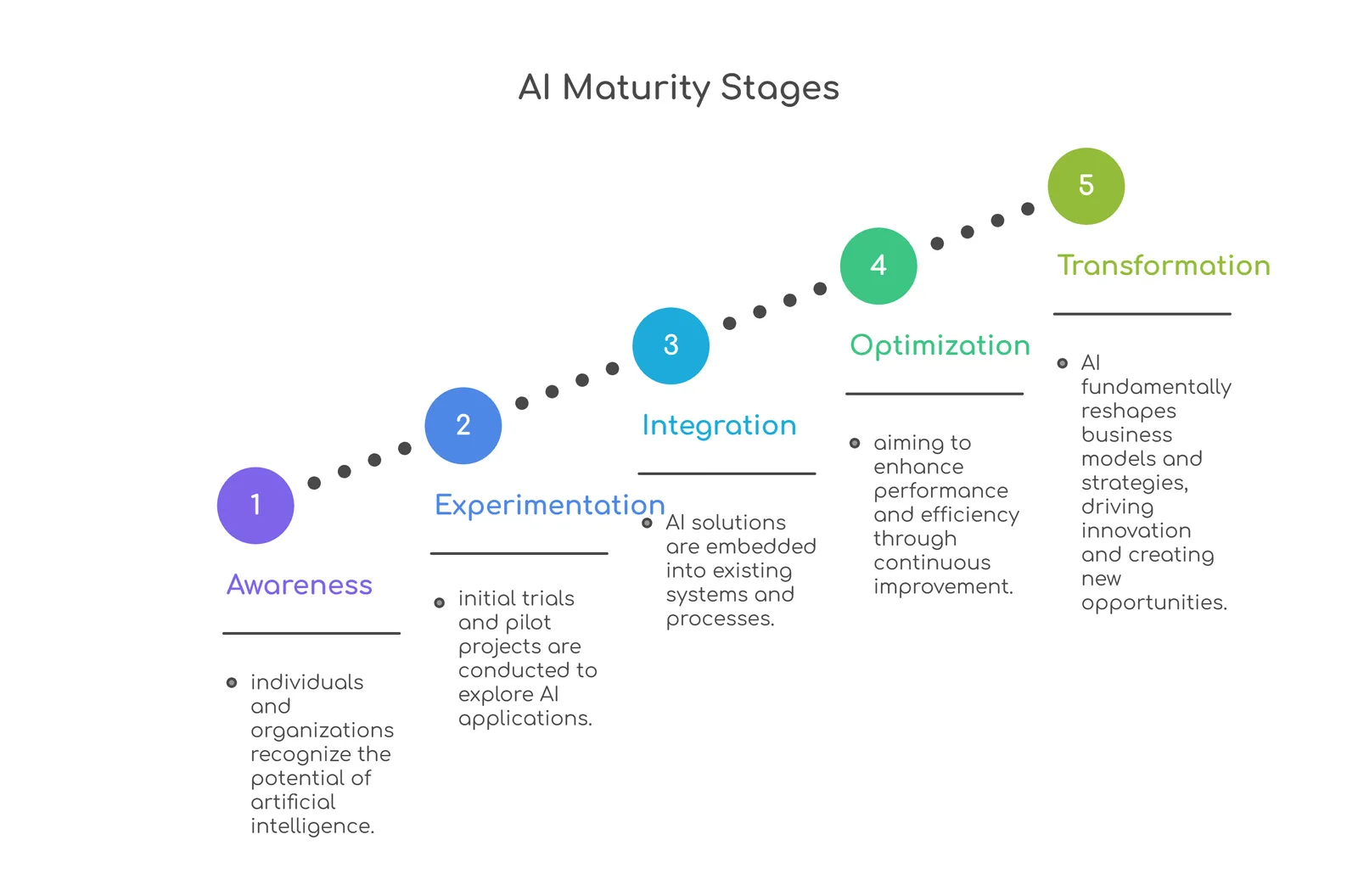
- Awareness – Leaders recognize AI’s potential; few practical projects exist.
- Experimentation – Pilot use cases begin, but they are limited in scale.
- Integration – AI becomes part of core workflows and systems.
- Optimization – AI drives measurable value across functions.
- Transformation – AI shapes strategy, customer experience, and competitive advantage.
Understanding where your organization sits on this progression helps you prioritize investments, manage risks, and unlock the real power of AI.
Where Do U.S. Organizations Stand on the AI Maturity Curve?
Most U.S. organizations today believe they are “doing AI.” And in many cases, they are, but not in the way true AI maturity demands.
The reality is that the majority of organizations still sit between the Experimentation and Integration stages of the AI maturity curve. AI exists, but often in pockets. Teams are testing tools, running pilots, or solving isolated problems, but AI hasn’t yet become a consistent, enterprise-wide capability.
Early Stage: Awareness and Experimentation
A large number of organizations, especially in traditional industries, are still focused on understanding AI’s potential and testing small use cases.
For example:
- Many mid-sized U.S. companies use generative AI tools for content drafting, basic analytics, or internal Q&A, but these tools operate outside core systems.
- In state and local government, AI pilots often focus on chatbots for public queries or document summarization, without deeper integration into workflows.
At this stage, AI is helpful, but optional. Results depend heavily on individuals rather than systems.
Middle Stage: Integration Is Underway, But Uneven
Some organizations have moved further. AI is embedded into specific business functions, yet still lacks consistency across the enterprise.
Real examples include:
- Large U.S. banks are using AI for fraud detection, credit scoring, and customer support automation, while other departments still rely on manual processes.
- Healthcare providers are applying AI to medical imaging or scheduling optimization, but not extending AI governance or data standards across the organization.
- Retail and logistics firms are using AI for demand forecasting or route optimization, but are struggling to align data across regions and systems.
Here, AI delivers value, but scaling remains hard. Different teams use different tools, data pipelines are fragmented, and ownership is often unclear.
Advanced Stage: Optimization and Transformation Are Still Rare
Only a small group of U.S. organizations has reached higher levels of AI maturity, where AI actively shapes strategy and long-term advantage.
Examples include:
- Digital-native companies that use AI across pricing, personalization, supply chain decisions, and customer experience, powered by unified data platforms.
- Manufacturing leaders using AI not just for predictive maintenance, but to redesign production planning and decision-making in real time.
- Forward-looking public sector agencies applying AI across operations, analytics, and citizen services with strong governance and accountability frameworks.
In these organizations, AI is no longer an experiment. It’s part of how decisions are made and how value is created.
The Big Gap
What separates most U.S. organizations from true AI maturity isn’t access to technology, it’s structure.
Common gaps include:
- Strong tools but weak data foundations
- Successful pilots with no scaling plan
- Innovation teams are moving faster than governance
- AI value that’s hard to measure at the enterprise level
This is why many leaders feel stuck. AI works in theory and in pockets, but translating that into repeatable, organization-wide impact remains the challenge.
Why does this matter for Leaders?
Understanding where your organization sits on the AI maturity curve is critical. The risks, investments, and decisions required at each stage are very different.
In 2026, the question for U.S. leaders is no longer “Should we use AI?” It’s “How do we move from scattered success to sustained, responsible impact?”
That shift, from experimentation to maturity, is where the next phase of competitive advantage will be decided.
What’s holding U.S. organizations back from AI Maturity?
Many U.S. organizations feel confident about their AI readiness. Tools are in place, pilots show promise, and teams are experimenting. But when leaders look for enterprise-level impact, progress often stalls. The gap between being AI-ready and being AI-mature is wider than it appears.
| What Organizations Say They’re Ready For | What Actually Happens on the Ground |
| “We have AI tools in place.” | Tools exist, but they are used inconsistently across teams and functions. |
| “We’ve run successful AI pilots.” | Pilots don’t scale due to a lack of integration with core systems. |
| “Our data is good enough.” | Data is fragmented, siloed, or not governed well enough for AI at scale. |
| “AI ownership sits with IT or innovation teams.” | Business teams lack clarity on accountability and decision rights. |
| “We’re moving fast to stay competitive.” | Speed outpaces governance, increasing operational and reputational risk. |
| “AI is improving productivity.” | Productivity gains are local, not enterprise-wide or measurable. |
| “We’ll address governance later.” | Governance gaps become blockers when adoption increases. |
| “Our teams are using AI already.” | Usage depends on individuals, not standardized processes. |
The core problem is that readiness is often overestimated
Many U.S. organizations believe they are AI-ready because:
- Employees are using AI tools
- A few pilots delivered promising results
- Leadership supports innovation in principle
But AI maturity requires more than intent and experimentation.
The gap appears when organizations try to move from:
- Individual productivity → enterprise value
- Innovation teams → operational teams
- Tools → systems
- Experiments → repeatable outcomes
Why does this gap persist?
Well, this is where the progress slows down.
1. Data Isn’t Built for Scale
Most organizations underestimate how much data quality, consistency, and governance matter once AI moves into core workflows.
2. Ownership Is Unclear
When AI sits only with IT or innovation teams, business impact remains limited. Mature AI requires shared ownership between technology, business, and leadership.
3. Governance Is Treated as a Brake, Not an Enabler
Many leaders worry that governance will slow them down. In reality, the lack of it becomes the biggest scaling barrier later.
4. ROI Is Hard to Prove
Without clear metrics, AI impact feels promising but vague, making it difficult to justify broader investment.
What does this mean for the U.S. Leaders in 2026?
The biggest blocker to AI maturity isn’t technology. It’s operating readiness.
Organizations that continue to treat AI as a collection of tools will stay stuck in experimentation. Those that treat AI as infrastructure, supported by data, governance, and clear ownership, are the ones moving toward real transformation.
In 2026, the advantage won’t come from who adopted AI first, but from who scaled it responsibly and effectively.
AI-Mature vs. AI-Immature Organizations
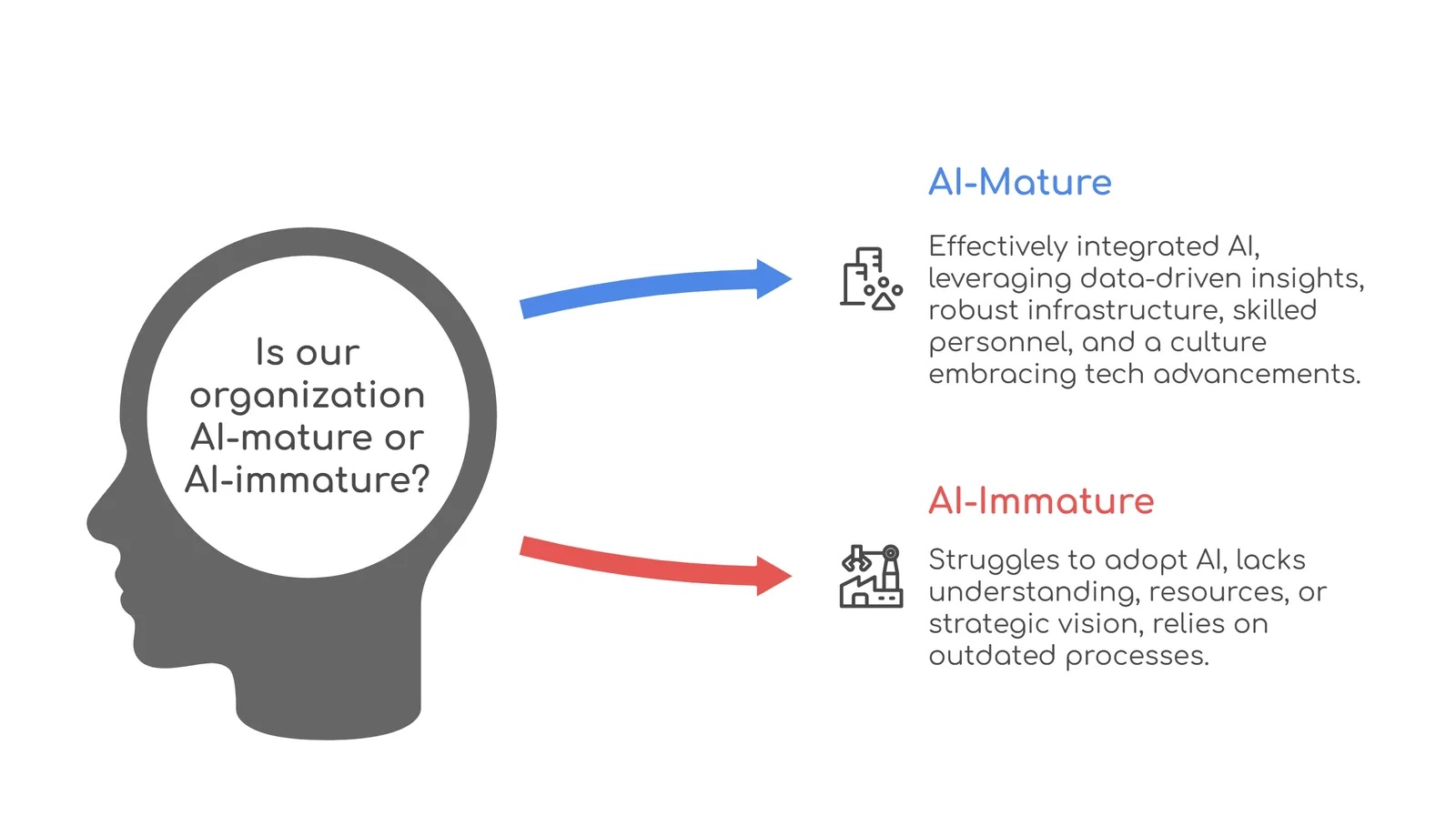
As AI adoption grows across the U.S., the real difference between organizations isn’t whether they use AI, rather, it’s how they use it. Two companies can invest similar amounts in AI and still see very different outcomes. The reason lies in maturity.
An AI-immature organization treats AI as a set of tools. An AI-mature organization treats AI as a core capability.
Here’s how the difference shows up in practice.
| AI-Immature Organization | AI-Mature Organization |
| Success depends on a few power users | AI adoption is standardized and accessible |
| Data is siloed and inconsistently governed | Data is unified, trusted, and well-governed |
| AI decisions are driven by tools and vendors | AI decisions are driven by business strategy |
| Governance is reactive or missing | Governance is built in from the start |
| ROI is unclear or anecdotal | AI impact is measured and tied to business outcomes |
| Innovation moves fast, but breaks at scale | Innovation scales without increasing risk |
| AI supports work occasionally | AI actively shapes how work gets done |
What does this look like in the real world?
An AI-immature organization might use AI to draft emails, analyze spreadsheets, or automate small tasks which are useful, but disconnected. When those tools fail, there’s no clear owner. When they succeed, it’s hard to replicate the success elsewhere.
An AI-mature organization, on the other hand, designs workflows where AI is expected. Data flows are intentional. Roles are clear. Governance isn’t a blocker because it’s what allows AI to scale safely. The result is consistency, trust, and measurable value.
Why does this distinction matter in 2026 & beyond?
In 2026, AI maturity is no longer about experimentation. Most organizations have already crossed that line. The real advantage now comes from operational discipline, which is the ability to turn AI into something reliable, repeatable, and responsible.
Leaders who recognize this difference early can shift focus from chasing tools to building capability. The question for U.S. organizations isn’t “Are we using AI?” It’s “Are we building something that lasts?”
What AI-Mature organizations do differently?
AI-mature organizations don’t win because they have better tools. They win because they make better choices about how AI fits into the business. Their advantage comes from discipline, clarity, and intent, and not experimentation alone.
Here’s what sets them apart.
1. They Lead with Strategy, Not Tools
AI-mature organizations start with business problems, not technology demos. Every AI initiative ties back to a clear goal for improving customer experience, reducing cost, increasing speed, or enabling better decisions.
AI isn’t treated as a side project. It’s part of the business roadmap.
2. They Build Strong Data Foundations First
These organizations understand a simple truth: AI is only as good as the data behind it. They invest early in data quality, integration, and governance so AI systems can scale without constant rework.
Instead of fixing data issues later, they design for reliability from day one.
3. They Embed AI Into Workflows
Rather than asking teams to “use AI when needed,” AI-mature organizations build AI directly into everyday workflows. Employees don’t have to think about when to use AI because it’s already there, supporting decisions and actions in real time.
This is where AI stops being optional and starts becoming infrastructure.
4. They Treat Governance as an Enabler
Mature organizations don’t see governance as a roadblock. They see it as a way to move faster with confidence. Clear rules around data use, model behavior, accountability, and risk allow teams to innovate without creating long-term problems.
Good governance makes scale possible.
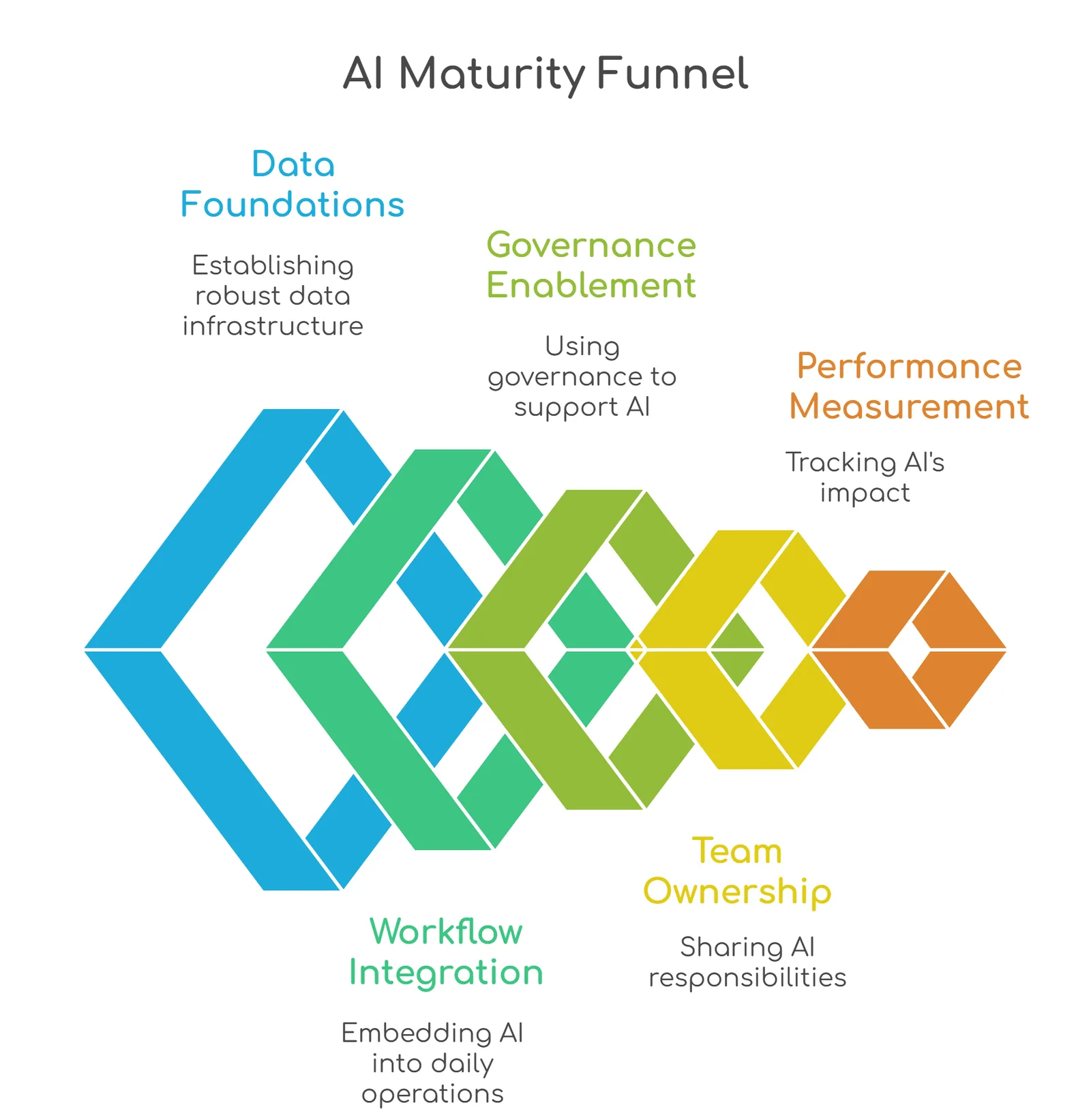
5. They Share Ownership Across Teams
AI success isn’t owned by IT alone. Business leaders, data teams, compliance, and operations all play a role. Clear ownership ensures decisions are faster, risks are managed, and outcomes are measurable.
When everyone owns AI, it actually works.
6. They Measure What Matters
Instead of tracking activity like the number of models or pilots, AI-mature organizations measure outcomes. They look at time saved, revenue impact, cost reduction, risk avoided, and customer satisfaction.
If AI doesn’t move the needle, they adjust or stop.
7. They Invest in People, Not Just Technology
Training isn’t optional. AI-mature organizations actively build AI literacy across roles, helping employees understand how to work with AI, question it, and trust it appropriately.
The goal is better collaboration between people and systems.
AI maturity isn’t about doing more experiments. It’s about doing fewer things better, and scaling what works.
In 2026, the organizations pulling ahead are the ones that treat AI like any other critical infrastructure: planned, governed, measured, and built to last.
Antino’s closing perspective and how we can help your enterprise with AI maturity?
As we move deeper into 2026, one thing is clear: AI is no longer a question of if, but how well. Most U.S. organizations have already crossed the adoption threshold. What separates leaders from the rest now is maturity, which is the ability to turn AI into something dependable, scalable, and valuable over the long term.
At Antino, we see this shift playing out every day. Organizations don’t struggle because AI doesn’t work. They struggle because moving from pilots to platforms requires new thinking about data, governance, ownership, and operating models. AI maturity is less about ambition and more about execution.
The organizations that succeed treat AI like infrastructure. They design it carefully, govern it responsibly, and align it tightly with business outcomes. They don’t chase tools. They build capability.
Ready to move from AI experimentation to enterprise-wide impact? Contact our experts to guide your AI maturity journey.