

AI is no longer an experimental line item in the budget. For most U.S. CXOs, the real challenge in 2026 is far more practical: where should we place our bets first? With dozens of AI use cases competing for attention, capital, and executive sponsorship, prioritization has become a boardroom conversation, not a lab discussion.
Are you investing in AI initiatives that can move the needle this fiscal year, or are you spreading resources thin across pilots that never scale? Which use cases deliver measurable business impact today, and which ones need more time, data readiness, or organizational buy-in before they can succeed? These are the questions keeping CEOs, CIOs, and CFOs aligned or misaligned when AI roadmaps are being approved.
This is where the Impact-Maturity Matrix becomes a powerful decision-making lens. It helps leadership teams step back from hype and evaluate AI initiatives based on two realities that matter most in U.S. enterprises: business value and execution readiness. Instead of asking “Is this cutting-edge?”, the matrix forces a more grounded question: Will this deliver results at our current level of data maturity, talent, and operating model?
For CXOs navigating regulatory pressure, shareholder expectations, and tighter ROI scrutiny, the Impact-Maturity Matrix offers a structured way to prioritize AI investments with confidence. It brings clarity to conversations around quick wins versus long-term transformation, operational efficiency versus strategic differentiation, and innovation versus risk. In the sections ahead, we’ll explore how this framework can help U.S. leadership teams make smarter, faster, and more defensible AI investment decisions.
But, before that, what is the Impact-Maturity Matrix?
The Impact-Maturity Matrix is a simple yet powerful framework that helps leadership teams evaluate and prioritize AI initiatives without getting lost in technical complexity. At its core, it answers one fundamental question every U.S. CXO is asking right now: Which AI investments make sense for us, right now?
Instead of looking at AI ideas in isolation, the matrix plots each potential use case across two clear dimensions:
1. Business Impact
2. Organizational Maturity
When viewed together, these dimensions create a practical map for decision-making, not just for data scientists, but for CEOs, CFOs, CIOs, and business leaders who are accountable for outcomes.
The two dimensions explained here…
Business Impact looks at the value an AI initiative can deliver once implemented. This includes:
- Revenue growth or new revenue streams
- Cost reduction and operational efficiency
- Improved customer experience or retention
- Risk mitigation and AML compliance improvements
In simple terms, this asks: If this works, how much does it help the business? High-impact initiatives directly affect KPIs that U.S. enterprises care about, such as margin improvement, customer lifetime value, speed to market, or regulatory resilience.
Organizational Maturity measures how ready your organization is to execute and scale that AI initiative today. This includes:
- Data availability and quality
- Technology infrastructure and integration readiness
- Talent, skills, and governance
- Change management and leadership alignment
This side of the matrix answers: Are we actually prepared to make this work without major disruption?
An idea can sound transformative on paper, but if the data is fragmented, systems are outdated, or teams are not aligned, execution risk increases significantly.
How does the matrix work?
You can think of the Impact-Maturity Matrix as a two-by-two grid.
- The horizontal axis represents Business Impact, moving from low to high.
- The vertical axis represents Organizational Maturity, moving from low to high.
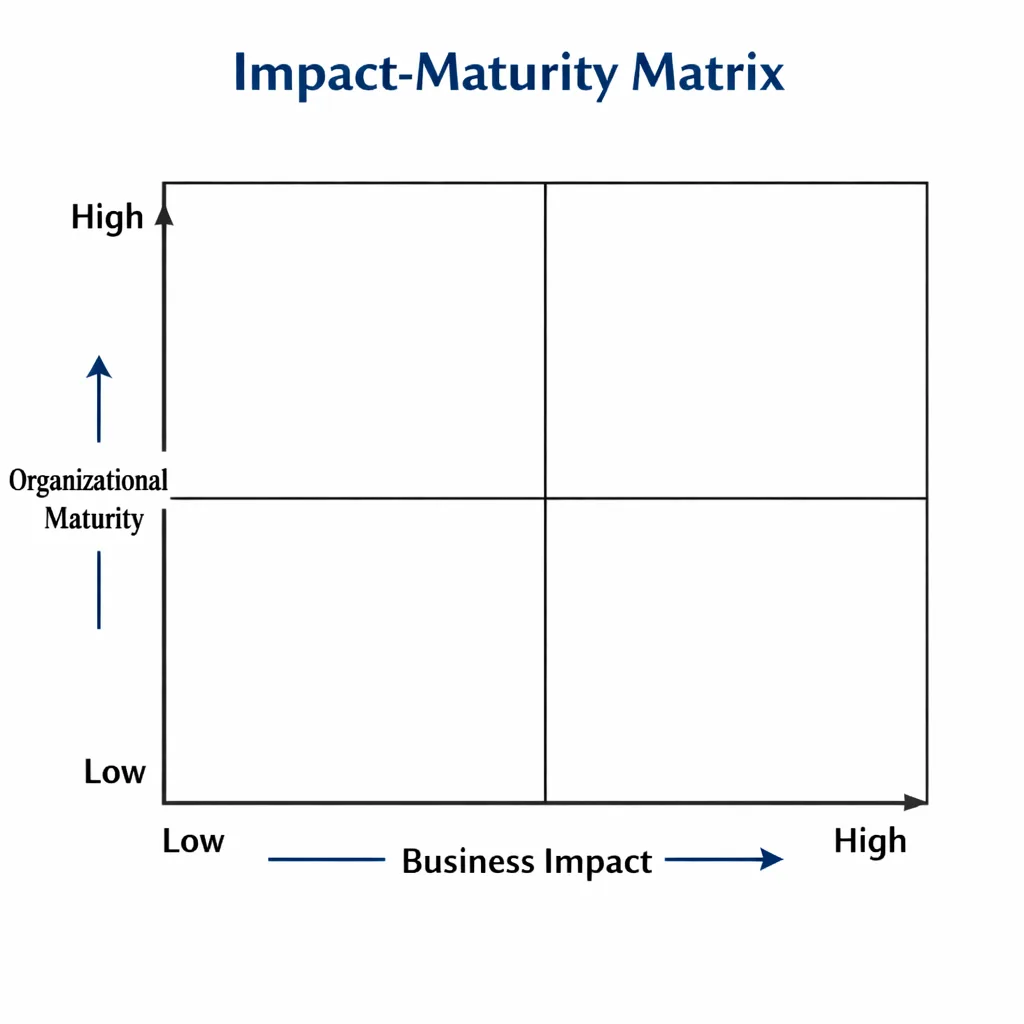
Every AI use case is plotted somewhere on this grid based on honest assessment, not ambition. Here’s how it plays out in real-world terms.
- High Impact, High Maturity
These are your priority investments. The value is clear, and the organization is ready. These initiatives are ideal for near-term funding, executive sponsorship, and scaled deployment. Many U.S. enterprises start here to demonstrate quick ROI and build confidence in AI adoption.
- High Impact, Low Maturity
These are strategic bets. The upside is significant, but the organization needs groundwork, such as better data pipelines, governance, or skills. These initiatives belong on the roadmap with phased investments rather than immediate full-scale deployment.
- Low Impact, High Maturity
These are often optimization or efficiency plays. They are easier to execute but may not justify large budgets. Leaders may choose to implement them selectively or bundle them with larger transformation programs.
- Low Impact, Low Maturity
These are typically experimental or early-stage ideas. While they may be innovative, they carry a higher risk with limited business return. Most CXOs either park these initiatives for later or run them as small, controlled pilots.
Why does this approach resonate with U.S. leadership teams?
For U.S. CXOs facing budget scrutiny, quarterly performance pressure, and board-level accountability, the Impact-Maturity Matrix introduces discipline into AI decision-making. It replaces gut feel and buzzwords with a shared language that finance, technology, and business leaders can align on.
Most importantly, it helps organizations avoid two common pitfalls: investing heavily in AI initiatives they are not ready to scale, or ignoring high-value opportunities because they seem complex. The matrix makes trade-offs visible, enabling smarter prioritization and clearer conversations across the C-suite.
In the next section, we’ll break down how CXOs can use this matrix to build a phased, ROI-driven AI investment roadmap that balances quick wins with long-term transformation.
How CXOs Can Use the Impact-Maturity Matrix to Prioritize AI Investments?
Once the Impact-Maturity Matrix is defined, the real value comes from how it is applied in practice. For U.S. CXOs, this is less about theory and more about making confident, defensible decisions in budget meetings, board discussions, and annual planning cycles.
Here’s how leadership teams can use the matrix as a practical prioritization tool rather than a conceptual exercise.
Step 1: Start with real business problems, not AI ideas
The most effective use of the matrix begins outside the technology function. Instead of asking, “Where can we use AI?” successful CXOs flip the question to “Where are we losing money, time, or customers today?”
This might include:
- Rising customer churn in specific regions
- Operational bottlenecks are slowing fulfillment or service delivery
- Increasing compliance costs or risk exposure
- Manual processes that don’t scale with growth
Each problem is then translated into potential AI-enabled use cases. This ensures every initiative entering the matrix is tied to a business outcome that leadership already cares about.
Step 2: Score impact and maturity honestly
Next comes evaluation. Each AI use case is assessed against the two matrix dimensions.
For impact, leadership teams ask:
- Will this initiative directly affect revenue, margins, or customer experience?
- Can success be measured in clear financial or operational terms?
- Does it align with strategic priorities for the next 12 to 36 months?
For maturity, the questions are more grounded:
- Do we already have the data needed, or will it take months to prepare?
- Can this integrate with existing systems without major rework?
- Do we have internal ownership and decision-making clarity?
- Are teams ready to adopt and trust the output?
The key here is realism. Overestimating maturity is one of the most common reasons AI initiatives stall after pilot phases.
Step 3: Group initiatives into action-oriented categories
Once plotted on the matrix, patterns begin to emerge. Instead of a long list of disconnected projects, CXOs can now group initiatives into clear action paths.
Some initiatives are ready for immediate execution, with strong impact and high readiness. These become flagship AI programs with executive sponsorship.
Others are future growth plays that need foundational work first. These inform investments in data platforms, governance, and skills rather than full deployment.
Some ideas may be low-risk optimizations that improve efficiency but don’t justify large funding. These are often delegated to business units with tight scope control.
Finally, a few initiatives may be deprioritized entirely, saving time and budget that would otherwise be lost to low-return experimentation.
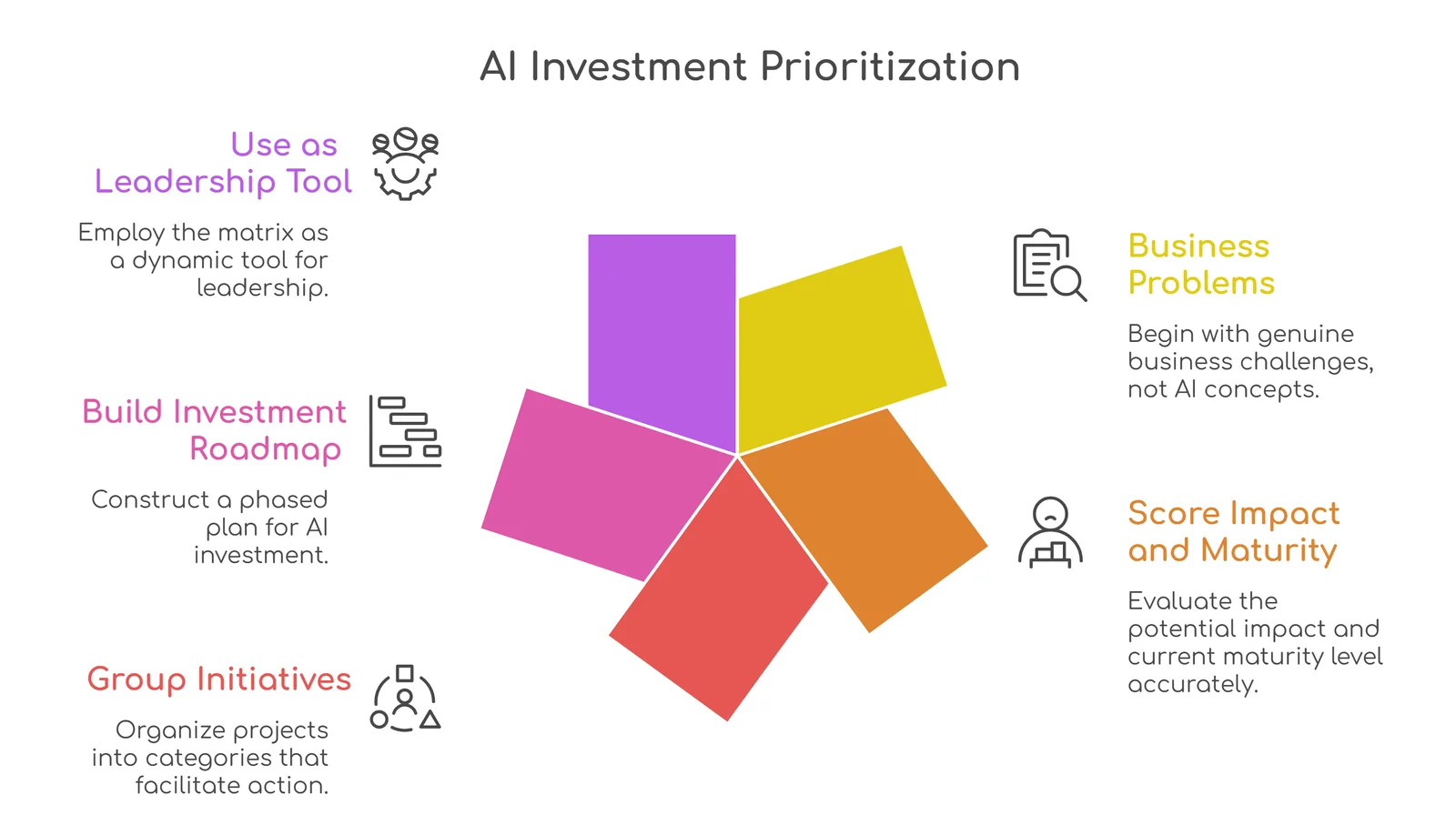
Step 4: Build a phased investment roadmap
One of the biggest advantages of the Impact-Maturity Matrix is that it naturally supports phased investment planning, which resonates strongly with U.S. boards and finance leaders.
Instead of requesting large, upfront AI budgets, CXOs can:
- Fund high-impact, high-maturity initiatives for near-term ROI
- Allocate smaller, targeted budgets to raise maturity in strategic areas
- Define clear exit or scale criteria for each initiative
This approach reduces risk, improves capital efficiency, and creates visible momentum, which is critical for sustaining executive and organizational buy-in.
Step 5: Use the matrix as a living leadership tool
The matrix is not a one-time exercise. As data improves, teams gain experience, and market conditions shift, initiatives move across the grid.
High-maturity programs today were often low-maturity bets a year ago. By revisiting the matrix quarterly or biannually, CXOs can adjust priorities without restarting strategy conversations from scratch.
More importantly, it becomes a shared language across the C-suite, helping technology, finance, and business leaders stay aligned on where AI fits into the broader enterprise agenda.
Used correctly, the Impact-Maturity Matrix turns AI prioritization from a reactive, hype-driven process into a structured leadership discipline. In the next section, we’ll explore common mistakes CXOs make when applying this framework and how to avoid them.
Common Mistakes CXOs Make When Using the Impact-Maturity Matrix (and How to Avoid Them)
While the Impact-Maturity Matrix is a powerful framework, its effectiveness depends entirely on how it’s used. Many AI initiatives in U.S. enterprises don’t fail because the technology is flawed, but because the matrix is applied with blind spots, assumptions, or internal bias. Below are some of the most common mistakes CXOs make, along with practical ways to avoid them.
Mistake 1: Confusing ambition with readiness
One of the most frequent missteps is rating initiatives as “high maturity” simply because the organization wants them to succeed. Vision is important, but readiness is factual.
Teams often assume maturity because:
- The idea has executive backing
- A vendor demo looks promising
- A proof of concept worked in isolation
In reality, maturity is about data reliability, system integration, governance, and day-to-day operational adoption. To avoid this, CXOs should insist on evidence-based scoring: documented data quality, integration paths, and clear ownership, not optimism.
Mistake 2: Overvaluing innovation and undervaluing impact
AI discussions can easily drift toward what sounds most advanced rather than what delivers measurable outcomes. Some initiatives score high in perceived innovation but low in tangible business value.
For example, a sophisticated AI model may attract attention, but if it doesn’t clearly improve margins, customer experience, or risk posture, its impact remains limited. Strong leaders keep the impact lens grounded in KPIs the board already tracks, ensuring AI remains a business enabler, not a technology showcase.
Mistake 3: Treating the matrix as a one-time exercise
Many organizations build the matrix during annual planning and never revisit it. This creates a static view of a dynamic reality.
Data platforms evolve, teams gain experience, and market conditions shift rapidly, especially in regulated U.S. industries. CXOs who get the most value from the matrix treat it as a living tool, revisiting assumptions and adjusting priorities regularly rather than locking decisions in for multiple years.
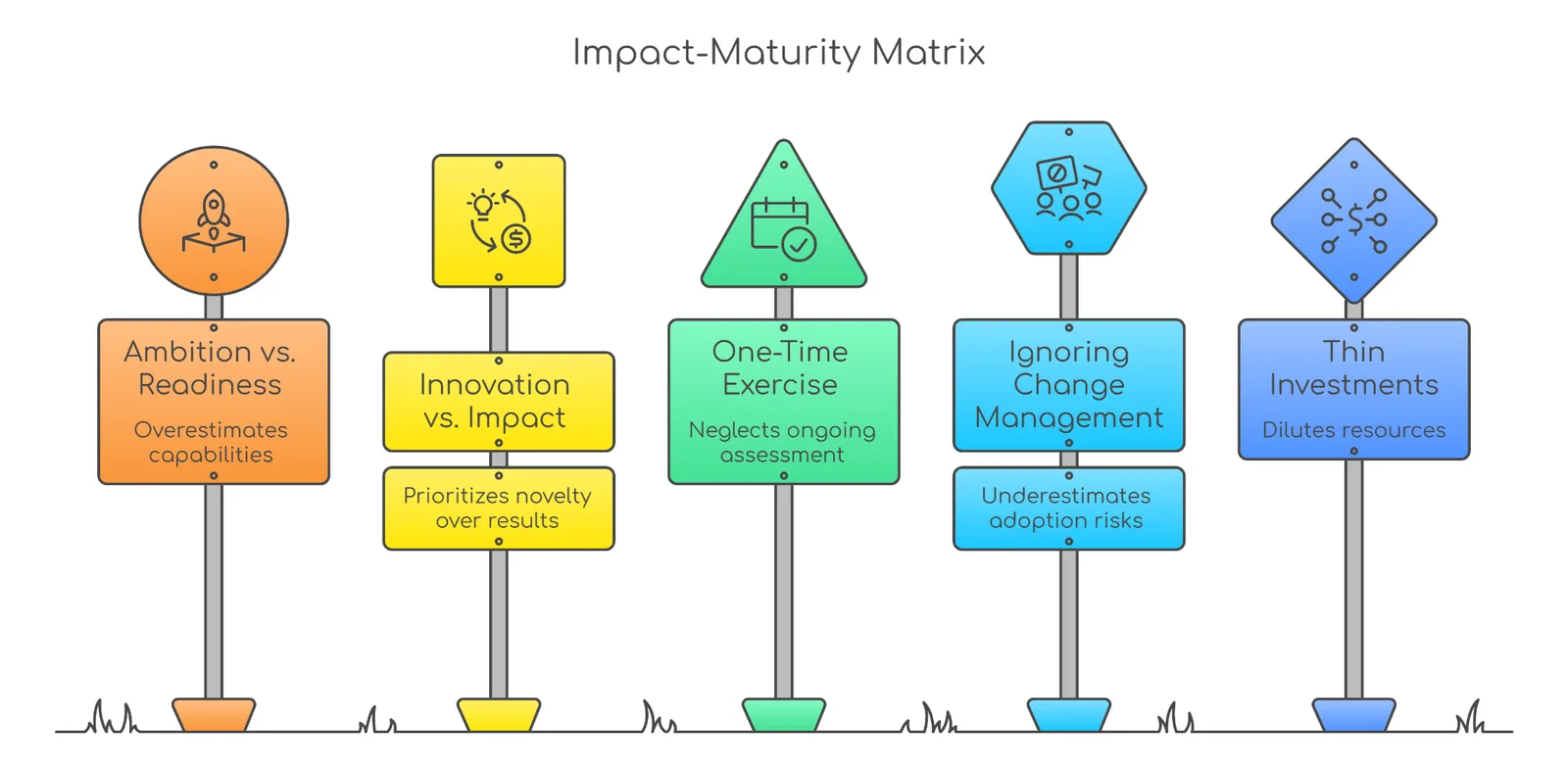
Mistake 4: Ignoring change management and adoption risk
An initiative may score high on technical maturity but still struggle if users don’t trust or adopt it. This is particularly common in customer-facing or compliance-driven use cases.
Leaders often underestimate:
- Resistance to automated decision-making
- Training requirements for frontline teams
- Cultural readiness to act on AI insights
To avoid this, adoption risk should be factored into maturity scoring, not treated as a downstream issue. If people won’t use it, maturity is lower than it appears.
Mistake 5: Spreading investments too thin
When every initiative looks “important,” nothing truly moves forward. Some CXOs attempt to fund too many initiatives across all quadrants, resulting in stalled pilots and diluted outcomes.
The matrix is designed to force trade-offs. High-impact, high-maturity initiatives deserve focus and scale. Others should wait, be phased, or be stopped altogether. Discipline here is what separates AI progress from perpetual experimentation.
Avoiding these mistakes allows the Impact-Maturity Matrix to serve its true purpose: enabling confident, outcome-driven AI investment decisions. When used with honesty, structure, and follow-through, the matrix becomes a leadership advantage, helping CXOs align strategy, execution, and ROI.
In the next section, we’ll look at how organizations can evolve their maturity over time and intentionally move high-impact initiatives into execution-ready territory.
How to Move AI Initiatives Up the Maturity Curve?
Identifying high-impact AI opportunities is only half the equation. For many U.S. organizations, the real challenge is this: How do we become ready to execute them? The Impact-Maturity Matrix makes gaps visible, but leadership action is what closes them.
Moving AI initiatives up the maturity curve requires intentional investment in a few foundational areas. It’s less about chasing new tools and more about strengthening the enterprise capabilities that allow AI to scale reliably and responsibly.
Strengthen data foundations before scaling use cases
Data maturity is the single biggest constraint for most AI programs. High-impact initiatives often stall because data is siloed, inconsistent, or poorly governed.
CXOs can accelerate maturity by:
- Prioritizing data quality over data volume
- Establishing clear data ownership across business units
- Standardizing definitions for critical metrics
- Investing in modern data platforms that support real-time access
When data becomes trusted and accessible, AI initiatives move faster and deliver more predictable outcomes.
Build governance that enables speed, not friction
In regulated U.S. industries, governance is often viewed as a blocker. In reality, the right governance model increases maturity by reducing uncertainty and rework.
Effective AI governance includes:
- Clear decision rights for model deployment and changes
- Ethical and compliance guidelines aligned with U.S. regulations
- Risk review processes that are embedded, not bolted on
- Documentation standards that support audit readiness
When teams know the rules, execution accelerates.
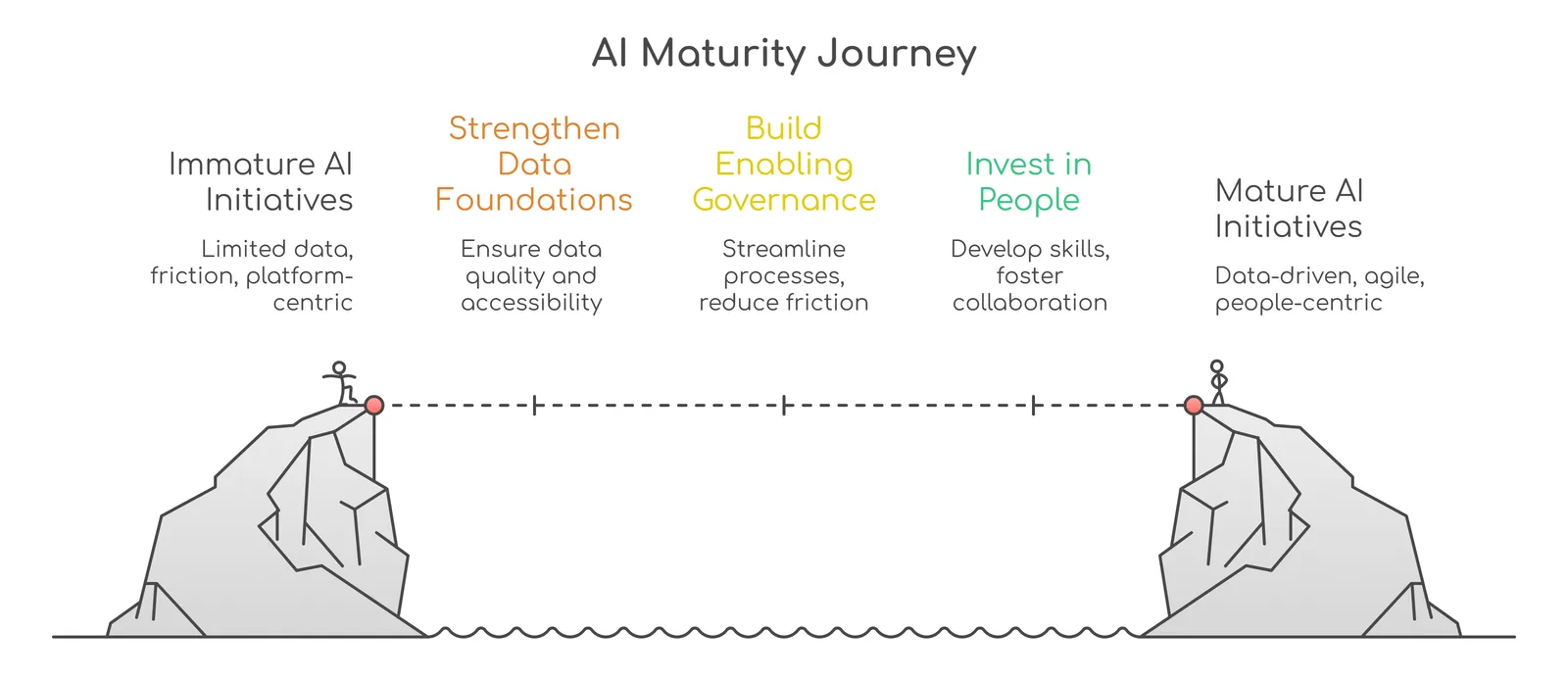
Invest in people, not just platforms
AI maturity is not achieved through technology alone. Organizations often underestimate the role of skills, accountability, and cross-functional collaboration.
To raise maturity, leaders should focus on:
- Upskilling business teams to interpret and act on AI outputs
- Creating clear product ownership for AI initiatives
- Aligning incentives so adoption is rewarded
- Encouraging collaboration between IT, data, and business leaders
AI initiatives mature faster when ownership is shared and outcomes are clearly defined.
Start small, but design for scale
Pilots are necessary, but pilots without a path to scale stall maturity. CXOs should insist that even early experiments answer a simple question: If this works, how do we expand it?
This means:
- Designing architectures that integrate with core systems
- Defining success metrics upfront
- Planning change management early
- Budgeting for scale, not just experimentation
Small, well-designed wins build credibility and create momentum across the organization.
Measure progress and recalibrate continuously
Maturity is not static. As teams gain experience and systems improve, initiatives should be reassessed and repositioned within the matrix.
Leading organizations:
- Review maturity scores regularly
- Track adoption, performance, and business impact
- Retire initiatives that no longer align with strategy
- Reinvest in areas showing strong momentum
This disciplined approach ensures that high-impact AI initiatives don’t remain stuck in planning mode.
By intentionally moving initiatives up the maturity curve, CXOs turn strategic intent into execution capability. The Impact-Maturity Matrix then becomes a roadmap for sustained AI-driven value creation.
Are you ready to turn your AI priorities into measurable outcomes with Antino?
AI prioritization is about building the clarity, readiness, and execution discipline to make those choices pay off. That’s where Antino comes in. We work closely with CXOs to translate high-level AI ambition into an actionable roadmap using frameworks like the Impact-Maturity Matrix.
From identifying high-impact opportunities to strengthening data foundations, governance, and delivery models, our experts help organizations move from scattered pilots to scalable, ROI-driven AI programs.
What sets Antino apart is our ability to bridge strategy and execution. We don’t stop at recommendations. Our teams design, build, and operationalize AI solutions that fit your organization’s current maturity while preparing you for what’s next. Whether you’re looking to unlock quick wins or invest in long-term transformation, Antino partners with you at every stage to ensure your AI investments deliver measurable business outcomes, not just technical progress.