We’re entering a phase where AI can draft emails, resolve tickets, summarise complex information, and occasionally present fiction as fact with equal conviction. Generative AI has become incredibly powerful, but in enterprise environments, power without precision quickly becomes a risk rather than an advantage.
This is exactly where the shift is happening.
Retrieval-Augmented Generation (RAG) development services are quietly redefining what “enterprise-grade AI” truly means. Instead of relying solely on probabilistic generation, RAG fuses AI with an organisation’s real-time, trusted data sources by bringing accuracy, traceability, and contextual awareness into every response. The model no longer invents answers, it validates them against your internal knowledge ecosystem.
And this matters more than ever.
According to recent industry analyses, over 70% of enterprises cite hallucinations as the top barrier to scaling GenAI, and nearly 65% plan to adopt retrieval-based AI architectures to mitigate this risk.
In this blog, we’ll decode why RAG is not just another technical upgrade, but a foundational blueprint for building AI systems that are robust, audit-friendly, and enterprise-ready. We’ll break down how it works, why leading companies are rapidly deploying it, and how RAG is enabling AI that understands, reasons, and delivers outcomes aligned with business intelligence.
What is Retrieval-Augmented Generation (RAG)?
Retrieval-Augmented Generation, or RAG, is a smarter way of building AI systems that can give accurate, trustworthy answers instead of relying only on what they were trained on. Think of it as giving an AI model access to a well-organized library of your company’s latest and most relevant information, so it can respond with facts, not guesses.
Most generative AI models learn from massive datasets, but those datasets are fixed. They only know what was true at the time they were trained and can’t automatically pick up new policies, product updates, internal documents, or industry changes. That’s why AI sometimes produces answers that sound confident but are completely wrong.
RAG changes this dynamic.
With RAG, the model retrieves the right information from external knowledge sources, like your internal documents, research papers, databases, process manuals, or any trusted repository, and uses it to shape its final response. This means every answer is grounded in real, verifiable data.
Why does RAG matter?
From an enterprise point of view, RAG solves three major challenges…
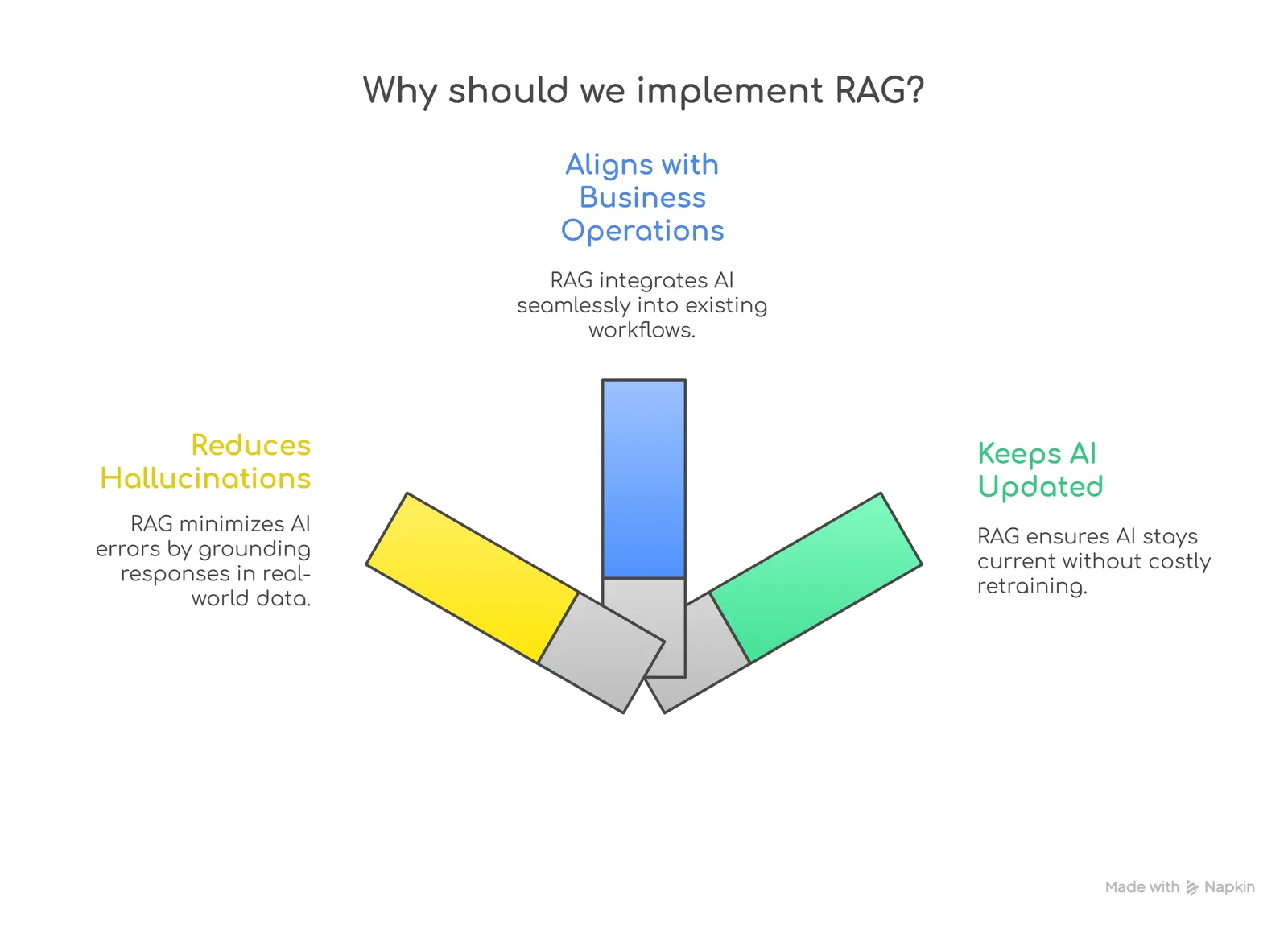
1. It reduces hallucinations.
By using real documents as a reference, RAG significantly lowers the chances of AI making up information. Industry studies show that grounding can cut hallucinations by 60-80%, making systems far more reliable.
2. It brings AI closer to how businesses actually work.
Enterprises run on domain knowledge like policies, SOPs, client data, research, and compliance rules. RAG allows AI to tap into this knowledge securely and deliver answers that match business logic, not generic internet content.
3. It keeps AI updated without retraining.
Whenever your content changes, RAG-enabled systems automatically reference the latest information. No costly retraining cycles. No outdated responses.
In simple terms…
RAG helps AI move from “I think this is the answer” to “Here’s the answer, and here’s the information it’s based on.” It’s a practical, future-ready way for organisations to build AI that is not only smart, but also reliable, transparent, and aligned with their business reality.
RAG helps AI move from “I think this is the answer” to “Here’s the answer, and here’s the information it’s based on.” It’s a practical, future-ready way for organisations to build AI that is not only smart, but also reliable, transparent, and aligned with their business reality.
Now, what is a RAG Chatbot?
A RAG chatbot is simply a conversational AI system that uses the Retrieval-Augmented Generation (RAG) architecture to deliver accurate, context-rich responses. Instead of answering questions based purely on what it learned during training, a RAG chatbot retrieves the most relevant information from trusted sources, such as company documents, knowledge bases, FAQs, SOPs, or internal databases, and uses that information to generate its final reply.
In other words, it’s a chatbot that doesn’t guess. It searches, retrieves, and then responds using verified data.
This makes RAG chatbots far more reliable for enterprise use cases like customer support, HR queries, IT service desks, product help, compliance workflows, and technical troubleshooting.
Is a RAG Chatbot different from RAG?
Yes, but in a simple way.
RAG is the underlying architecture.
It’s the framework that combines retrieval + generation to give AI access to real, updated knowledge.
A RAG chatbot is an application built on top of that architecture. It uses RAG to power conversations in a natural, human-like manner.
Think of it like this…
- RAG = the engine
- RAG chatbot = the car built using that engine
You can use RAG to build many things beyond chatbots, like intelligent search systems, document analysis tools, automated report generation, code assistants, or decision-support systems. A RAG chatbot is just one of the most common and useful implementations.
Why does a RAG chatbot matter for enterprises?
Because it delivers…
- Accurate responses grounded in real company knowledge
- Reduced hallucinations, even for complex or domain-heavy queries
- Instant access to up-to-date information, policies, and documents
- Scalable support, without retraining the model each time something changes
- Better trust and adoption among employees and customers
In short, while RAG sets the foundation, a RAG chatbot brings that foundation to life by helping organizations offer conversational experiences that are not only intelligent but also consistent, compliant, and business-ready.
RAG vs Fine-Tuning vs Traditional Chatbots: How do they differ?
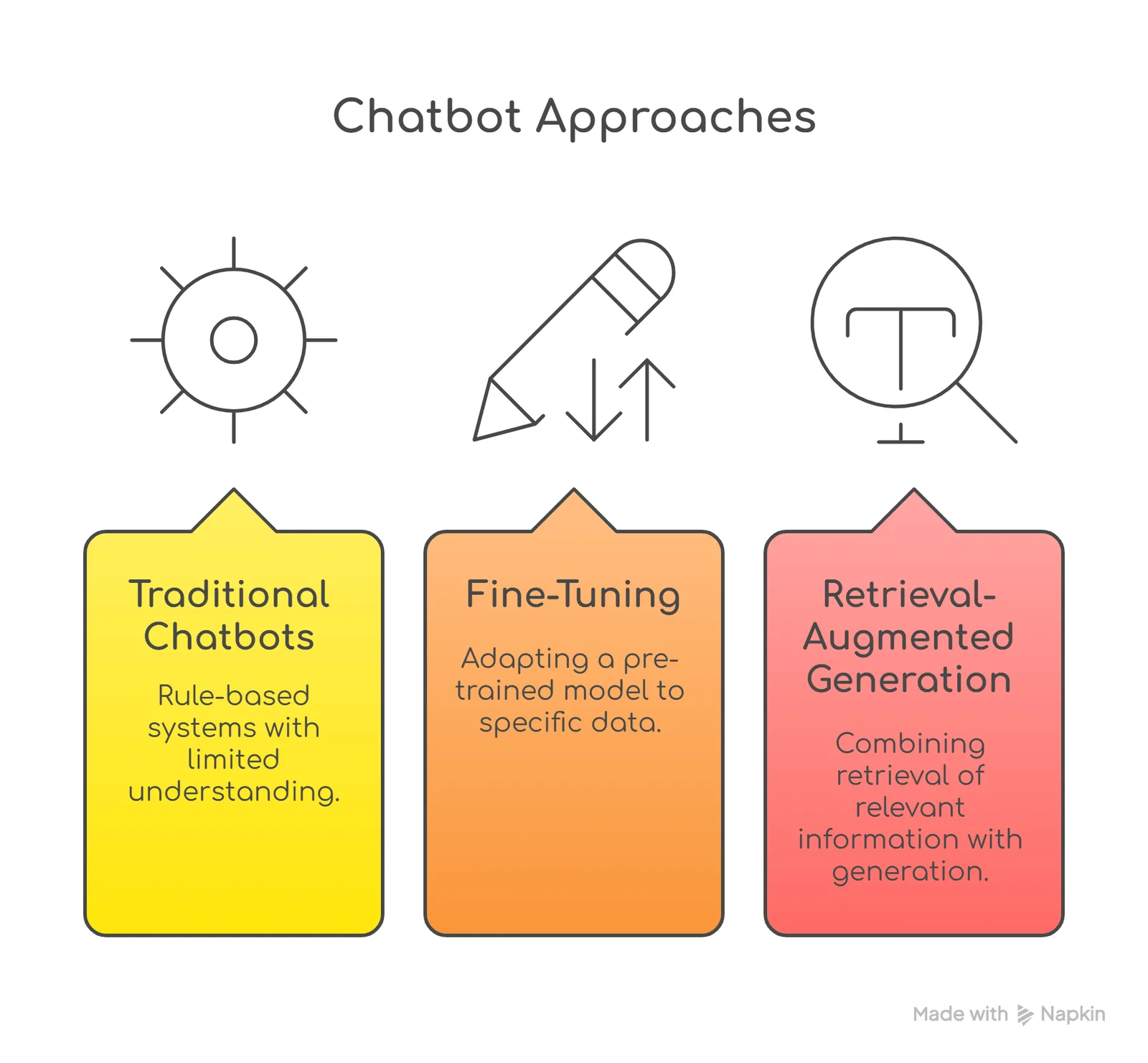
As enterprises adopt AI at scale, three common approaches come up repeatedly: Traditional Chatbots, Fine-Tuned Models, and RAG-based systems. While all 3 aim to improve how businesses deliver information and support, they work in fundamentally different ways.
1. Traditional Chatbots
Traditional chatbots rely on pre-written scripts, decision trees, or rule-based flows. They follow a fixed logic, and if a user asks something outside the script, the bot usually fails. These chatbots are good for predictable, repetitive tasks, but struggle with anything nuanced or dynamic.
2. Fine-Tuning
Fine-tuning trains an existing large language model on additional organisation-specific data. It teaches the model new patterns, terminology, and domain knowledge. Fine-tuning improves performance, but it also has limitations, such as high cost, long training cycles, and the need to retrain every time information changes. It also doesn’t fully eliminate hallucinations.
3. Retrieval-Augmented Generation (RAG)
RAG takes a different approach. Instead of embedding all company knowledge into the model, it allows the AI to retrieve the most relevant information in real time from trusted sources. It then uses this retrieved content to generate accurate, context-aware responses. RAG reduces hallucinations, keeps the AI up to date, and avoids the cost of constant retraining, making it ideal for enterprise use cases.
Easy-to-Understand Comparison Chart
| Feature / Approach | Traditional Chatbots | Fine-Tuning | RAG (Retrieval-Augmented Generation) |
| How it works | Rule-based scripts and decision trees | Model learns from extra training data | Model retrieves relevant info + generates answer |
| Accuracy | Low for complex queries | Medium to High | Very High (grounded in real data) |
| Handles new info? | No, needs manual updates | No, requires retraining | Yes, updates instantly from knowledge sources |
| Hallucination risk | None (rules only) | Moderate | Very Low |
| Cost to maintain | Low | High (requires new training) | Medium (no retraining, only content updates) |
| Best for | Simple, repetitive tasks | Structured domain knowledge | Enterprise-grade, dynamic, knowledge-heavy tasks |
| Flexibility | Low | Medium | High |
| Setup time | Fast | Slow | Medium |
| Scalability | Limited | Moderate | Excellent |
| Examples | FAQ bots, menu-based bots | Custom LLMs for legal, finance, HR | Enterprise chatbots, knowledge assistants, search copilots |
In simple terms
- Traditional chatbot: Follows a script. Great for “Yes/No” or menu-driven queries.
- Fine-tuned model: Learns from your data, but needs retraining to stay updated.
- RAG model: Pulls fresh, verified information every time, which makes it the most reliable and scalable option for enterprise AI today.
How Enterprises Can Adopt RAG Chatbots?
Adopting a RAG chatbot is an organisational shift toward building AI systems that are accurate, explainable, and deeply aligned with internal knowledge. To implement it successfully, enterprises need to consider data, infrastructure, governance, security, and change management. Below is a step-by-step breakdown of how large organisations can integrate RAG chatbots into their ecosystem.
1. Identify the Right Use Cases
Before jumping into development, enterprises must identify areas where a RAG chatbot will deliver measurable value. Ideal use cases include:
- Customer Support: Automated, accurate responses to product questions, warranties, and troubleshooting.
- Employee Support: HR queries, IT helpdesk issues, policy clarifications.
- Sales Enablement: Quick access to product sheets, pricing, and proposal templates.
- Compliance & Legal: Policy interpretation, regulatory updates, controlled guidance.
- Knowledge Management: Summaries, document retrieval, and contextual insights.
The goal is to focus on workflows where accuracy, traceability, and contextual understanding are non-negotiable.
2. Build a Central Knowledge Repository
RAG systems are only as strong as the information they retrieve. Enterprises should:
- Consolidate fragmented data from SharePoint, Google Drive, Confluence, internal portals, and databases.
- Remove outdated or duplicate content.
- Establish clear owners for each knowledge domain.
- Convert documents into machine-readable formats (PDF, DOCX, HTML, Markdown).
This central repository becomes the “single source of truth” that powers the retrieval pipeline.
3. Structure and Index the Data
RAG chatbots rely heavily on well-structured and indexed data. This step includes:
a. Chunking
Splitting large documents into small, meaningful sections (200–500 words) so the model can retrieve precise, relevant content.
b. Embeddings
Converting text chunks into vector embeddings using models like OpenAI, SentenceTransformers, or enterprise-grade embedding models.
c. Vector Database Setup
Storing embeddings in a vector database, such as:
- Pinecone
- Weaviate
- Qdrant
- Milvus
- Azure Cognitive Search
This enables fast and context-aware search.
d. Metadata Tagging
Adding attributes like document type, date, version, owner, department, and confidentiality level to ensure high-quality retrieval.
4. Design the RAG Architecture
A typical enterprise RAG architecture includes:
- Document ingestion pipeline
Automates cleaning, chunking, embedding, and indexing. - Vector database
Stores embeddings for semantic search. - Retrieval module
Fetches the most relevant chunks for each user query. - LLM generation module
Combines retrieved content with generative reasoning. - Orchestration layer
A workflow engine (LangChain, LlamaIndex, RAGFlow, Azure Prompt Flow) that connects all components. - Guardrails and validation
Tools that enforce safety, compliance, and response accuracy.
Enterprises should also design for scalability, latency, and failover to ensure smooth performance.
5. Ensure Security, Compliance & Access Control
Security is the most critical part of adopting RAG chatbots in enterprises.
Key considerations
- Role-based access control (RBAC): Ensure users only access information they’re authorized to see.
- Data encryption: Secure both data at rest and in transit.
- Redaction: Automatically remove sensitive data (PII, financials, PHI).
- Audit trails: Track every query and response.
- Compliance alignment: GDPR, HIPAA, SOC2, ISO 27001 standards.
A RAG system must never expose confidential data through retrieval, so governance is essential.
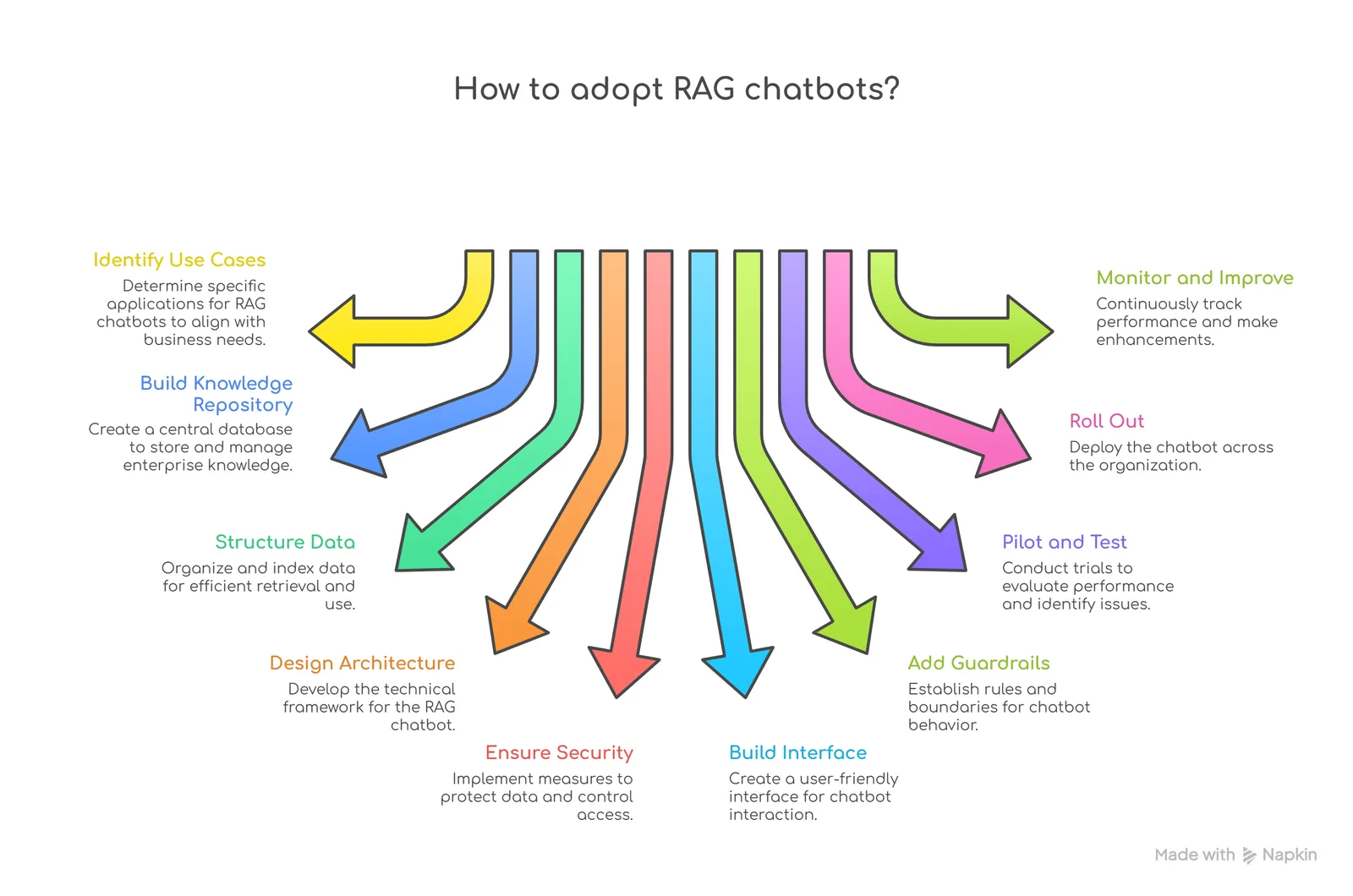
6. Build the Chatbot Interface
The front-end experience should be simple, intuitive, and integrated into the user’s existing workflows.
Options include:
- Web chat interface (React, Angular, Vue)
- Microsoft Teams/Slack bot integration
- CRM integration (Salesforce, HubSpot)
- Mobile app chatbot
- Embedded widget inside internal portals
Focus on ease of use, search refinement options, and action buttons.
7. Add Enterprise Guardrails (Very Important)
To ensure safe and reliable AI behavior:
- Response grounding: Restrict the model to the retrieved content to minimize hallucinations.
- Source citation: Provide document references for every answer.
- Content filtering: Block inappropriate, outdated, or non-compliant output.
- Validation routing: High-risk queries can be routed to a human expert (human-in-the-loop).
This builds trust and transparency for end users.
8. Pilot, Test, and Evaluate
Start with a controlled pilot group (HR, IT, Sales, Customer Support). Test across:
- Accuracy of responses
- Relevance of retrieved content
- Latency
- User satisfaction
- Coverage gaps in the knowledge base
- Edge-case performance
- Security vulnerabilities
Collect feedback and refine the data pipeline, prompting, and guardrails.
9. Roll Out Organisation-Wide
Once validated:
- Expand access gradually by team or department.
- Provide onboarding and training sessions.
- Share clear dos and don’ts for usage.
- Continuously gather user feedback to improve the system.
A successful rollout is supported by employee education and change management.
10. Continuously Monitor & Improve
RAG chatbots are not “set and forget.” Enterprises should set up continuous improvement loops:
- Refresh embeddings as new documents are added.
- Update knowledge sources regularly.
- Track usage analytics (top queries, failure points).
- Improve prompts based on performance.
- Revisit guardrails as business rules evolve.
A mature RAG chatbot operates like a living system, always learning from new content.
All in all, adopting a RAG chatbot is a journey. When done right, a RAG chatbot becomes a powerful digital expert that is capable of answering questions with accuracy, explaining its sources, and adapting to your business knowledge in real time.
RAG Use Cases
Retrieval-Augmented Generation (RAG) unlocks the ability for users to interact with complex data through natural, conversational language. By combining real-time retrieval with generative AI, enterprises can drive better accuracy, relevance, and decision-making across multiple business functions. Below are some of the most impactful use cases where RAG is transforming operations.
1. Intelligent Chatbots and Virtual Assistants
Many organisations want to automate customer and employee interactions but quickly discover that generic AI models lack deep, domain-specific knowledge. RAG closes this gap by connecting the AI to internal documentation, product manuals, service policies, and knowledge bases.
What does this enable?
- Customer support chatbots that always reflect the latest service and product updates
- Virtual assistants that remember prior interactions and tailor responses accordingly
- AI agents capable of addressing technical queries with verified information
This results in faster, more accurate responses and a significantly improved user experience.
2. Advanced Research and Insights
RAG is exceptionally suited for research-heavy environments because it can read, retrieve, and synthesise information from multiple structured and unstructured sources.
Examples
- Financial teams generate client-specific reports using the latest market data and historical investment records
- Healthcare professionals reference patient histories, clinical notes, and medical journals
- Legal teams search across vast internal case libraries and regulations
RAG provides analysts with richer, more context-aware insights in a fraction of the time.
3. High-Accuracy Content Generation
While generative AI is powerful, it can also create information that looks correct but isn’t. RAG reduces this risk by grounding content in verified sources.
Benefits
- More reliable articles, blogs, reports, and documentation
- The ability to cite evidence directly from trusted internal or external sources
- Improved accuracy for technical, scientific, regulatory, or compliance-heavy content
This makes RAG especially valuable for industries where factual precision is mandatory.
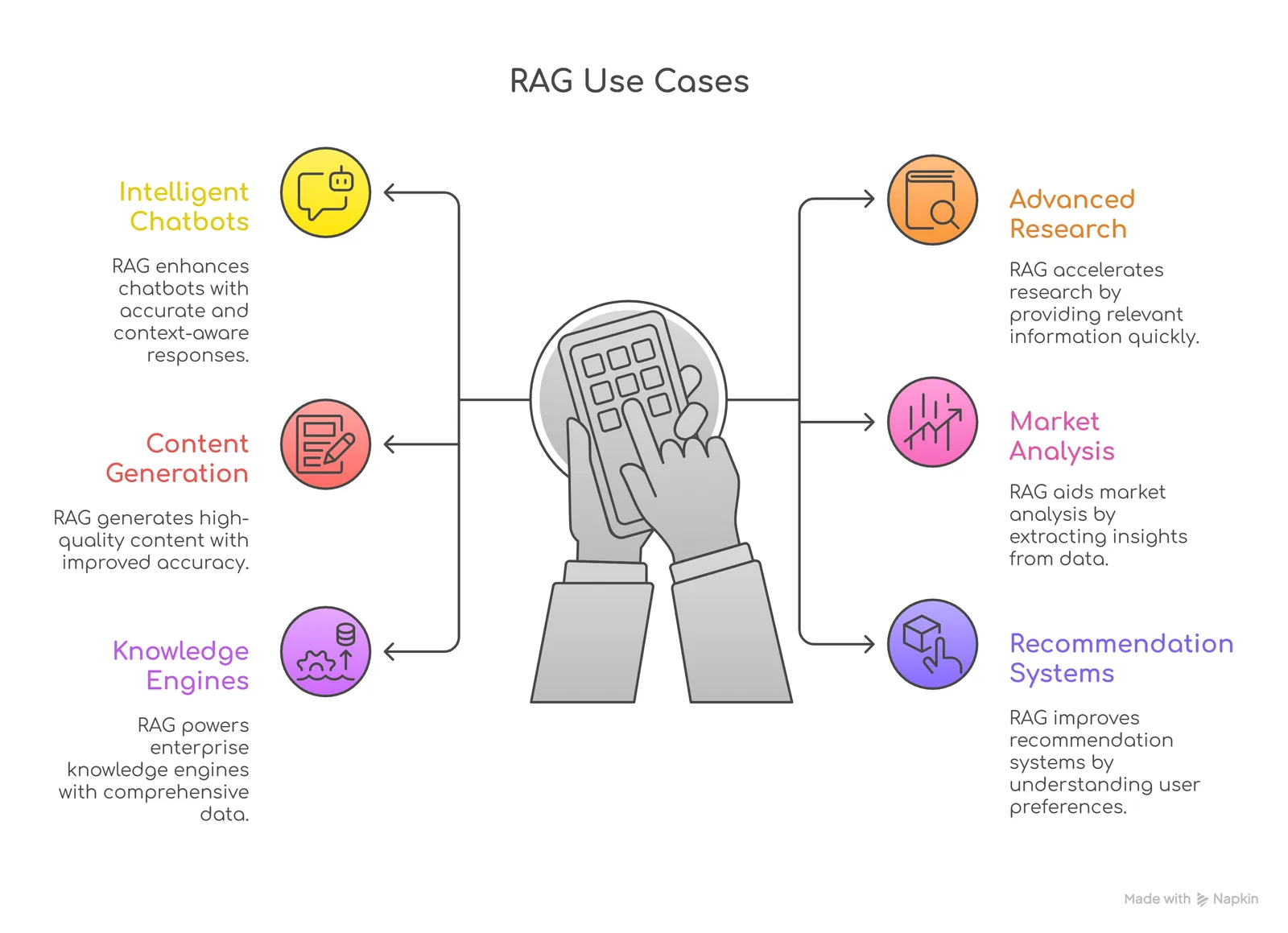
4. Market Analysis and Product Development
RAG can pull information from social platforms, competitor websites, industry reports, customer feedback, and more to help organisations make sharper business decisions.
Use cases include
- Monitoring consumer trends and sentiment
- Tracking competitor movements and product launches
- Analysing feedback to guide product roadmaps
- Identifying emerging opportunities or threats in the market
With a RAG system, decision-makers get a real-time, 360° view of their landscape.
5. Enterprise Knowledge Engines
RAG-powered knowledge engines improve how employees discover and use company information. Instead of searching across multiple tools, teams get answers instantly through conversational queries.
Applications
- Faster and smoother onboarding
- Instant access to HR, IT, or policy information
- Field teams receive step-by-step guidance
- Sales teams retrieving product details or pricing structures on demand
This drives productivity and reduces the burden on internal support teams.
6. Smarter Recommendation Systems
RAG enhances recommendation engines by combining user behaviour with contextual business knowledge.
For example
- E-commerce platforms recommend products based on browsing history plus real-time catalogue updates
- Media platforms suggest content by blending viewing patterns with the most relevant metadata
- B2B platforms offer personalised recommendations informed by previous queries, purchases, or support interactions
The result is more personalised, accurate, and engaging recommendations that drive customer satisfaction and revenue.
RAG brings reliability and relevance to AI applications by grounding outputs in trusted information. From customer support to research, market strategy, onboarding, and personalised recommendations, RAG unlocks a wide range of high-value use cases, which makes it one of the most impactful AI architectures for modern enterprises.
How can Antino AI Labs Solutions help you build a RAG Chatbot?
Antino development Solutions helps enterprises move beyond generic AI tools and build fully customized, enterprise-grade RAG chatbots that are accurate, secure, and deeply aligned with your business knowledge. Our teams work with you end-to-end by starting with use case discovery, knowledge audits, and data readiness assessments. We structure and index your internal documents, build robust vector databases, and design the right RAG architecture using best-in-class tools like LangChain, LlamaIndex, and Azure/AWS/GCP AI stacks.
Every solution comes with enterprise guardrails, role-based access control, grounding techniques to reduce hallucinations, and source-backed answers that meet compliance and security standards. Whether you need a customer support chatbot, an internal knowledge assistant, or a domain-specific AI agent, our experts build scalable, high-performance systems that integrate seamlessly into your CRM, HRMS, ITSM, or internal portals. With continuous monitoring, update pipelines, and optimization cycles, Antino AI Labs ensures your RAG chatbot evolves with your business and stays accurate in real time.
Ready to build an enterprise RAG chatbot that delivers accuracy, trust, and real business impact? Connect with Antino today.