

Forget everything you thought you knew about AI! Literally!
Yes, we are not lying because a new era has already begun. A technology is emerging that doesn’t just compute… it perceives. It listens, observes, reads, and interprets the world with a blend of senses much closer to our own. It’s the age of multimodal AI, where intelligence is no longer limited to a single stream of data, but fuelled by the combined power of text, images, audio, and video.
This multisensory capability is reshaping how machines understand human intent and context. The shift from traditional, single-mode AI to multimodal systems marks a pivotal moment for the enterprise landscape where interactions become more intuitive, decisions more informed, and experiences more immersive.
However, in parallel, Generative AI (GenAI) continues to unlock new thresholds of innovation like accelerating enterprise reinvention, powering AI-driven operations, and enabling experiences that blur the boundaries between digital and physical worlds.
But…but…but, at the center of this evolution stands the Multimodal AI model, which is the clearest evidence of how far GenAI has come. Designed to interpret inputs across multiple formats and deliver insights in real time, this technology acts as the eyes, ears, and cognitive engine behind next-generation AI systems.
Why is that so?
No wonder C-suite leaders are calling multimodal AI the next big inflection point. Its impact spans everything from conversational intelligence and data analytics to autonomous systems and robotics. And the momentum is undeniable because the global multimodal AI market, valued at USD 1.73 billion in 2024, is expected to surge at a 35.8% CAGR from 2024 and will reach USD 10.89 billion by 2030, signaling a rapid shift toward multisensory AI adoption across industries.
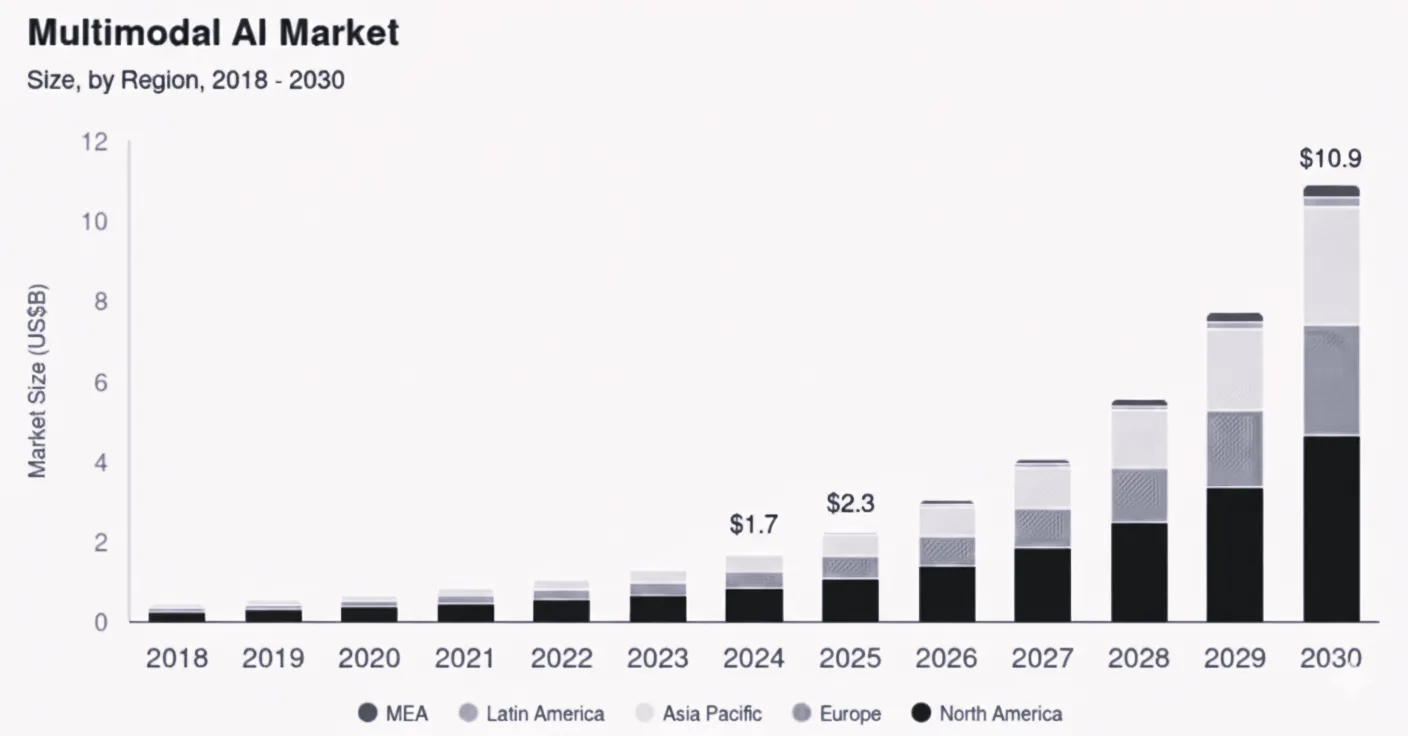
Analysts echo this trajectory. Gartner predicts that multimodal AI will have a “transformational impact” on enterprises, which will redefine human-machine interaction and expand the boundaries of enterprise intelligence as we move into 2026 and beyond.
But what exactly is Multimodal AI?
Multimodal AI represents the next evolution of artificial intelligence that mirrors the way humans naturally perceive and interpret the world. Instead of relying on a single stream of data, these systems can understand multiple modalities at once, including text, images, audio, and video.
This ability to synthesize diverse inputs allows the model to build a far more holistic and contextual understanding. Traditional AI might read text or recognize an image, but multimodal AI can combine both to derive deeper meaning. For example, the system can look at a picture of a dog, interpret a question asking for its breed, and respond accurately by correlating visual and textual cues.
This convergence of sensory data is foundational to unlocking advanced real-world applications. Autonomous vehicles integrate camera feeds, radar, and lidar in real time to navigate safely. Virtual assistants can understand a spoken command while simultaneously interpreting what the camera sees. In short, multimodal AI is enabling a new generation of systems that reason more like humans and act with greater precision.
How Does Multimodal AI Work?
At its core, multimodal AI operates by bringing together insights from different data streams to form a unified, contextually enriched understanding. The process typically unfolds in three interconnected stages…
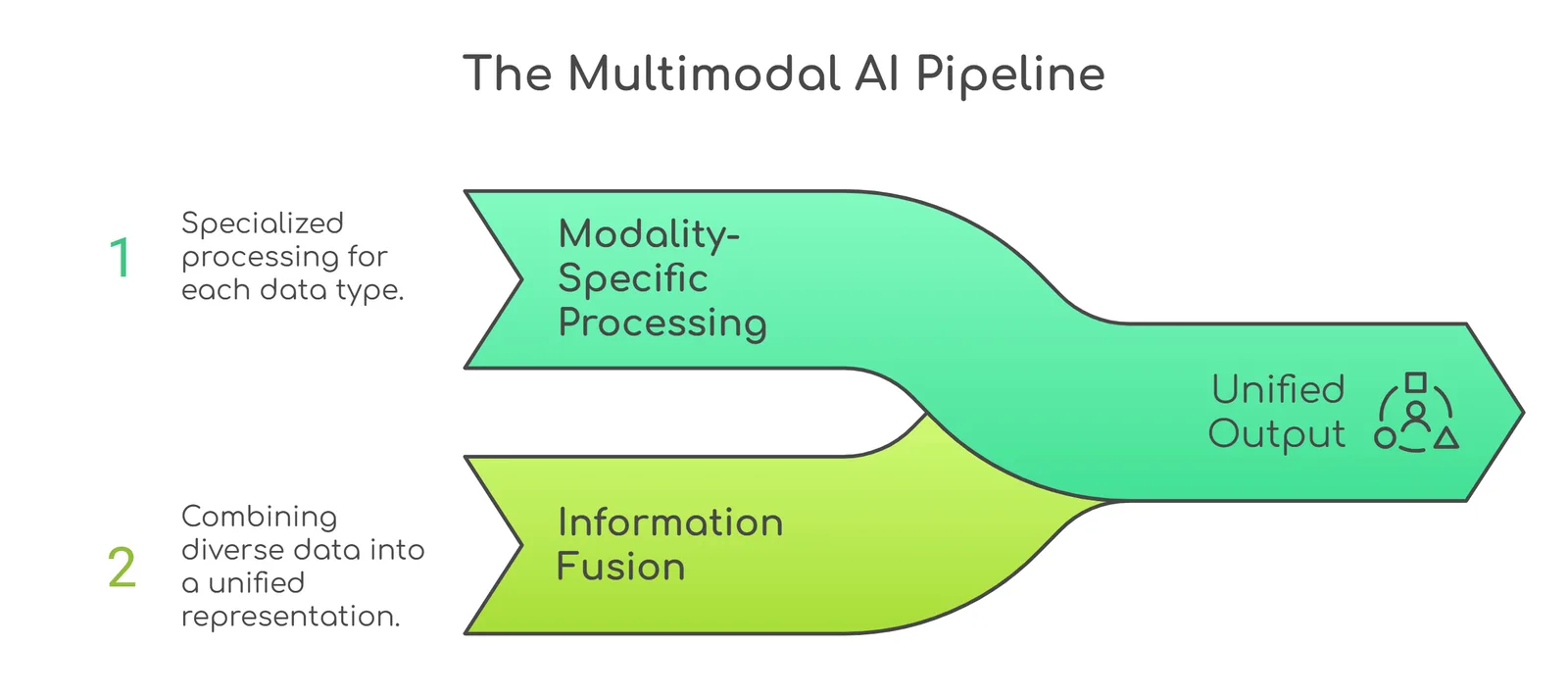
1. Modality-Specific Processing
The journey begins with each type of input being processed through a specialized model.
- Text is analyzed using natural language processing (NLP) techniques.
- Images and videos are interpreted using computer vision algorithms.
- Audio is decoded through speech recognition and sound-analysis models.
Regardless of the modality, each input is translated into a common machine-understandable format like vector embeddings. Whether it’s a sentence, a pixel pattern, or a sound wave, all data becomes numerical representations that can be aligned, compared, and combined. This conversion lays the groundwork for deeper cross-modal understanding.
2. Information Fusion
Once each input is converted, the system moves to the most critical phase, and that is fusion. During this stage, neural networks learn how different modalities relate to each other. For example, the model internalizes that the phrase “golden retriever” corresponds to a particular visual pattern or that an audio clip of barking may correlate with the image of a dog.
This fusion layer allows the AI to build richer semantic connections, enabling a more nuanced interpretation of complex situations. It’s this cross-modal reasoning that gives multimodal systems their unique advantage over traditional single-modality approaches.
3. Unified Output
Finally, the integrated insights are used to generate a unified, context-aware response. Depending on the need, the output may include:
- A detailed answer to a multimodal query
- A caption for an image or video
- A decision or recommendation based on multiple sensory inputs
- New content generated using a combination of text, visuals, and audio
By drawing from multiple modalities simultaneously, multimodal AI overcomes the narrow perspectives of traditional models and delivers more accurate, relevant, and human-like outcomes.
What is the difference between multimodal AI and traditional (unimodal) AI?
Traditional AI systems, often referred to as unimodal AI, are designed to work with a single type of data. They excel in narrow, well-defined tasks such as text classification, image recognition, or speech-to-text conversion. However, they operate in isolation: an NLP model can understand sentences but cannot interpret images; a vision model can detect objects but cannot understand spoken instructions. This siloed approach limits their ability to grasp real-world complexity, where information almost always appears in multiple forms.
Multimodal AI, on the other hand, breaks these boundaries. It processes and interprets multiple data modalities at the same time, including text, images, creating videos, audio, and more, and blends them to form a deeper, more contextual understanding. Think of it as moving from a single sense to a full sensory suite. This allows the AI to recognize patterns that would be invisible in unimodal systems and generate richer, human-like responses.
Where unimodal AI provides accuracy within its specific domain, multimodal AI provides intelligence across domains. This shift fundamentally changes how systems understand interactions, reason about complex environments, and support decision-making.
From autonomous vehicles and diagnostic imaging to conversational assistants that see and hear simultaneously, multimodal AI represents a major leap forward by enabling applications that demand a comprehensive, multisensory perspective rather than a narrow viewpoint.
Multimodal AI vs. Traditional (Unimodal) AI
| Parameter | Traditional (Unimodal) AI | Multimodal AI |
| Data Types Processed | Works with a single modality (text or image, or audio). | Processes multiple modalities simultaneously (text, images, audio, video, sensor data). |
| Contextual Understanding | Limited to the information available in one data stream. | Builds richer context by fusing insights from several data sources. |
| Real-World Applicability | Effective for narrow, isolated tasks. | Designed for complex scenarios requiring multi-sensory interpretation. |
| Learning Approach | Learns patterns from one type of input only; lacks cross-modal reasoning. | Learns relationships across modalities, enabling deeper semantic understanding. |
| Output Quality | Accurate but limited to its modality; lacks full context. | More accurate, context-aware, and human-like outputs. |
| Examples of Use Cases | Chatbots, sentiment analysis, OCR, image classification, speech recognition. | Autonomous vehicles, multimodal assistants, video Q&A, surgical robotics, immersive GenAI. |
| Scalability | Scales within its single domain, but struggles with complex data environments. | Highly scalable across diverse, multimodal datasets for enterprise-wide use cases. |
| User Interaction | Single-channel interaction (only text input, only audio input, etc.). | Multi-channel interaction. Users can speak, type, show an image, or combine inputs. |
| Enterprise Value | Provides efficiency in specific functions. | Drives enterprise-wide transformation through holistic intelligence and decision support. |
What are the real-world applications of multimodal AI?
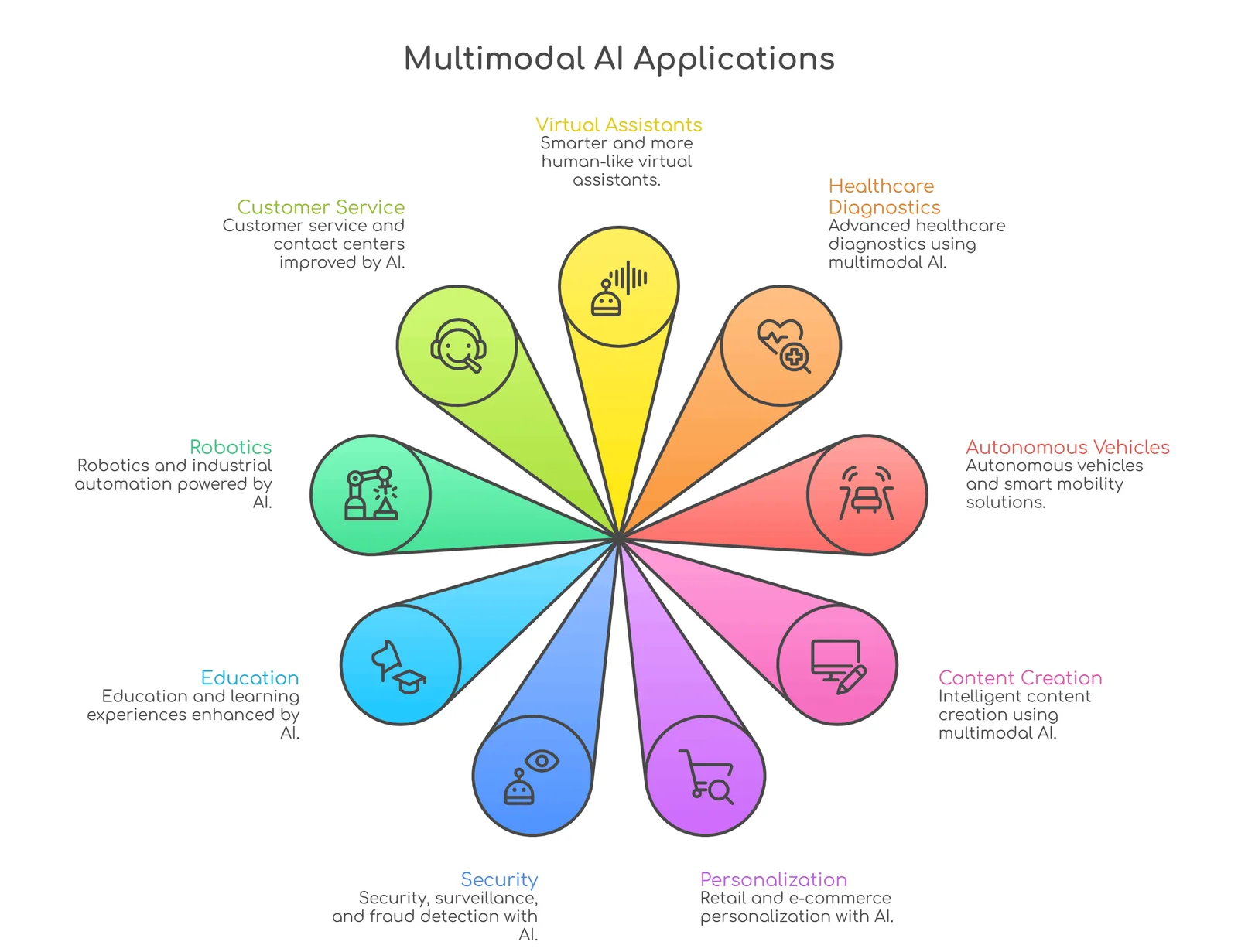
Multimodal AI is a practical enabler that is already reshaping industries, customer experiences, and enterprise operations. By combining multiple types of data, such as text, visuals, audio, and sensor inputs, multimodal systems provide a more complete and human-like understanding of situations. This deeper contextual intelligence unlocks powerful applications across real-world environments.
Below are some of the most impactful and relatable use cases where multimodal AI is making a measurable difference today.
1. Smarter and More Human-Like Virtual Assistants
Traditional virtual assistants only understand text or voice. Multimodal AI changes this entirely.
Imagine an assistant that can:
Listen to your question
Understand your expression from a camera feed.
Analyze the object you’re pointing at
Respond with actions instead of just words.
Whether it’s troubleshooting a device during a video call or helping visually impaired users understand their surroundings, multimodal assistants offer a more natural, intuitive, and context-aware experience.
2. Advanced Healthcare Diagnostics
Healthcare generates complex data like scans, lab reports, patient histories, and real-time sensor information. Multimodal AI brings these scattered data points together.
It powers:
Diagnostic support by combining CT scans, X-rays, and clinical notes
Disease progression predictions by analyzing images + time-series data
Remote patient monitoring using audio (breathing analysis), video (movements), and text records
This holistic view improves accuracy, reduces clinician workload, and increases the speed of medical decision-making.
3. Autonomous Vehicles and Smart Mobility
Self-driving systems rely on real-time interpretation of multiple sensory streams:
Cameras
Lidar
Radar
GPS
Environmental audio
Multimodal AI merges these modalities to understand the environment, detect obstacles, read road signs, and predict human behavior more reliably. This sensory fusion is the backbone of safer autonomous navigation and next-gen mobility systems.
4. Intelligent Content Creation
From marketing teams to entertainment studios, multimodal AI is transforming creative workflows.
It enables:
Generating social media posts based on uploaded images
Producing videos from scripts or storyboards using an advanced image to video AI engine.
Creating product descriptions from photos
Designing visual assets using both text prompts and sample images
By blending creativity with contextual insight, multimodal AI becomes a true co-pilot for designers, writers, and creators. Tools like Predis AI can support these workflows by helping marketers and creators generate social media content and visual assets with AI.
5. Retail and E-commerce Personalization
Retailers now use multimodal AI to deliver experiences that feel almost concierge-level.
Examples include:
Product recommendations based on behavior, images, and voice queries
Virtual try-ons that merge user images, preferences, and catalog data
Real-time assistance where customers can ask, “Do you have something like this?” and show a picture
It combines customer intent, visual cues, and shopping patterns to provide smarter and more relevant suggestions.
6. Security, Surveillance, and Fraud Detection
Security systems traditionally analyzed video alone. Multimodal AI moves beyond that.
It integrates:
Video feeds
Audio signals
Access logs
Sensor data
Identity documents
This allows enterprises to detect anomalies with far greater precision, whether it's unusual movement patterns, voice mismatches, or inconsistent visual cues, providing a stronger, layered approach to safety. Additionally, an intelligent video management system unifies everything and enables security teams to surface critical incidents in seconds rather than sifting through hours of footage.
7. Education and Learning Experiences
Multimodal AI enriches learning by adapting to how students naturally absorb information.
Examples include:
Interactive learning platforms that evaluate speech, handwriting, and facial cues
Automated feedback systems for assignments, presentations, and practice sessions
Tutors who understand diagrams, voice questions, and written notes
This creates a more personalized and engaging learning environment.
8. Robotics and Industrial Automation
In factories or field operations, robots must understand instructions and interpret their environment dynamically.
Multimodal AI powers robots that can:
Read labels
Detect sounds like machinery failures.
Interpret human gestures
Process sensor data for precision tasks
This makes industrial automation more adaptable, responsive, and safer.
9. Customer Service and Contact Centers
The future of customer support is multimodal.
Service bots can now:
Read images of faulty products
Interpret tone and sentiment.
Understand text queries
Analyze customer history
This leads to faster resolutions, lower manual workload, and more empathetic interactions.
Multimodal AI is bridging the gap between human perception and machine intelligence. By integrating data the same way humans use multiple senses, it is enabling next-generation solutions across healthcare, mobility, retail, security, and enterprise operations.
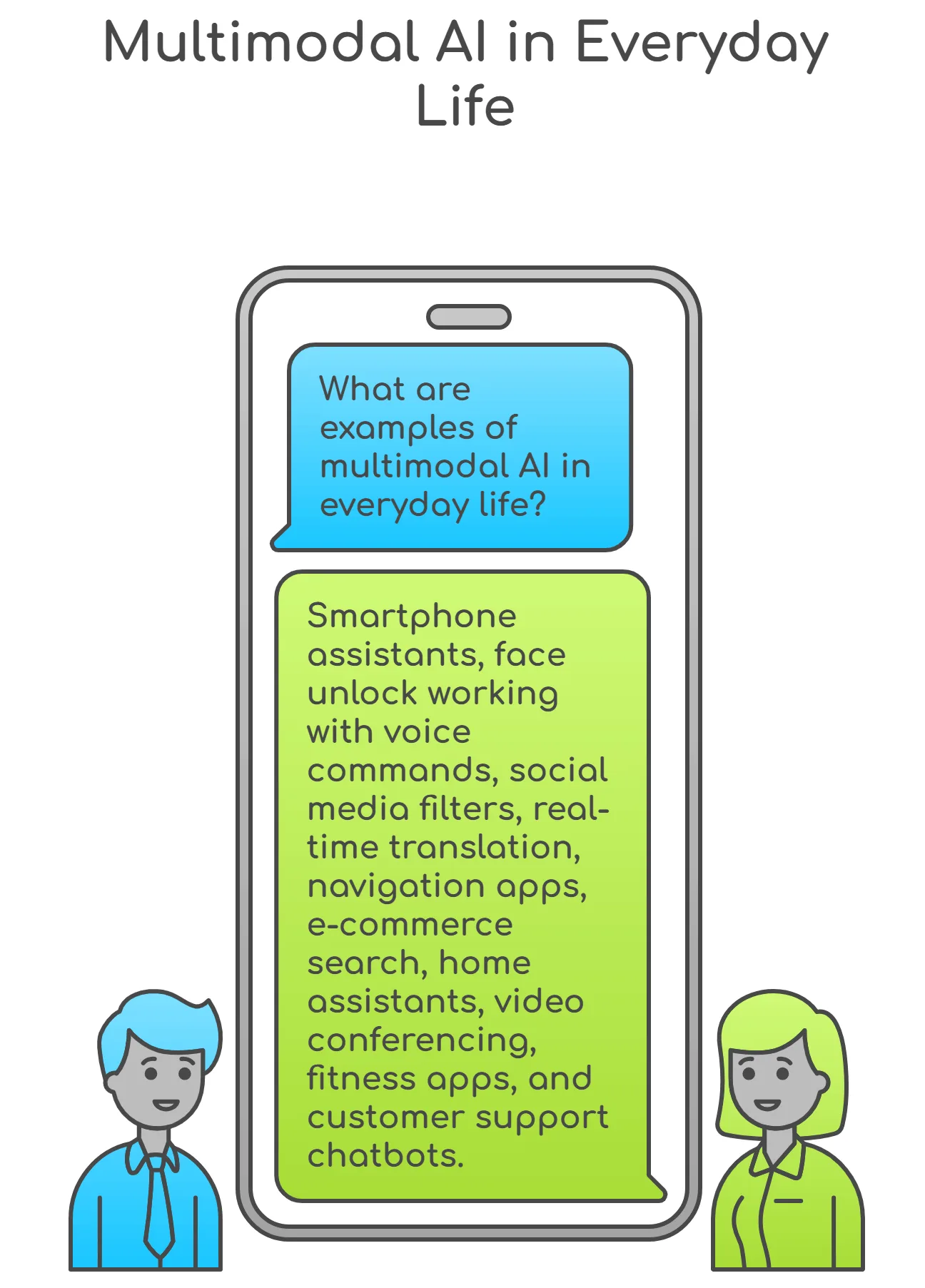
What are examples of multimodal AI in everyday life?
Multimodal AI is already woven into the routines of our daily lives. From the apps we use to the devices we depend on, multimodal intelligence quietly enhances convenience, personalizes experiences, and makes technology feel more human.
Here are some real, relatable examples of where you encounter multimodal AI every single day.
1. Smartphone Assistants (Like Siri, Google Assistant, or Alexa)
When you say, “What’s this?” while pointing your camera at an object, your phone analyzes both:
- Your voice command
- The image captured by the camera
This combination allows your assistant to identify objects, translate text from images, or guide you through complex tasks. It’s multimodal AI turning your phone into a mini problem-solver.
2. Face Unlock and Voice Commands Working Together
Modern phones and smart devices often pair face recognition with speech detection for verification. For instance…
- Your device unlocks with your face.
- You confirm a payment by speaking.
- Gestures + voice control help you navigate touch-free
This blend of biometrics and commands is classic multimodal AI at work.
3. Social Media Filters and Content Understanding
Platforms like Instagram, Snapchat, and TikTok use multimodal AI when they:
- Detect your face to apply filters
- Analyze audio to sync captions.
- Recognize objects and scenes in your videos.
- Read the text you add to your posts.
- Recommend content by combining visuals, sound, and captions.
These features work because the AI understands multiple signals simultaneously.
4. Real-Time Language Translation Apps
Apps such as Google Lens or translation tools combine:
- Images (photos of menus, signboards)
- Text recognition (OCR)
- Speech input
This allows you to take a photo of a sign written in another language and instantly see the translated version. A perfect example of multimodal understanding in everyday travel.
5. Navigation Apps in Cars
Apps like Google Maps or systems in modern cars merge:
- GPS
- Live camera feeds
- Traffic visuals
- Voice instructions
- Sensor data
This multimodal blend helps the system provide lane guidance, detect obstacles, and give spoken directions, all in real time.
6. E-commerce Product Search
When you upload a picture and search “Find similar products,” multimodal AI combines:
- Your image
- Your text query
- Your shopping behavior
This experience is powered by visual recognition + language understanding working together.
7. Home Assistants Like Amazon Echo Show
These devices use:
- Voice input
- Screen visuals
- Cameras
- Gesture recognition
You can ask for a recipe, show your fridge to the camera, and get suggestions, all through multimodal processing.
8. Video Conferencing Platforms
During meetings, platforms like Zoom or Teams use multimodal AI to:
- Auto-generate captions by analyzing speech
- Blur backgrounds or track your face
- Improve lighting based on the visual feed.
- Detect gestures like raising a hand.
A mix of audio + facial cues + text processing enhances communication.
9. Fitness Apps and Smart Wearables
Smart watches and fitness platforms combine:
- Heart rate data
- Motion sensors
- Voice commands
- Visual workout recognition
This allows them to track exercises, detect posture, and guide you with voice or screen prompts.
10. Customer Support Chatbots
Every time you upload a picture of a damaged product or send a voice note to a support bot, multimodal AI is processing:
- Your text
- Your image
- Your tone
- Your previous interactions
This helps provide more accurate and empathetic assistance.
Multimodal AI is already everywhere and fueling smarter devices, intuitive apps, and more immersive experiences. From unlocking your phone to browsing social media, using GPS, or shopping online, you’re interacting with multimodal systems more often than you realize.
Some prominent companies that are already employing multimodal AI
Multimodal AI is rapidly moving from theoretical innovation to mainstream adoption. Leading global brands and forward-thinking Indian enterprises have already integrated multimodal intelligence into their products, platforms, and customer ecosystems. These companies are combining text, images, video, audio, and sensor data to deliver richer experiences and unlock deeper insights.
Below are some prominent organizations that demonstrate the breadth of multimodal AI applications in the real world.
1. Netflix
Netflix uses multimodal AI to create a highly personalized content discovery experience. The platform blends viewing history, thumbnail interactions, scene visuals, audio sentiment, and text metadata to recommend the most relevant titles for each user.
Its systems understand not only what users watch but also how they respond to specific visuals, sound patterns, and story elements. This multimodal approach strengthens engagement, reduces churn, and improves overall content performance across global markets.
2. Snapchat
Snapchat’s AR experiences are powered by multimodal AI that interprets facial landmarks, movements, voice signals, environmental objects, and on-screen text at the same time. This intelligence enables real-time filters, interactive lenses, gesture-based features, and voice-activated effects.
Its ability to process multiple modalities simultaneously makes Snapchat one of the most advanced consumer platforms for immersive AI-driven interactions.
3. Meta
Meta applies multimodal AI across its family of apps and in its work on future immersive environments. The company’s systems learn from speech, images, text, and video to power features like auto-captions, real-time translation, content safety, creator tools, and personalized recommendations.
Meta’s foundational multimodal models are also shaping the building blocks of metaverse experiences, where visual, auditory, and behavioral inputs come together seamlessly.
4. Reliance Jio
Jio employs multimodal AI to support high-volume customer operations and enhance digital services. Its assistants combine voice commands, text-based queries, and behavioral patterns to deliver accurate, vernacular-friendly support.
Multimodal systems also help Jio analyze device diagnostics, sentiment patterns, and user interactions to improve service quality and product recommendations at a massive scale.
5. Antino
Antino is actively advancing multimodal AI capabilities across its engineering and product innovation initiatives. The company integrates text, images, audio inputs, and behavioral data to build intelligent digital experiences for clients in sectors like healthcare, fintech, mobility, and consumer apps.
Antino’s teams apply multimodal intelligence in areas such as customer journey automation, image-based verification, video analytics, voice-assisted workflows, real-time data interpretation, and personalized content generation. By combining multimodal models with enterprise-grade engineering, Antino helps businesses adopt AI ecosystems that are scalable, context-aware, and aligned with real-world user behavior.
From consumer technology leaders like Netflix and Snapchat to enterprise innovators like Reliance Jio and Antino, multimodal AI is becoming a competitive differentiator across industries. These companies, including us, are proving that when systems can listen, see, read, and interpret simultaneously, the quality of insights, experiences, and decisions improves dramatically.
How can companies implement multimodal AI in their products or services?
Implementing multimodal AI is not just a technology upgrade. It is a strategic shift that enables organizations to deliver richer experiences, automate complex processes, and unlock deeper insights from diverse data sources. Companies that adopt multimodal AI thoughtfully can transform customer interactions, enhance operational intelligence, and differentiate themselves in competitive markets.
Below are the key steps organizations can follow to successfully introduce multimodal AI into their products and services.
1. Identify High-Value Use Cases
The first step is understanding where multimodal intelligence can make the greatest impact. Companies should map their customer journeys, operational workflows, and data touchpoints to identify areas where multiple data streams already exist.
Examples include:
- Customer support that blends chat, voice tone, and screen context
- Healthcare systems that combine medical images with clinical notes
- Retail apps that merge product visuals with user search queries
- Verification processes that use documents, images, and biometric inputs
Selecting use cases that solve real business problems helps demonstrate early value and accelerates adoption.
2. Consolidate and Prepare Multimodal Data
Multimodal AI relies on high-quality, diverse data. Organizations need to bring together text, images, audio, video, sensor signals, or transactional logs into a unified data strategy.
Key steps involve:
- Collecting data from relevant channels
- Cleaning and labeling each modality
- Ensuring data formats are compatible
- Establishing governance and compliance
- Creating pipelines that enable real-time processing
This foundational data work is critical for building models that are accurate, context-aware, and scalable.
3. Choose the Right Multimodal Models and Tools
Companies can select from a growing ecosystem of multimodal AI models, including open-source, commercial, and domain-specific options. Decisions should align with business needs and technical maturity.
Considerations include:
- Whether to fine-tune an existing multimodal foundation model
- Whether to build a custom model using internal data
- Compatibility with existing tech stacks
- Cloud vs on-premise requirements
- Integration with enterprise security and compliance frameworks
The right model choice balances performance, cost efficiency, and long-term scalability.
4. Build Multimodal Workflows and Integrations
Once a model is selected, it must be embedded into real business processes. This requires seamless integration with applications, user interfaces, and backend systems.
Implementation typically involves:
- Creating APIs to connect the model with products
- Designing interfaces that accept multiple input types
- Using orchestration layers to combine model outputs
- Ensuring low-latency performance for real-time use cases
For customer-facing products, thoughtful UX design is essential to ensure users intuitively understand how to interact with multimodal features.
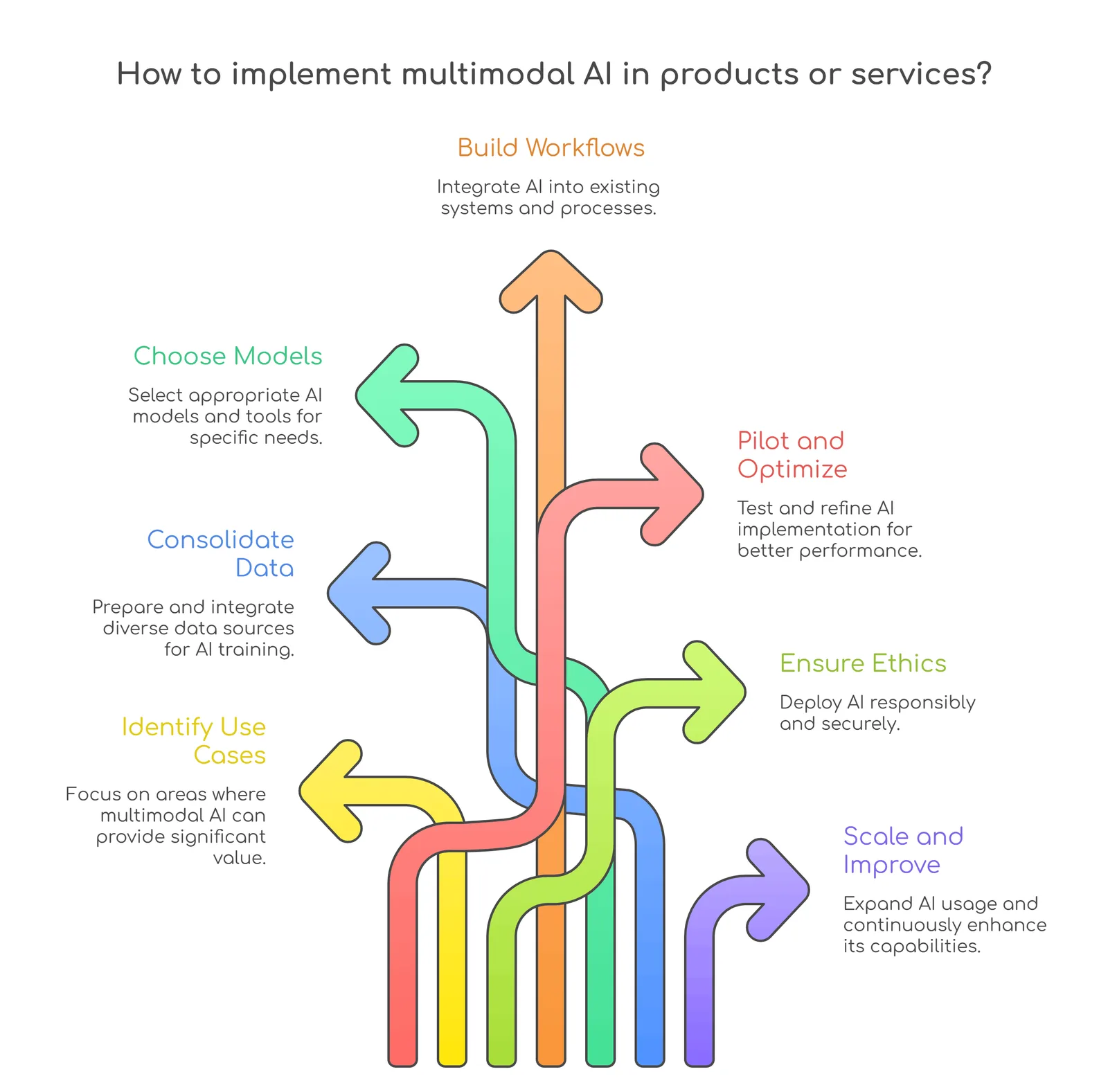
5. Pilot, Test, and Optimize
A controlled pilot helps validate the multimodal solution before full-scale rollout. During pilots, companies focus on:
- Accuracy and reliability of outputs
- Responsiveness under real workloads
- User experience feedback
- Edge-case behavior and failure modes
Based on insights, the system is refined, retrained, or optimized to meet performance standards.
6. Ensure Ethical, Secure, and Responsible Deployment
Multimodal models handle large volumes of sensitive data. Companies must embed security, fairness, and compliance into both design and deployment.
Key considerations include:
- Bias detection across different modalities
- Secure handling of images, voice samples, and documents
- Clear user consent for data collection
- Transparent communication around AI use
- Continuous auditing to prevent model drift
Responsible AI practices help build trust and support long-term adoption.
7. Scale and Continuously Improve
Once validated, companies can scale multimodal AI across product lines and departments. A continuous improvement loop ensures models stay accurate as new data and behaviors emerge.
Scaling involves:
- Expanding to new use cases
- Retraining models with fresh multimodal data
- Introducing automation to reduce manual dependencies
- Monitoring performance through analytics dashboards
Organizations that treat multimodal AI as an evolving capability, rather than a one-time implementation, realize the greatest benefits.
Implementing multimodal AI requires a balance of strategic planning, data readiness, technical integration, and responsible governance. Companies that invest early and thoughtfully can unlock powerful advantages, including more intuitive user experiences, smarter decision-making, and streamlined operations. As multimodal AI becomes the new frontier of enterprise intelligence, organizations that adopt it now will set the benchmark for innovation in the years ahead.
Should you be concerned about security, privacy, and bias while implementing multimodal AI in your products or services?
Absolutely. As multimodal AI becomes more embedded in products and operations, it introduces a new layer of complexity that goes far beyond traditional AI risk considerations. Because these systems process combined inputs like text, images, voice, documents, and user behavior data, the potential exposure, if not managed responsibly, increases significantly. Organisations must therefore treat security, privacy, and bias not as afterthoughts but as foundational design principles.
1. Security risks increase with multiple data streams
Multimodal AI systems constantly ingest and interpret rich, high-volume data from different sources. This creates a broader “attack surface” for cyber threats.
Examples include:
- Adversarial attacks that manipulate images, audio, or text to mislead the model
- Model inversion attacks, where hackers reconstruct sensitive information from AI outputs
- Unauthorized access to data pipelines or metadata generated from multimodal input
To mitigate this, enterprises should:
- Establish secure data ingestion protocols
- Encrypt all multimodal data in transit and at rest.
- Conduct red-teaming and adversarial testing specifically tailored for multimodal models.
- Implement role-based access to model outputs, logs, and training datasets.
Multimodal AI cannot be treated like a standalone text model. Every new modality introduces a new avenue of vulnerability if left unmanaged.
2. Privacy concerns intensify as data becomes more personal
Traditional AI might use text or numeric data, but multimodal systems often process highly sensitive elements like faces, voices, images, behavioral cues, or location metadata.
This increases the risk of:
- Accidental collection of personally identifiable information
- Unintentional storage of sensitive visual or audio inputs
- Violations of compliance frameworks like GDPR, DPDP Act, or HIPAA
To ensure responsible deployment, organizations should:
- Follow data minimization practices and collect only what is absolutely required
- Build consent-aware pipelines that inform users when images, audio, or video are being processed.
- Use edge-processing or on-device inference wherever possible.
- Set strict retention policies for visual and voice data.
Multimodal AI must be implemented with the same level of caution as biometric systems, because the nature of the data is equally sensitive.
3. Bias becomes harder to detect and easier to amplify
In unimodal models, you can check a dataset and identify textual or numerical biases. But multimodal AI learns from a mix of visual cues, audio tones, languages, gestures, and contextual information. Bias can creep in silently and manifest in ways that are difficult to trace.
Examples include:
- Misinterpretation of accents or speech patterns
- Uneven performance across skin tones in computer vision
- Reinforcement of gender or cultural stereotypes in image-text pairings
- Disproportionate misclassification when modalities overlap (e.g., image plus caption)
To mitigate multimodal bias, companies should:
- Apply cross-modal fairness checks throughout development
- Audit datasets for demographic imbalance across each modality
- Use synthetic data to fill existing gaps.
- Conduct scenario-based testing in real-world environments.
- Include diverse evaluation teams who can identify cultural nuances.
Bias in multimodal AI is not a technical issue alone. It is a socio-technical challenge requiring both engineering and ethical governance.
Companies should absolutely be concerned about security, privacy, and bias when deploying multimodal AI. These systems are powerful and transformative, but they also demand stronger guardrails, governance frameworks, and continuous monitoring. When designed responsibly, multimodal AI becomes a strategic advantage. However, when deployed carelessly, it becomes a high-risk asset that can damage trust, compliance posture, and brand equity.
How can Antino help in implementing Multimodal AI for your business?
Antino is a leading AI development solutions company that helps businesses move from experimentation to real, scalable impact with multimodal AI. Our engineering teams specialise in building systems that combine text, vision, speech, sensors, and structured data into one unified intelligence layer. Whether you want to enhance customer experience, automate complex workflows, or build AI-native products, we bring deep expertise in model design, data pipelines, cloud architecture, and integration with your existing systems. From strategy to deployment, we ensure your multimodal capabilities are reliable, secure, and tuned for real-world performance.
What truly differentiates Antino is our execution-focused approach. We work closely with your teams to identify high-impact use cases, build custom models or integrate enterprise-grade APIs, and deliver production-ready solutions with measurable ROI. With robust governance practices, strong emphasis on privacy and security, and continuous optimisation frameworks, we help you implement multimodal AI responsibly and at scale. If you’re looking to transform your product or operations with next-generation AI, Antino is your partner in making it happen.