

Your customers are no longer comparing you to the bank down the street. They are comparing you to Amazon, Netflix, and every hyper-personalized digital experience they interact with daily. And most banks are losing that comparison. Quite literally!
Somewhere between the legacy core systems, the compliance overhead, and the quarterly earnings pressure, a tectonic shift has started. Agentic AI is no longer a concept in a research paper. It is live in production at some of the world's biggest financial institutions, autonomously handling loan approvals, fraud interventions, investment rebalancing, and customer support without a human in the loop.
So here is the uncomfortable question: Is your bank building the future, or funding your own obsolescence?
The numbers tell a story that should keep every banking executive up at night…
- According to McKinsey's 2025 Global Banking Annual Review, generative and agentic AI could add between $200 billion and $340 billion in value annually across the global banking sector.
- Citigroup estimates that AI adoption could add $170 billion (or 9%) to the global banking sector's profit pool by 2028, potentially pushing total industry profits to $2 trillion.
- And according to Accenture, banks that lead on AI implementation are already seeing productivity gains of 20 to 30% in targeted functions.
This is not a technology story. This is a competitive strategy story. And agentic AI is the protagonist.
What is Agentic AI in Retail Banking?
Before we go into the weeds, it is worth separating signal from noise. The term artificial intelligence gets applied to everything from a basic rule-based chatbot to the most sophisticated autonomous decision systems in the world. Agentic AI sits at the top of that spectrum, and it is fundamentally different from what most banks have deployed so far.
Traditional AI in banking has been largely reactive and narrow. A fraud detection model flags suspicious transactions. A recommendation engine suggests a savings product. A chatbot answers frequently asked questions using predefined scripts. These are useful, but they are essentially sophisticated pattern-matchers that respond to inputs without the ability to reason, plan, or act across multiple steps.
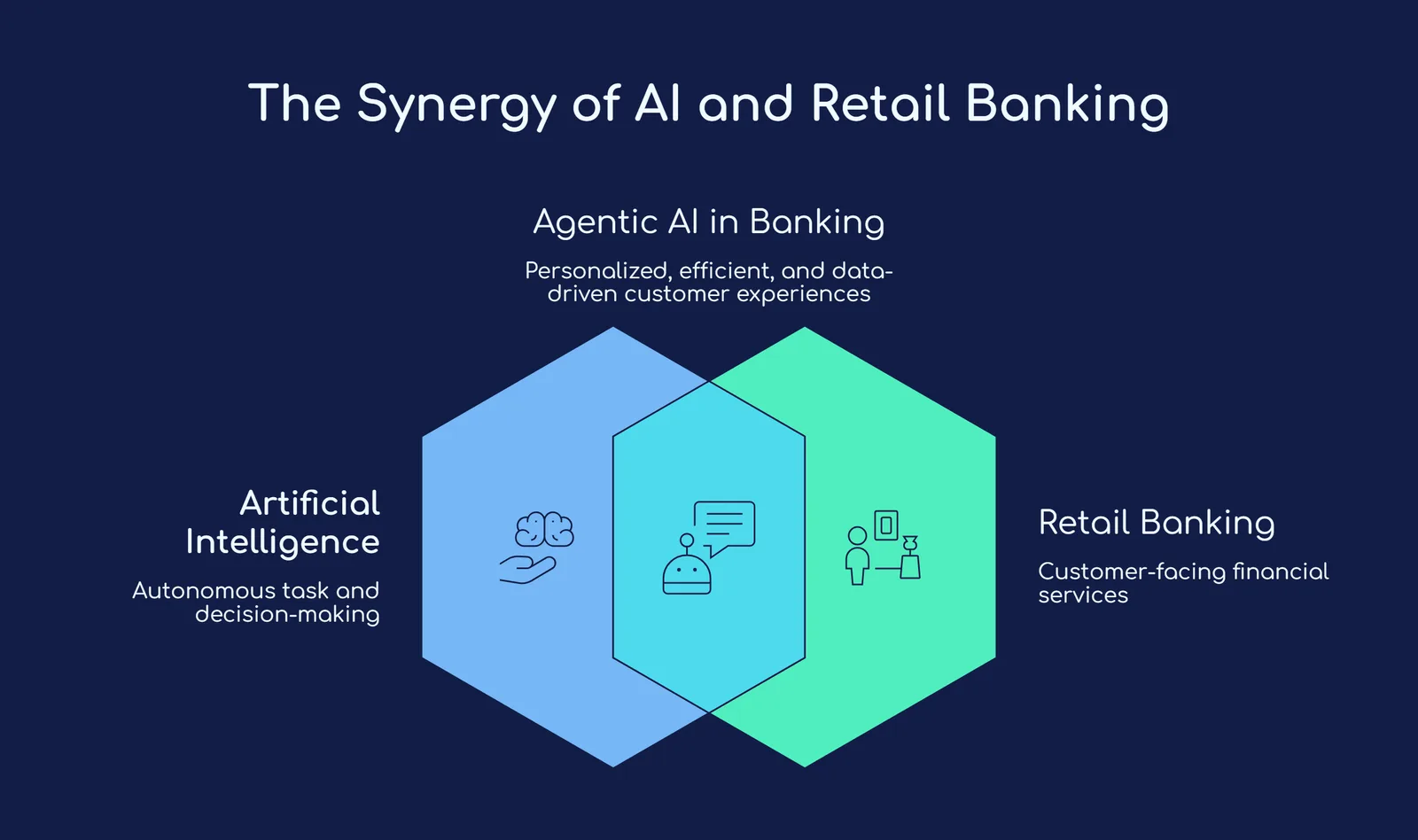
Agentic AI is different in three important ways.
- First, it reasons. Agentic systems use large language models to understand context, infer intent, and plan a sequence of actions rather than just responding to a single prompt.
- Second, it acts. These systems are connected to tools, APIs, databases, and internal systems. They can read a customer's financial history, query a credit bureau, draft a loan offer, and submit it for compliance review without human intervention at each step.
- Third, it learns and adapts. Unlike static models, agentic systems can update their behavior based on feedback loops, new data, and changing instructions.
Technical Definition: Agentic AI systems are built on a ReAct (Reasoning + Acting) architecture combined with tool-use capabilities. They operate through an agent loop - Observe the environment, reason about the goal, select and execute a tool, observe the outcome, and iterate. In banking, these tools can include CRM APIs, core banking systems, fraud engines, regulatory databases, and customer communication channels.
The easiest way to understand is that you can think of Traditional AI as a calculator and Agentic AI as a financial analyst who can read the spreadsheet, identify the anomaly, call the right department, draft the memo, and schedule the follow-up meeting, all without being told to do each step individually.
"We are moving from AI that assists humans to AI that acts on behalf of humans. That shift has enormous implications for how banks are structured, how risk is managed, and how value is created." - Zhu Min, Former Deputy Managing Director, International Monetary Fund.
The Spectrum of Agentic AI in Retail Banking
Agentic AI is not a single product you buy and deploy. It exists on a spectrum of autonomy, and where your bank operates on that spectrum determines both the risk profile and the upside potential of your investments.
Level 1: Assisted Automation
At this level, AI agents handle well-defined, repeatable tasks with human oversight at key decision points. Think of automated document verification in loan origination, where the AI extracts data from submitted documents, cross-references it with internal and external databases, and presents a structured summary to a human underwriter.
The human makes the final call, but the AI has done 80 percent of the cognitive work. Most retail banks are operating at this level today in pockets of their business.
Level 2: Supervised Autonomy
Here, the AI agent takes end-to-end actions within defined parameters, with humans monitoring outcomes rather than approving individual steps.
A customer service agent powered by AI might handle the full lifecycle of a dispute resolution, from receiving the complaint to investigating the transaction to communicating the outcome, with a human supervisor reviewing resolved cases in batches rather than approving each one in real time. JPMorgan Chase's COIN platform, which reviews commercial loan agreements, operates in this zone.
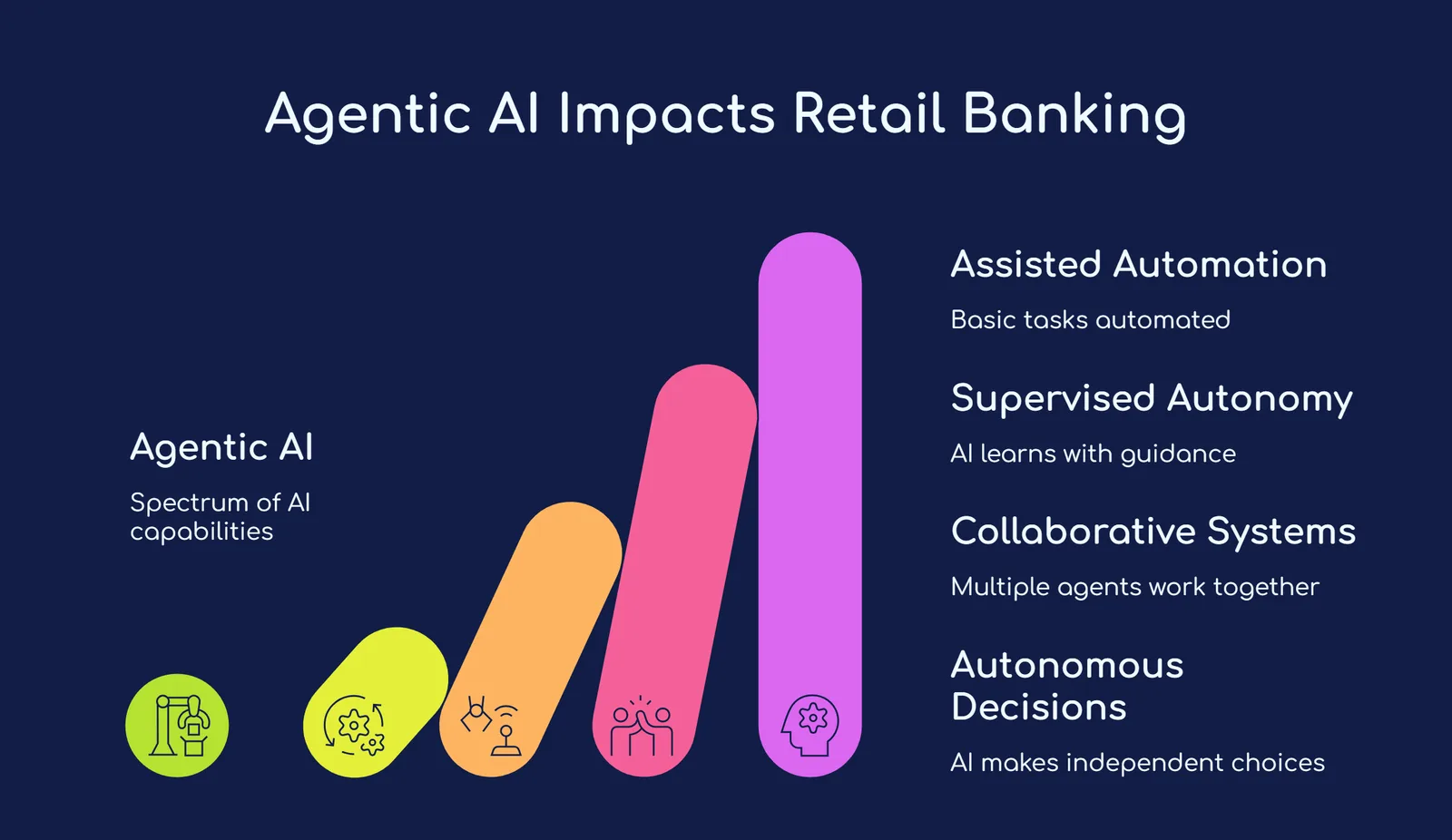
Level 3: Collaborative Multi-Agent Systems
This is where things get genuinely complex and genuinely powerful. Multiple AI agents with specialized functions work in concert, passing information and decisions between each other to accomplish a goal that no single agent could handle alone.
Imagine a mortgage origination workflow where one agent handles document parsing, a second handles credit analysis, a third monitors for regulatory compliance, a fourth orchestrates customer communication, and an orchestrator agent coordinates the entire workflow and escalates edge cases to humans. This is not science fiction. It is the architecture that firms like Morgan Stanley and Bank of America are building toward.
Level 4: Autonomous Decision Agents
At the frontier, AI agents operate with full autonomy within defined risk parameters, making and executing decisions without human approval loops. High-frequency trading systems already operate here.
The next frontier is applying this level of autonomy to retail banking use cases like real-time credit line adjustments, proactive fraud intervention, and dynamic product pricing. The regulatory and governance challenges at this level are significant, which is why most banks are approaching it carefully and in specific, controlled domains.
Key Insight: A 2025 report from Deloitte found that 74% of financial services executives believe agentic AI will fundamentally transform banking operations within five years, but only 18% say they have a coherent enterprise-wide strategy to deploy it. The gap between ambition and execution is where competitive advantage will be won or lost.
Use Cases of Agentic AI Across Distinct Verticals of Retail Banking
Agentic AI is poised to transform retail banks. Neither the customer journey nor its underlying workflows will ever be the same. Here are the use cases you needed to read about today…
1. Lending and Credit Decisioning
Credit decisioning is arguably the most consequential function in retail banking, and it is also one of the most ripe for agentic transformation. Traditional credit models are static, backward-looking, and limited to structured data. Agentic AI changes all three of those constraints.
An agentic lending system can ingest a customer's full financial life, including transaction history, income patterns, spending behavior, open banking data from connected accounts, and even alternative data like rental payment history, and generate a nuanced, real-time credit profile. The agent can then reason about risk, price it appropriately, structure a product offer, run it through compliance checks, and present the customer with a decision in minutes rather than days.
Upstart, the AI-powered lending platform, uses machine learning models trained on over 1,000 data variables to assess credit risk. The results are telling: Upstart-powered banks approve 27% more applicants than traditional models while experiencing 16% lower default rates, according to the company's 2023 Annual Report. That is not a marginal improvement. That is a structural competitive advantage.
Beyond origination, agentic AI can manage the full credit lifecycle. Agents can proactively identify customers showing early signs of financial stress, adjust credit facilities in real time, and trigger support interventions before a borrower defaults rather than after. This shifts lending from a transactional product to a relationship-based service.
2. Fraud Detection and Financial Crime Prevention
Fraud is a $485.6 billion problem for the global financial industry annually, according to the 2025 report by LexisNexis Risk Solutions. Traditional rule-based fraud detection systems generate enormous volumes of false positives, frustrating legitimate customers while sophisticated fraudsters learn to route around the rules.
Agentic AI brings a fundamentally different approach. Instead of matching transactions against static rule sets, an agentic fraud system reasons about the full context of a transaction. It considers the device being used, the geographic location, the transaction history with that merchant, the customer's typical behavioral patterns, and signals from across the network of customers and accounts. When something deviates, the agent does not just flag it. It investigates.
An agentic fraud agent might observe an unusual transaction, query the authentication logs to check the device fingerprint, cross-reference it with known fraud patterns, reach out to the customer through their preferred channel to verify intent, and either clear or block the transaction, all within seconds and without human intervention. Mastercard's Decision Intelligence platform uses similar multi-signal AI reasoning to evaluate transactions and has reduced false decline rates by up to 50 percent, according to the company.
For financial crime more broadly, agentic AI is transforming anti-money laundering operations. HSBC has deployed AI systems in partnership with Google Cloud that can analyze customer transaction networks in graph form, identifying complex multi-hop money laundering patterns that are invisible to traditional transaction monitoring systems. The bank reported a significant reduction in the time required to investigate AML alerts.
3. Wealth Management and Personal Financial Planning
For years, personalized financial advice was a luxury reserved for high-net-worth clients who could afford a private banker. Agentic AI is democratizing that experience at scale.
An agentic wealth management system can monitor a customer's portfolio in real time, model the impact of market events on their specific holdings, identify rebalancing opportunities, and execute trades within pre-approved parameters, all while explaining its reasoning to the customer in plain language. More importantly, it can proactively reach out when it identifies a life event-driven planning opportunity, whether that is the birth of a child, a job change, or a significant market move that affects the customer's goals.
Morgan Stanley's AI at Work, built in partnership with OpenAI, gives financial advisors access to an AI system trained on the firm's entire library of research, market commentary, and financial planning frameworks. The system does not replace advisors. It makes each advisor significantly more capable, allowing them to serve more clients with higher quality advice. Morgan Stanley reports that more than 200 of its internal applications now leverage this AI infrastructure.
For retail banking specifically, the opportunity is in the mass-affluent segment, customers with between $100,000 and $1 million in investable assets who are underserved by traditional advisory models. Agentic AI makes it economically viable to provide genuinely personalized planning to this segment at scale.
"The most exciting thing about AI in financial services is not efficiency. It is access. For the first time in history, every customer can have the equivalent of a sophisticated financial advisor working on their behalf 24 hours a day." - Adena Friedman, Chair and CEO, Nasdaq.
4. Customer Onboarding and KYC
Know Your Customer compliance is one of the most friction-heavy experiences in retail banking. The average onboarding time for a new business banking customer is 24 days, according to a 2023 survey by Encompass Corporation. For retail customers, it is shorter, but still plagued by document requests, verification delays, and abandonment rates that cost banks billions in lost revenue annually.
Agentic AI can compress this timeline dramatically. An onboarding agent can guide a customer through document submission, perform real-time verification against government databases, assess PEP and sanctions lists, evaluate risk profile, and complete the KYC workflow in a single session. ING Bank has deployed AI-powered KYC automation and reported a 50% reduction in onboarding time alongside improved compliance outcomes.
Beyond efficiency, agentic onboarding creates a better first impression. A customer who opens a current account in 10 minutes and immediately receives a personalized product recommendation based on their declared financial goals is a different kind of customer than one who waited three weeks for a letter in the post confirming their account activation.
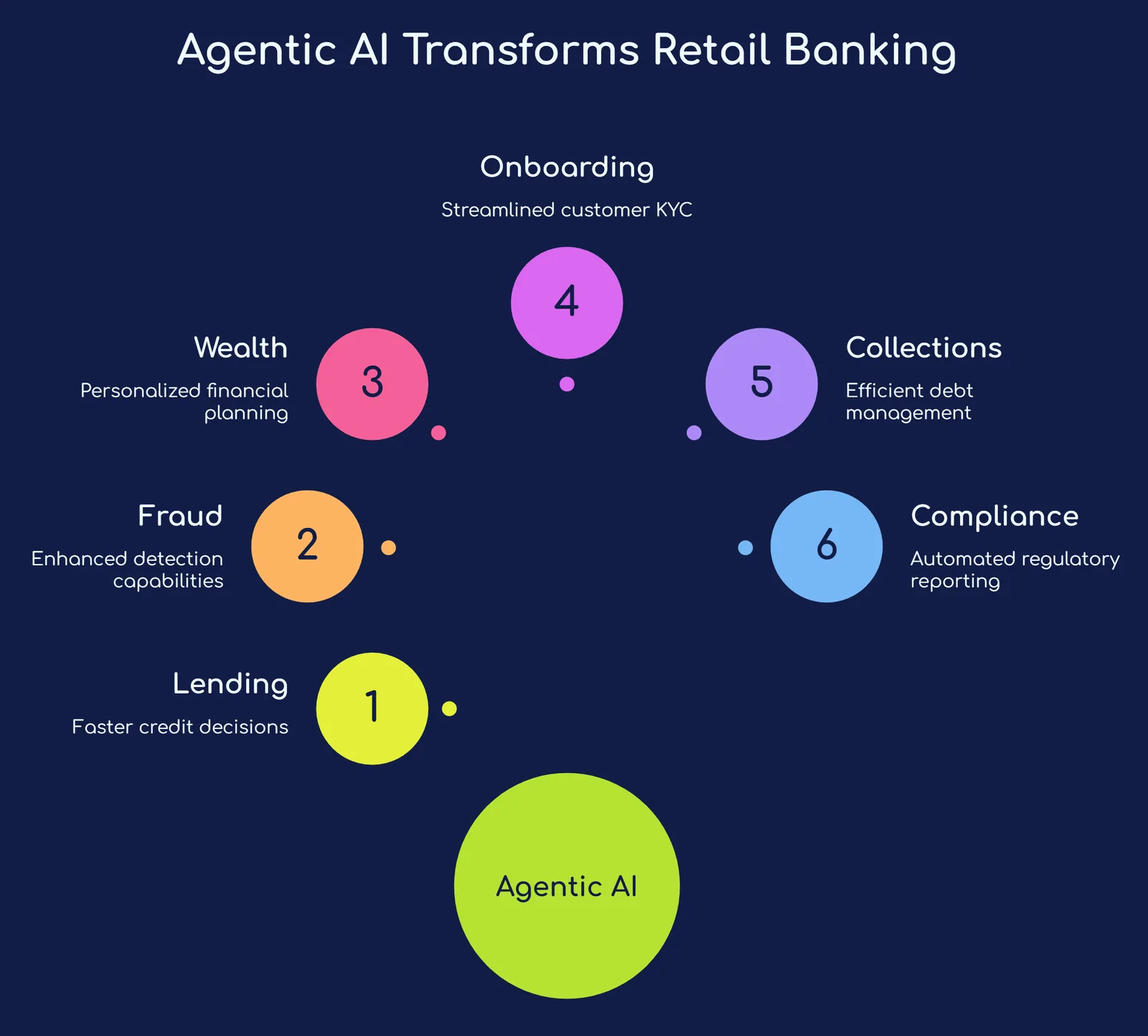
5. Collections and Debt Management
Collections is a domain where the human cost of poor execution is high, both for the customer and for the bank. Aggressive collections practices damage relationships, invite regulatory scrutiny, and often produce worse recovery outcomes than thoughtful, empathetic engagement.
Agentic AI enables a fundamentally different collections approach. An agent can analyze a customer's financial situation, identify the most likely repayment pathway, and craft a personalized communication and repayment plan that balances the bank's recovery goals with the customer's capacity to pay. It can dynamically adjust outreach timing, channel, and tone based on response patterns.
Lloyds Banking Group has deployed AI in its collections function and reported improvements in both recovery rates and customer satisfaction scores, demonstrating that these goals are not in conflict when the approach is intelligent and empathetic.
6. Regulatory Compliance and Reporting
Regulatory compliance costs the global banking industry an estimated $270 billion annually, according to a 2025 report by the Competitive Enterprise Institute. A significant portion of that cost is human effort spent on monitoring, reporting, and responding to regulatory requests.
Agentic AI can automate the continuous monitoring of transactions against regulatory requirements, generate compliance reports, flag potential violations before they become reportable events, and maintain audit trails that satisfy regulators. For stress testing and capital adequacy reporting, agentic systems can run complex scenarios and generate narrative explanations of the results for submission to regulators, a task that currently requires significant analyst time.
Leading Banks and Fintechs Deploying Agentic AI
The transition from experimentation to production deployment is happening faster than most industry observers predicted. Here is what some of the world's leading financial institutions are actually doing.
JPMorgan Chase
JPMorgan Chase has been among the most aggressive deployers of AI in banking. The firm's LLM Suite, an internal platform built on large language model technology, is now available to more than 60,000 employees. The bank's Chief Data and Analytics Officer has described it as giving every employee the equivalent of a research analyst. Beyond productivity tools, JPMorgan has been vocal about the application of AI in trading, fraud, and credit risk. The bank files more AI-related patents than any other financial institution and has committed over $15 billion annually to technology investment.
Bank of America
Erica, Bank of America's AI-powered virtual financial assistant, has surpassed 2 billion interactions since its launch and serves more than 37 million clients. But Erica represents only the customer-facing layer of Bank of America's AI ambitions. Behind the scenes, the bank has deployed AI across risk management, compliance monitoring, and operations. The bank has also invested heavily in AI-driven financial guidance capabilities that allow Erica to proactively surface insights about spending patterns, savings opportunities, and bill management to customers.
BBVA
BBVA has been building AI capabilities for over a decade and has embedded AI into both its retail and wholesale banking operations globally. The bank's AI models are used in credit decisioning, customer segmentation, fraud detection, and regulatory compliance. BBVA has been particularly vocal about using AI to expand financial inclusion, using alternative data models to extend credit to customers who would be declined by traditional underwriting methods.
Revolut
Revolut demonstrates what is possible when agentic AI is built into the architecture of a financial institution from the start rather than grafted onto legacy systems. Revolut uses AI agents across fraud detection, customer support, compliance, and product personalization. The company handles millions of customer interactions daily with a customer support function that is significantly AI-mediated, enabling rapid scale without proportional headcount growth.
Klarna
Klarna's deployment of an AI-powered customer service agent, built on OpenAI technology, became one of the most discussed AI deployments in 2024. The company reported that the AI assistant was doing the work equivalent to 700 full-time customer service agents and handling 66% of all customer service chats. The company reported higher customer satisfaction scores for AI-handled interactions compared to some human-handled ones and a 25% reduction in repeat inquiries due to more complete first-contact resolution.
Goldman Sachs
Goldman Sachs has embedded AI across its engineering, research, and client-facing functions. The bank's internal AI platform, built partly on Google Cloud infrastructure, gives analysts access to AI-assisted research synthesis, document analysis, and market commentary generation. Goldman has also been exploring the application of AI in its retail banking arm, Marcus, for personalized lending and savings product recommendations.
How Does the Future of Agentic AI in Retail Banking Look?
Predicting the future in any technology domain is an exercise in structured speculation. But the trajectory of agentic AI in retail banking has some fairly clear themes that executives should be thinking about now.
The Orchestrated Bank
The bank of 2030 will likely look less like a traditional financial institution and more like an orchestration platform. At its center will be a network of specialized AI agents, each trained on specific domains, coordinated by orchestrator agents that understand the customer's full context and financial life. A customer relationship will no longer be managed by a relationship manager supplemented by digital tools. It will be managed by a portfolio of AI agents that collectively have more context, more analytical capacity, and more responsiveness than any human team could deliver.
The humans in this model are not eliminated. They are elevated. The most effective banks will redeploy human talent toward the highest-judgment, highest-empathy interactions, such as complex life planning conversations, crisis support, and business banking relationships, while AI handles the volume.
Embedded Finance Gets Actually Intelligent
Embedded finance, the integration of financial products into non-financial platforms, has been a growth theme for several years. Agentic AI transforms embedded finance from a product distribution play into a genuine intelligence play.
Instead of just putting a loan button in an e-commerce checkout flow, an agentic financial system embedded in a business software platform can monitor a business's cash flow, identify a working capital gap before it becomes a crisis, structure an appropriate financing facility, and present it to the business owner at exactly the right moment. This is the difference between access and intelligence.
Regulatory Technology Becomes Proactive
Regulators around the world are rapidly developing frameworks for AI in financial services. The EU AI Act, which came into full effect in 2024, classifies many financial AI applications as high-risk and imposes significant governance, transparency, and testing requirements. The UK's FCA has taken a principles-based approach but is moving toward more specific guidance on model risk and explainability. Banks that build governance infrastructure for AI now will have a structural compliance advantage as the regulatory landscape hardens.
There is also a positive feedback loop here. Agentic AI deployed in compliance functions can help banks navigate increasingly complex regulatory requirements more effectively than human teams alone. The technology that creates regulatory complexity also provides the tools to manage it.
Hyper-Personalization at Population Scale
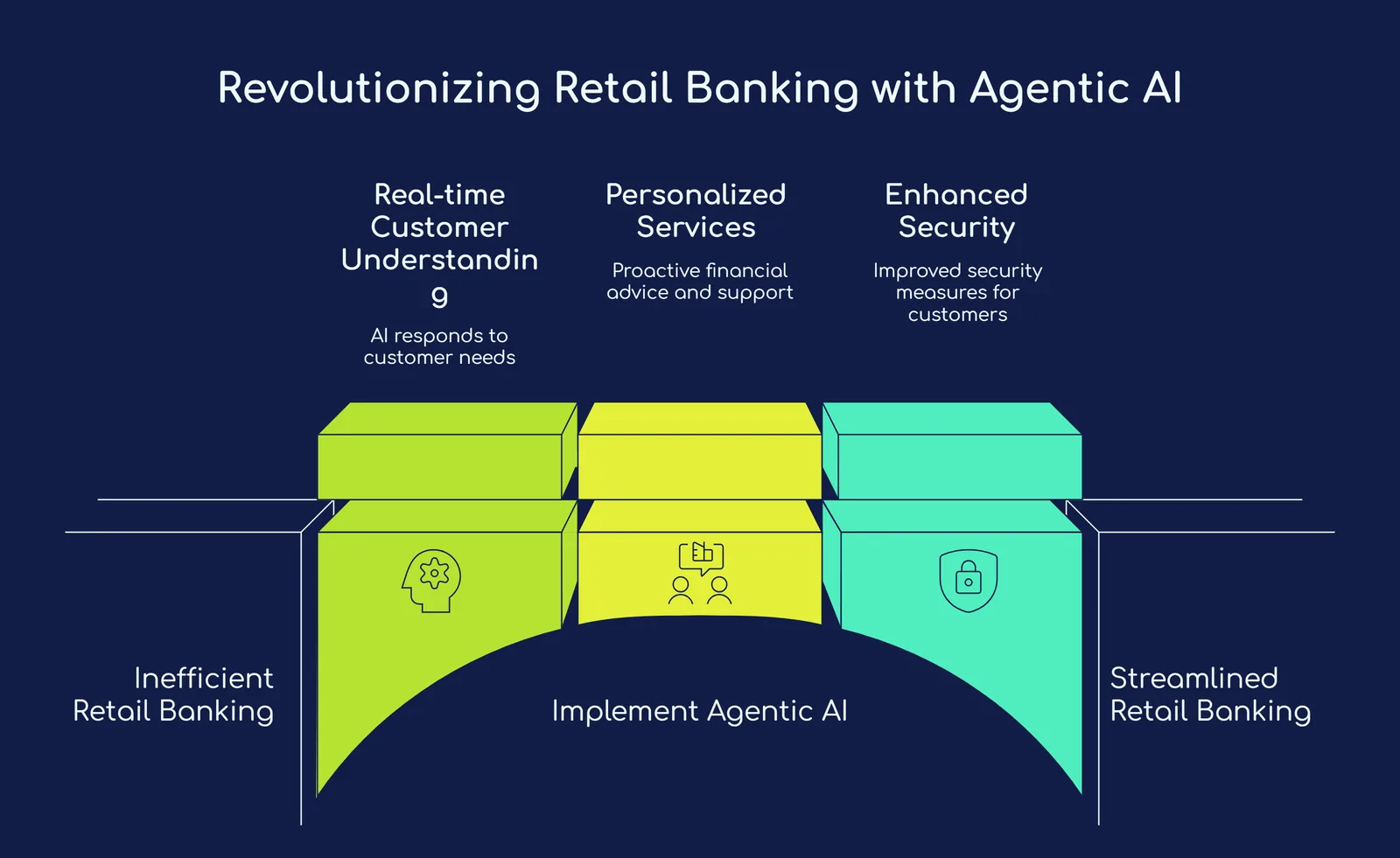
The most transformative long-term implication of agentic AI in retail banking is the ability to deliver genuinely individual financial experiences to every customer, regardless of their balance sheet. For the first time, a customer with a $500 balance will have access to the same quality of financial reasoning, the same proactive insight, and the same responsiveness as a private banking client.
The implication for financial inclusion is enormous. So is the implication for customer loyalty. According to a 2024 survey by Salesforce, 73% of customers expect companies to understand their unique needs and expectations. In banking, that expectation is currently met only for the wealthiest customers. Agentic AI eliminates that constraint.
The Rise of Financial Health as a Product Category
There is a meaningful shift underway from banking products to banking outcomes. Customers do not want a savings account. They want financial security. They do not want a loan.
They want to buy a house. Agentic AI enables banks to organize their services around the customer's goal rather than the bank's product catalogue. Banks that make this transition successfully will not compete on rate and fee. They will compete on trust, outcomes, and the quality of the financial intelligence they bring to each customer relationship.
"The banks that win the next decade will not be the ones with the best products. They will be the ones with the best understanding of their customers and the most effective AI infrastructure to act on that understanding." - Anne Boden, Founder, Starling Bank.
How Can Antino Help You Build for This Future?
Antino is an AI consulting and digital transformation company that has spent years at the intersection of financial services and advanced AI. We do not build generic AI platforms. We build specific, production-grade agentic systems for banks, fintechs, and financial institutions that are serious about competitive differentiation.
What We Bring to the Table?
Our AI engineering team has deep expertise in building agentic architectures on top of large language models, including agent orchestration, tool-use integration, retrieval-augmented generation for financial data, and multi-agent workflow design. We understand the specific constraints of banking environments, including core system integration, regulatory documentation, data privacy architecture, and model governance requirements.
We work across the full deployment stack. That means we can help you design the strategy, build the technical architecture, integrate with your existing systems, run pilots in controlled environments, and scale to production with the governance frameworks that your risk and compliance teams require.
Where Do We Start?
Most of our banking engagements start in one of three places.
- The first is a specific, high-value use case where you have identified a problem that agentic AI can solve and you need a technical partner who can move from concept to production in a realistic timeframe.
- The second is an AI readiness assessment, where we work with your technology and business leadership to map your current AI maturity, identify the highest-value opportunities, and build a prioritized roadmap.
- The third is an innovation sprint, a focused engagement where we prototype an agentic use case against your actual systems and data to demonstrate what is possible before committing to full development.
Our Commitment
We are builders, not consultants. We are not here to produce a report that sits in a drawer. We are here to build systems that work in production, that your operations teams can trust, and that your customers actually benefit from. If you are a banking executive who is serious about agentic AI as a strategic priority, we would welcome the conversation.
The window for building genuine competitive advantage in AI is not infinite. The banks that move deliberately and intelligently in the next 18 to 24 months will establish positions that will be difficult to close. The ones that wait for perfect clarity will find themselves playing catch-up against institutions that already have millions of agent-hours of operational experience.
The question is not whether agentic AI will transform retail banking. It already is. The question is whether your bank will be a beneficiary of that transformation or a casualty of it. Contact our AI experts today!
Frequently Asked Questions
Is agentic AI regulated in financial services?
Yes, and the regulatory landscape is evolving rapidly.
In the European Union, the AI Act classifies many financial AI applications, including credit scoring, fraud detection, and customer-facing advisory systems, as high-risk. This means they are subject to requirements around transparency, explainability, human oversight, and pre-deployment testing. Banks operating in the EU must document the data used to train models, demonstrate that they do not produce discriminatory outcomes, and maintain audit trails for AI-driven decisions that affect customers.
In the United States, there is no single federal AI law, but multiple existing regulations apply to AI in banking. The Equal Credit Opportunity Act requires that adverse action notices explain why credit was denied, which creates explainability requirements for AI credit models. The Fair Housing Act prohibits discriminatory lending. Existing guidance from the OCC, FDIC, and Federal Reserve on model risk management, particularly SR 11-7, applies to AI models. The CFPB has been increasingly active in signaling its intent to scrutinize AI-driven consumer financial decisions.
In India, there is currently no single AI-specific law equivalent to the EU AI Act, but banks using AI are governed through a combination of RBI supervision, sectoral financial regulations, cybersecurity requirements, and the Digital Personal Data Protection framework. The RBI’s 2025 FREE-AI report sets out a responsible AI roadmap for the financial sector, covering governance, protection, assurance, auditability, risk management, and human accountability.
Banks using AI for credit scoring, fraud detection, underwriting, customer support, or advisory workflows must also consider the Digital Personal Data Protection Act and DPDP Rules, which introduce obligations around lawful processing, notice, consent, data safeguards, retention, breach reporting, and accountability.
For AI-driven credit decisions, Indian banks and fintechs need to ensure that models are explainable, non-discriminatory, auditable, and aligned with RBI expectations on responsible lending, digital lending, cybersecurity, outsourcing, and model governance. As of 2026, India’s approach is still more principle-led and regulator-driven than the EU’s risk-classification model, but the direction is clear: financial AI systems must be transparent, accountable, secure, and subject to human oversight.
What is the ROI of agentic AI in retail banking?
The ROI of agentic AI varies significantly by use case, deployment maturity, and baseline operational efficiency. However, published data from early deployments provides meaningful benchmarks.
- In fraud prevention, banks deploying advanced AI report false positive rate reductions of 30 to 50%, which translates directly into reduced operational costs for investigating false alerts and improved customer experience from fewer declined legitimate transactions.
- In lending operations, AI-automated underwriting can reduce processing time from days to minutes, cutting operational costs per application by 40 to 60 percent in well-implemented systems.
- In customer service, banks that have deployed AI agents at the front line report containment rates of 60 to 75 percent for customer inquiries, meaning the AI resolves the issue without human intervention, at a fraction of the per-interaction cost of human agents.
The harder ROI to quantify, but arguably more significant, is the revenue upside from better personalization and proactive engagement. Banks with mature AI personalization capabilities report higher product attachment rates, lower churn, and higher customer lifetime value in segments served by AI-driven relationship models.
McKinsey estimates that the full deployment of AI capabilities across a major retail bank could generate between $1 billion and $6 billion in additional annual value, depending on the size of the institution and the ambition of the deployment.
How is agentic AI different from traditional banking chatbots?
This is one of the most important distinctions for banking executives to understand, because conflating the two leads to underestimating both the opportunity and the organizational change required.
Traditional banking chatbots are essentially sophisticated decision trees or intent classifiers. They are designed to handle a specific set of predefined queries by matching the customer's input to a known category and returning a scripted or templated response. They have no memory of previous interactions, no ability to take action in external systems, no capacity to reason about edge cases not covered by their training data, and no ability to pursue a goal across multiple steps.
Agentic AI systems, by contrast, have all four of those capabilities. They can maintain context across a conversation and across sessions. They can take actions in external systems such as querying account data, initiating transactions, or filing a support ticket. They can reason about novel situations and produce responses that were not explicitly programmed. And they can pursue multi-step goals such as resolving a disputed transaction or completing a loan application by sequencing the necessary actions intelligently.
The practical difference for the customer is the difference between a voice-activated FAQ and a genuinely knowledgeable assistant who can actually do things on your behalf. The practical difference for the bank is the difference between a cost reduction tool and a genuine service capability transformation.
How are leading banks using agentic AI today?
The most mature deployments are concentrated in a few categories.
- JPMorgan Chase has deployed AI tools to more than 60,000 employees for research synthesis, document analysis, and decision support.
- Bank of America's Erica platform has crossed 2 billion customer interactions and is increasingly used to proactively surface financial insights rather than just answer questions.
- Morgan Stanley has built an AI advisor platform used by thousands of financial advisors that synthesizes the firm's research into real-time guidance during client conversations.
- In fraud and financial crime, HSBC and Featurespace have deployed graph-based AI systems that can identify complex fraud patterns at network scale.
- Mastercard's AI-powered transaction scoring operates across billions of transactions daily and has meaningfully reduced false declines.
- In lending, Upstart demonstrates the performance of AI underwriting against traditional credit models, approving more customers at lower default rates.
- Klarna's AI customer service agent handling the equivalent workload of hundreds of human agents is the most-cited example of production-scale agentic deployment in financial services.
- Revolut's fraud detection and customer support automation gives the company the ability to scale its customer base without proportional headcount growth.
What connects all of these deployments is that they are not experiments. They are production systems handling real customer interactions and real financial decisions at scale. The era of AI in banking as a proof-of-concept exercise is ending. The era of AI as core operational infrastructure is beginning.