
The artificial intelligence landscape has crossed a consequential inflection point. Enterprises that approached AI as an efficiency instrument, deploying it to automate discrete tasks, accelerate content generation, or augment human decision-making at the margins, are now confronting a paradigm of an altogether different magnitude.
Agentic AI, characterized by its capacity for autonomous goal-directed reasoning, multi-step execution, and self-correcting behavior across complex enterprise environments, is no longer a frontier technology. It is rapidly becoming the operational backbone of the world's most competitive organizations.
For Chief Executive Officers, Chief Technology Officers, and Chief Operating Officers, the strategic calculus is unambiguous: agentic AI will restructure competitive dynamics across virtually every industry vertical within the next three to five years.
Enterprises that move with deliberation and structural intent will capture disproportionate productivity gains, accelerate value creation cycles, and embed structural moats that late movers will find exceedingly difficult to overcome. Those who treat agentic AI as a future consideration risk ceding ground that cannot be recovered through subsequent investment alone.
This blog provides leaders with a rigorous, practitioner-grounded examination of agentic AI: its definitional architecture, its divergence from conventional AI adoption models, its transformative impact on enterprise operations, its governance imperatives, and the strategic roadmap required to translate this technology into sustained competitive advantage. It concludes with a perspective on how Antino is uniquely positioned to guide enterprise organizations through this transformation.
What is Agentic AI, and why do enterprises need to pay attention now?
Agentic AI refers to artificial intelligence systems designed not merely to respond to prompts or perform singular analytical tasks, but to pursue multi-step objectives with a degree of autonomous reasoning, planning, tool utilization, and adaptive learning that is qualitatively distinct from prior generations of AI technology.
Where conventional generative AI models operate within a call-and-response paradigm, AI agents perceive environmental inputs, decompose complex goals into sequential actions, interact with external systems and data sources, evaluate outcomes, and iteratively self-correct to achieve defined objectives, all without requiring continuous human instruction at each step.
The architectural composition of an agentic system typically encompasses several interdependent layers: a large language model serving as the cognitive reasoning engine, a planning module that sequences and prioritizes subtasks, a memory architecture that retains contextual state across interactions, and a tool-use layer that enables the agent to call upon APIs, databases, enterprise platforms, and external services.
When multiple agents are orchestrated within a coordinated framework, the resulting system exhibits emergent capabilities that far exceed the sum of its components, enabling end-to-end workflow execution at enterprise scale.
This is not an incremental evolution of chatbot technology. It is a structural reconfiguration of how work is executed, how decisions are informed, and how value is generated within the enterprise.
The Convergence of Forces Driving Urgency
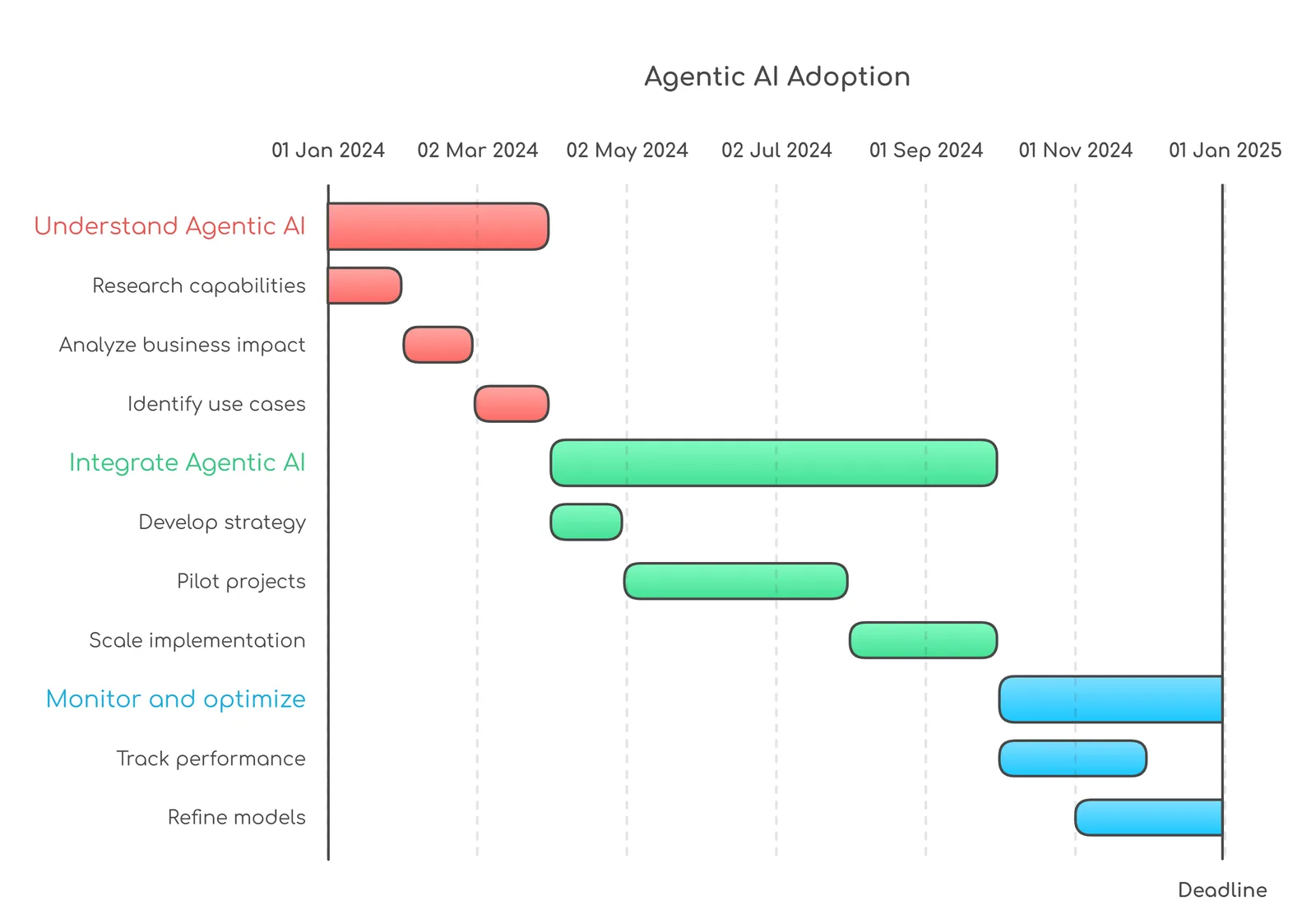
Three concurrent developments have compressed the timeline within which enterprises must formulate a substantive agentic AI strategy.
- First, the underlying model capabilities underpinning agentic systems have advanced at a pace that consistently outstrips institutional projections. Breakthroughs in deep learning architectures, coupled with the proliferation of AI-optimized compute infrastructure, have endowed frontier models with the contextual reasoning capacity, multi-modal processing capability, and tool-use sophistication required to operate reliably within complex enterprise environments. The technology, in short, is ready for production deployment at scale.
- Second, the enterprise data substrate required to make agentic systems genuinely useful has matured substantially. The widespread adoption of cloud-based ERP, CRM, and collaboration platforms over the preceding decade has created the structured, accessible data ecosystems upon which AI agents operate most effectively. Enterprises that have invested in data infrastructure are now positioned to harvest outsized returns from that investment through agentic AI deployment.
- Third, competitive pressure from both technology-native disruptors and from incumbents with more aggressive AI adoption postures is accelerating the urgency of board-level response. According to research compiled across leading global advisory firms, organizations that have deployed AI agents at scale are reporting workflow acceleration of 30 to 50% in targeted process domains, with reductions in low-value employee labor consumption ranging from 25 to 40%. These are structural cost and speed advantages that compound over time.
The question confronting enterprise leadership is not whether agentic AI will reshape their industry. That outcome is no longer a subject of reasonable debate. The question is whether their organization will be among those defining the new competitive baseline or among those reacting to it.
Why Traditional AI adoption strategies fall short for Enterprises?
Traditional AI adoption strategies are no longer in use. Considering tools like Claude, ChatGPT, Gemini, etc, following the traditional path feels a little useless for Enterprises. Want to know more? Have a look…
Limitations of the Augmentation Paradigm
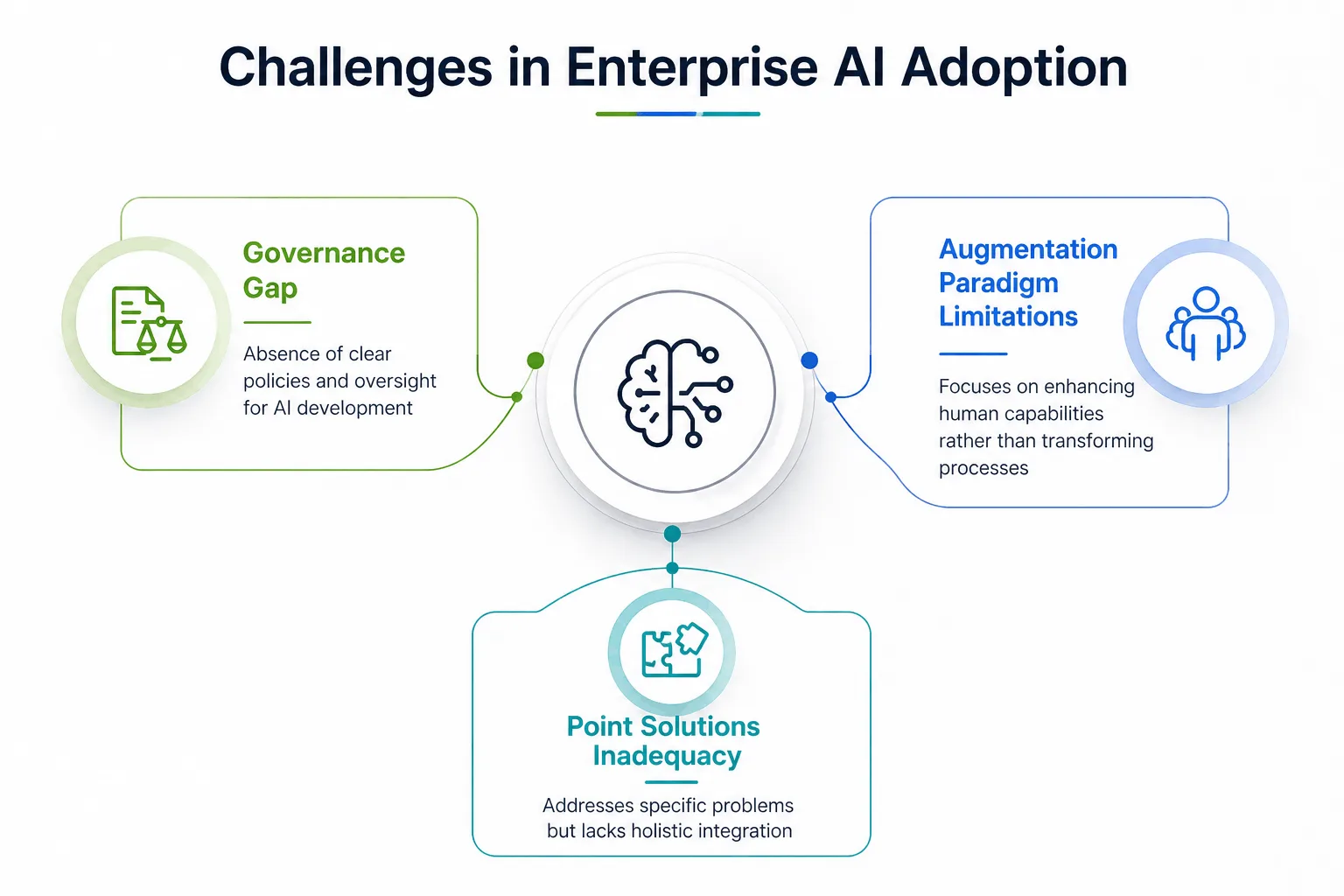
The dominant AI adoption model that most enterprises have pursued to date operates within what may be termed the augmentation paradigm: AI as an instrument that assists human workers in performing defined tasks more efficiently. Copilots that accelerate code generation, conversational interfaces that surface relevant data, and recommendation engines that inform but do not determine commercial decisions. Within this paradigm, human judgment remains the authoritative decision node, and AI functions as an advanced productivity tool.
This model delivered genuine value in its time. However, it carries structural limitations that prevent it from capturing the transformative potential of agentic AI.
The augmentation paradigm is inherently bounded by human throughput. When AI outputs still require human review, approval, and action at each consequential step, the system's operational velocity is constrained by the cognitive bandwidth and availability of the human actors within it. In a world where AI agents can execute thousands of decision cycles per second across interconnected enterprise systems, human-in-the-loop architectures designed for augmentation create a bottleneck that negates the most significant productivity gains that agentic technology offers.
Furthermore, the augmentation paradigm typically frames AI deployment as a tool implementation rather than a process transformation. Organizations procure AI capabilities, integrate them into existing workflows, and measure success by user adoption rates and task-level efficiency improvements. This framing systematically underinvests in the workflow redesign, data architecture modernization, and governance infrastructure that are prerequisites for agentic AI to function at its full potential. The result is an AI capability that is technically deployed but operationally constrained.
Why Point Solutions No Longer Suffice?
A related limitation of conventional enterprise AI adoption strategies is their tendency toward point-solution deployment: identifying discrete use cases, implementing AI capabilities within those use cases in relative isolation, and aggregating the resulting efficiency gains as evidence of AI maturity. This approach generates measurable near-term returns but fails to exploit the compounding value that emerges when AI agents operate across integrated workflow ecosystems.
The distinctive value proposition of agentic AI is not its ability to perform individual tasks autonomously. It is its capacity to orchestrate multi-step, cross-functional processes with minimal human intervention, passing context and outputs seamlessly between workflow stages, dynamically adapting to changing conditions, and escalating appropriately when human judgment is genuinely required.
A procurement agent that detects cost anomalies, queries the ERP for supplier alternatives, triggers a renegotiation workflow, and updates financial forecasts is not replicating a sequence of point solutions. It is executing an integrated business process that previously required coordination across multiple human roles and organizational functions.
Realizing this value requires enterprises to move beyond the point-solution mentality and toward an architectural conception of AI deployment: one that treats agentic systems as foundational operational infrastructure rather than as a portfolio of discrete tools.
Governance Gap in Conventional AI Programs
Perhaps the most consequential deficiency in conventional enterprise AI adoption strategies is the absence of governance frameworks calibrated for autonomous AI systems. The risk and compliance architectures that most organizations have developed for traditional AI deployments are oriented around model explainability, bias monitoring, and output auditing, applied to systems whose actions are bounded by human review.
These frameworks are inadequate for agentic systems that execute consequential actions, interact with external parties, modify enterprise data, and make resource allocation decisions with limited or no human oversight at the point of execution.
The governance requirements for agentic AI are categorically different in scope and complexity. They encompass agent identity and access management, definition of autonomy thresholds, escalation protocol design, auditability of multi-step reasoning chains, cybersecurity surface management across expanded agent-tool interaction points, and accountability assignment for outcomes generated by autonomous systems.
Enterprises that have not invested in developing these capabilities will find themselves institutionally unprepared to deploy agentic AI responsibly at scale, regardless of the sophistication of the underlying technology.
How Agentic AI Transforms Enterprise Operations and Decision-Making?
The transformative impact of agentic AI on enterprise operations operates at two distinct but interrelated levels: the process level and the organizational level.
The Process Level
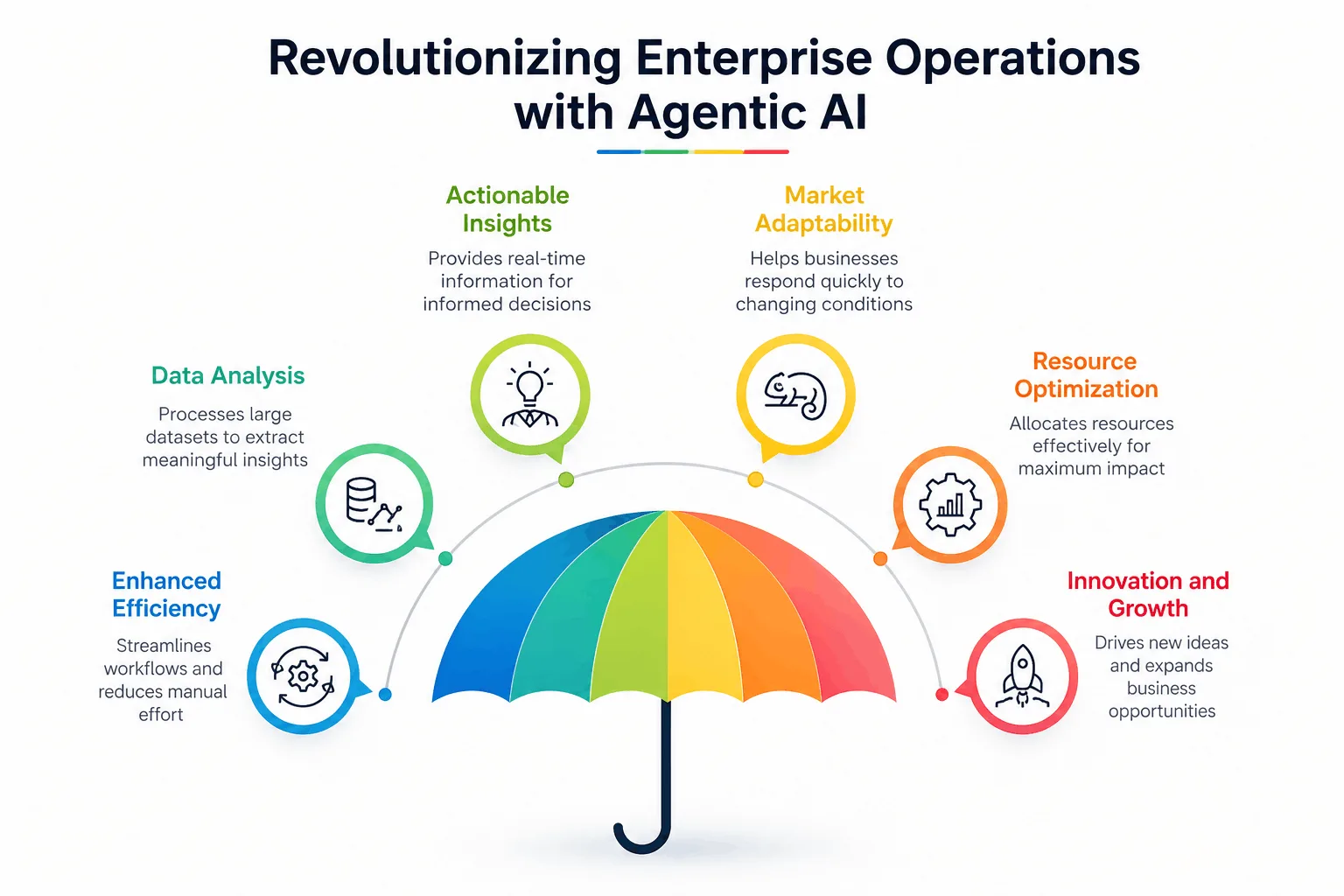
At the process level, agentic AI converts previously sequential, human-coordinated workflows into dynamically orchestrated, AI-executed operational streams. Enterprise resource planning systems that once served primarily as repositories of structured transaction data become active participants in operational decision-making, with embedded AI agents monitoring inventory positions, detecting demand signal deviations, initiating procurement actions, and updating financial projections in real time without awaiting human instruction. What is ITSM also becomes relevant in this context, as IT service management provides a structured framework for managing the service workflows and operational processes that AI agents may increasingly support.
Customer relationship management platforms evolve from structured databases into intelligent engagement systems, with agents autonomously qualifying leads, personalizing outreach sequences, managing pipeline health, and routing escalations based on real-time behavioral signals. Customer relationship management platforms evolve from structured databases into intelligent engagement systems, with agents autonomously qualifying leads, using a lead finder to identify relevant prospects, personalizing outreach sequences, managing pipeline health, and routing escalations based on real-time behavioral signals.
The operational velocity implications of this transformation are profound. AI agents do not fatigue, do not maintain cognitive queues during high-demand periods, and do not require organizational coordination to pass context between functional handoffs. They process information and execute actions at a pace and consistency that human organizational structures cannot match. Early enterprise adopters across finance, operations, and customer service functions are documenting business process acceleration of 30 to 50 percent in domains where agentic AI has been thoughtfully deployed.
The Organizational Level
At the organizational level, agentic AI redefines the role of human talent within the enterprise. As AI agents absorb the execution burden of structured, rules-based, and data-intensive work, human capital is progressively redirected toward the activities where human judgment generates the greatest differential value: strategic problem formulation, creative synthesis, stakeholder relationship cultivation, ethical oversight, and the management of exception cases that fall outside the parameters of AI-defined operational envelopes. This shift represents not a reduction in the value of human talent but a significant elevation in the strategic quality of human contribution.
Functional domain impact at scale
The transformative reach of agentic AI extends across every major functional domain of the enterprise, though the specific manifestations vary by domain context.
Within supply chain and operations management, AI agents are demonstrating the capacity to monitor multi-tier supplier networks in real time, detect early signals of supply disruption, model alternative sourcing scenarios, and initiate mitigation actions autonomously.
An agent embedded within a supply chain management platform might detect a logistics delay affecting critical components, model the downstream production schedule impact, identify alternative supplier options within approved vendor lists, and trigger a renegotiation workflow, all before a human supply chain analyst has had the opportunity to open the relevant dashboard.
Within financial management and risk oversight, agents are autonomously executing anomaly detection across transaction flows, forecasting liquidity positions under multiple scenario assumptions, and recommending portfolio reallocation actions for risk officer review. Pilot deployments in financial services and corporate treasury functions have documented reductions in risk-event frequency of up to 60 percent in controlled environments, a consequence of the agents' capacity for continuous, comprehensive monitoring that human teams cannot replicate.
Within customer operations, agentic AI is managing end-to-end service processes that previously required coordination across multiple human roles. An insurance claims agent, for example, can receive a first notice of loss, validate policy coverage, assess the claim against historical fraud patterns, triage for complexity, initiate document requests, and determine eligibility for automated settlement, compressing a process that historically spanned days into a matter of hours.
Organizations deploying these capabilities have reported claim handling time reductions of 40% alongside meaningful improvements in customer satisfaction metrics.
Decision Architecture Transformation
Beyond process execution, agentic AI is transforming the decision architecture of the enterprise in ways that have far-reaching implications for organizational design. Decisions that previously required escalation through multiple organizational layers can now be governed by agent-executed decision logic within pre-defined autonomy thresholds, with escalation occurring only when decisions exceed defined risk parameters or fall outside the agent's authorization scope. Browser automation MCP tools can support this model by giving agents a way to interact with web-based systems when carrying out authorized actions across enterprise workflows. This compression of decision latency represents a structural competitive advantage in markets where speed of response is a differentiating factor.
Critically, the quality and consistency of AI-executed decisions within their defined parameters typically exceed that of human decision-making applied to the same structured inputs. AI agents are not subject to decision fatigue, anchoring bias, or the variability introduced by differing experience levels across a distributed workforce. Within their operational domain, they apply consistent logic to every case, every time, at any volume.
How Leading Enterprises Are Implementing Agentic AI Successfully?
Successful enterprise agentic AI implementations share a common architectural discipline: they approach agent deployment not as a technology project but as a business transformation program, structured around three interdependent phases of organizational engagement.
Design Phase
The design phase demands that organizational leaders translate business objectives into secure, governance-embedded agent architectures before a single line of code is written. This requires explicit definition of each agent's operational scope, the boundaries of its autonomy, the data and systems it is authorized to access, the escalation conditions that trigger human oversight, and the ethical constraints that constitute hard operational boundaries.
The governance architecture, in other words, must be native to the agent's design rather than retrofitted after deployment. Organizations that approach design with this rigor avoid the costly remediation cycles that characterize implementations where governance is treated as a post-production consideration.
Build Phase
The build phase translates design specifications into production-ready agent systems through a discipline of comprehensive validation and controlled experimentation. Leading practitioners mandate structured red-team exercises in which designated teams attempt to elicit unintended or harmful behaviors from agents under development, surfacing failure modes before they manifest in production.
Parallel to this, sandbox testing environments that replicate production data structures without operational consequences allow organizations to validate agent behavior across a comprehensive range of scenarios before authorizing live deployment.
Operate Phase
The operate phase treats deployed agents as living products requiring continuous oversight, iterative improvement, and disciplined change management. Human oversight is not merely a compliance checkbox within this framework; it is an active operational responsibility.
Organizations that have implemented agentic AI at scale maintain empowered human oversight teams with clear authority to intervene, modify, or suspend agent operations in response to detected anomalies. Every consequential agent decision is logged with sufficient granularity to support post-event reconstruction and regulatory audit, providing the explainability and auditability that regulated industries in particular require.
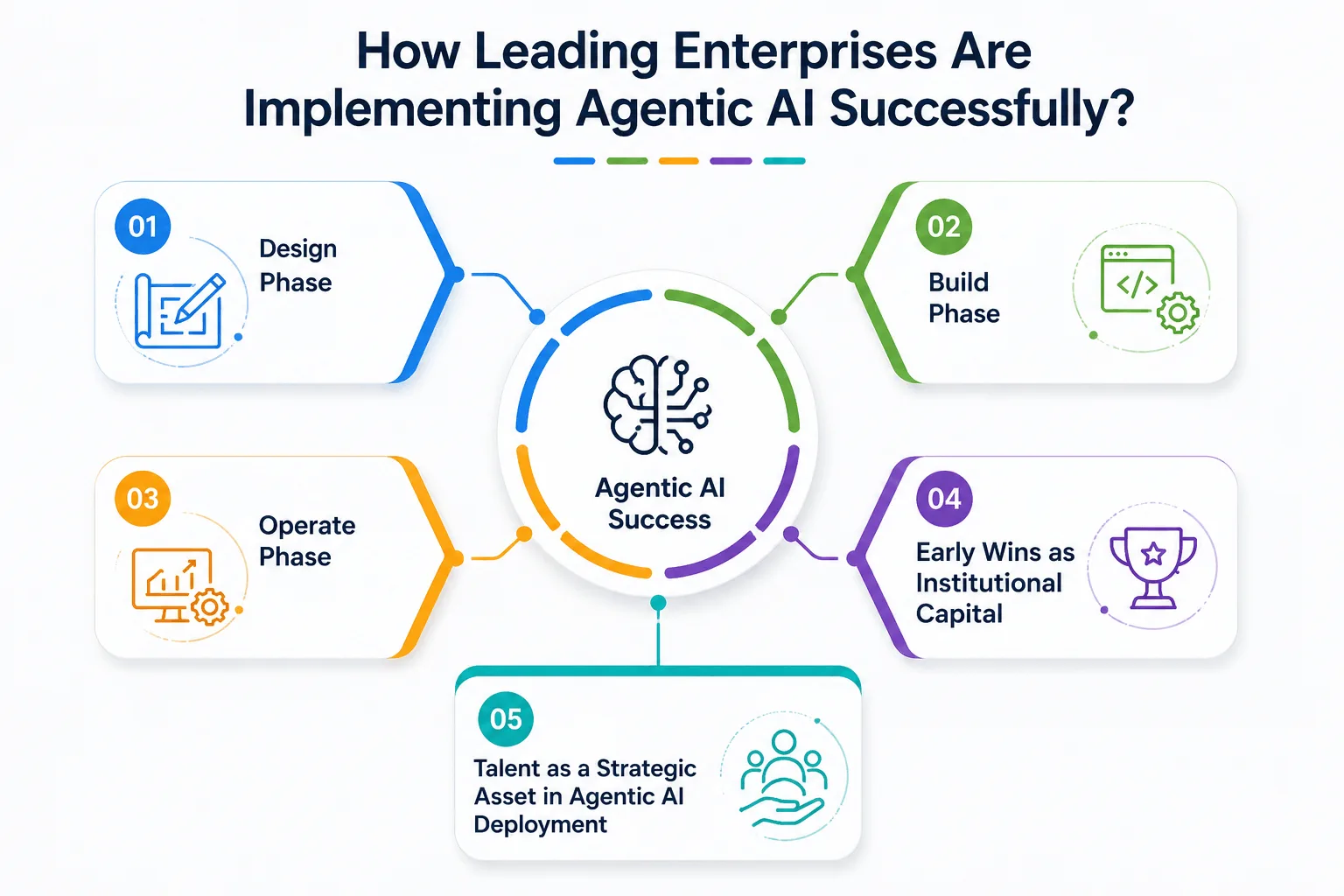
Early Wins as Institutional Capital
A consistent pattern among successful large-scale agentic AI implementations is the strategic prioritization of early, high-visibility wins that generate organizational confidence and executive sponsorship before broader deployment is attempted. Ambitions that are too broad at the outset frequently generate organizational stall: slow progress, diffuse accountability, and erosion of executive commitment in the absence of tangible demonstrated value.
The pattern that generates durable momentum begins with a narrowly scoped but high-impact deployment in a process domain where success can be defined, measured, and communicated clearly within a 60-to-90-day horizon. Vendor onboarding automation, procurement cycle acceleration, claims triage management, and lead routing optimization are some leading workflow automation examples; represent categories that have generated documented early wins at multiple enterprise organizations.
These initial deployments serve dual purpose: they deliver direct operational value and they build the institutional knowledge, governance experience, and organizational credibility required to justify and execute more ambitious subsequent deployments.
Talent as a Strategic Asset in Agentic AI Deployment
No dimension of agentic AI implementation is more systematically underestimated by enterprise leadership than the talent requirement. The capabilities required to design, deploy, and manage agentic AI systems at enterprise scale represent a convergence of technical depth and business domain expertise that is genuinely scarce in the current labor market.
On the technical dimension, organizations require AI engineering talent capable of working with frontier language models, agent orchestration frameworks, enterprise API integration, and the security architecture of multi-agent systems. Given how fast this skill set is evolving, many professionals are choosing to build it systematically through a structured agentic AI course rather than piecing it together on the job.
On the business dimension, they require translators who possess deep domain knowledge of the specific workflows and decision environments into which agents will be deployed, and who can articulate use cases, define success criteria, and identify failure modes with the granularity that agent design requires. The absence of either capability dimension creates implementation fragility that technical investment alone cannot resolve.
Leading organizations are addressing this through deliberate hybrid team structures that pair technical AI practitioners with experienced domain specialists from finance, operations, legal, and customer experience functions. These integrated teams are constituted not as temporary project resources but as permanent organizational capabilities with ongoing accountability for the performance and governance of deployed agent systems.
Key Risks of Delayed Agentic AI Adoption for Enterprise Leaders
Compounding Cost of Inaction
The conventional enterprise risk framework treats technology adoption delay as a recoverable position: organizations can observe the market, learn from early adopters' mistakes, and deploy at a point of greater maturity with reduced implementation risk. This framework does not apply with adequate precision to agentic AI, for reasons that are structural rather than circumstantial.
Agentic AI systems improve through deployment. The data generated by agent operations, the feedback loops that refine agent decision logic, and the institutional knowledge accumulated through managing agentic workflows at scale are all assets that compound with time. Organizations that deploy agentic AI in 2025 will possess, by 2027, operational assets derived from two years of continuous agent learning and organizational adaptation that competitors entering in 2027 cannot purchase or replicate through capital investment alone. The advantage, in short, is path-dependent.
Furthermore, the talent required to design and operate agentic AI systems is already constrained and will become more so as enterprise demand scales. Organizations that delay investment in agentic AI capability development are simultaneously allowing competitors to secure preferred access to the talent, platform partnerships, and vendor relationships that will govern implementation quality for the foreseeable future.
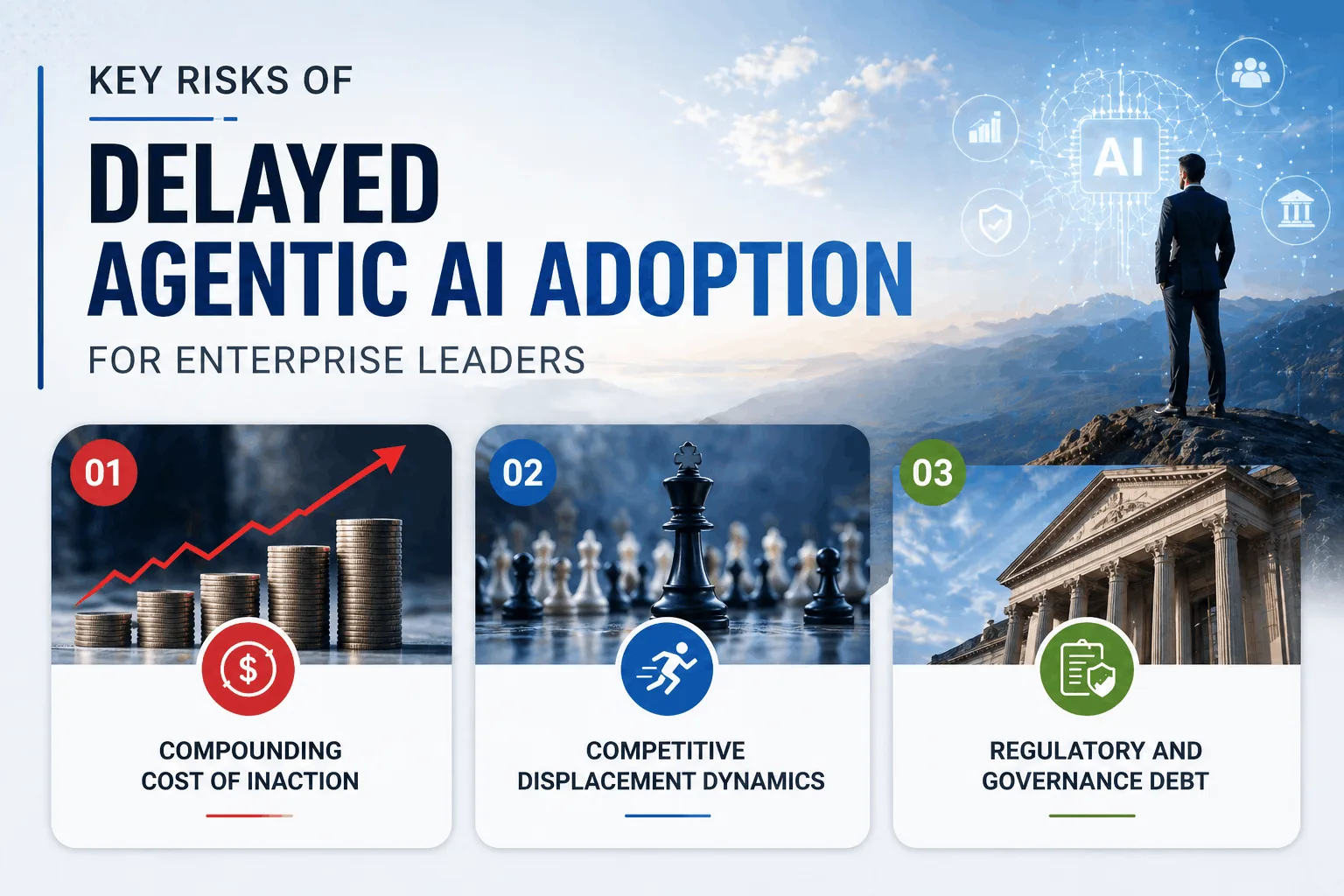
Competitive Displacement Dynamics
The competitive risk of delayed agentic AI adoption is not symmetric across industry verticals, but it is present in virtually all of them. In sectors where speed of execution, cost efficiency, and personalization quality are primary competitive differentiators, including financial services, retail, healthcare administration, and manufacturing, organizations deploying agentic AI at scale will progressively build structural cost and speed advantages that cannot be neutralized by competitors operating within conventional process architectures.
The displacement mechanism is not a dramatic disruption in a single event. It is progressive margin compression and market share erosion as agentic-AI-enabled competitors operate at lower unit costs, respond to market signals more rapidly, and deliver more personalized and frictionless customer experiences. By the time the displacement is legible in financial performance data, the strategic gap will typically have widened beyond what reactive investment can close within a competitive timeframe.
Regulatory and Governance Debt
A less discussed but equally consequential risk of delayed adoption is regulatory debt. Governments and regulatory bodies across major jurisdictions are actively developing governance frameworks for autonomous AI systems. Enterprises that are not operationally engaged with agentic AI during this formative regulatory period are abdicating their opportunity to shape those frameworks through constructive engagement and demonstrated responsible practice.
More practically, they are accumulating governance debt: the organizational learning, policy development, and technical infrastructure required to meet emerging regulatory standards will need to be developed under time pressure rather than through the deliberate, iterative process that proactive adoption enables.
How to build an Enterprise AI strategy around Agentic capabilities?
Constructing an enterprise AI strategy around agentic capabilities requires leadership to reconceptualize AI not as a tool portfolio but as an operational layer embedded within the enterprise's core value chain. This reconceptualization has architectural, organizational, and cultural dimensions that must be addressed with equal rigor.
From an architectural perspective,
Agentic AI readiness requires enterprises to assess and, where necessary, modernize three foundational infrastructure layers, including support for LLM long term memory. The data layer must provide AI agents with access to high-quality, well-governed, real-time data from across the enterprise's operational systems.
Fragmented data architectures, poor master data governance, and the absence of standardized APIs represent the single most common implementation failure point in enterprise agentic AI programs. The platform layer must evolve from static, record-of-system architectures toward event-driven, agent-compatible infrastructure that can respond to AI-initiated actions with the latency and reliability that real-time agent orchestration requires.
The security layer must extend enterprise identity and access management frameworks to encompass AI agents as distinct actor classes with explicitly defined permissions, behavioral monitoring, and anomaly detection capabilities.
From an organizational perspective,
The enterprise must develop new governance structures specifically designed for the oversight of autonomous systems. This includes the designation of clear accountability for each deployed agent, the establishment of cross-functional governance bodies with authority over agent deployment decisions, and the integration of AI agent performance monitoring into existing risk management and compliance frameworks.
The governance architecture must be designed from the outset to scale: ad hoc oversight arrangements that suffice for initial pilots will be demonstrably inadequate as the organization's agent portfolio grows to encompass dozens or hundreds of deployed systems.
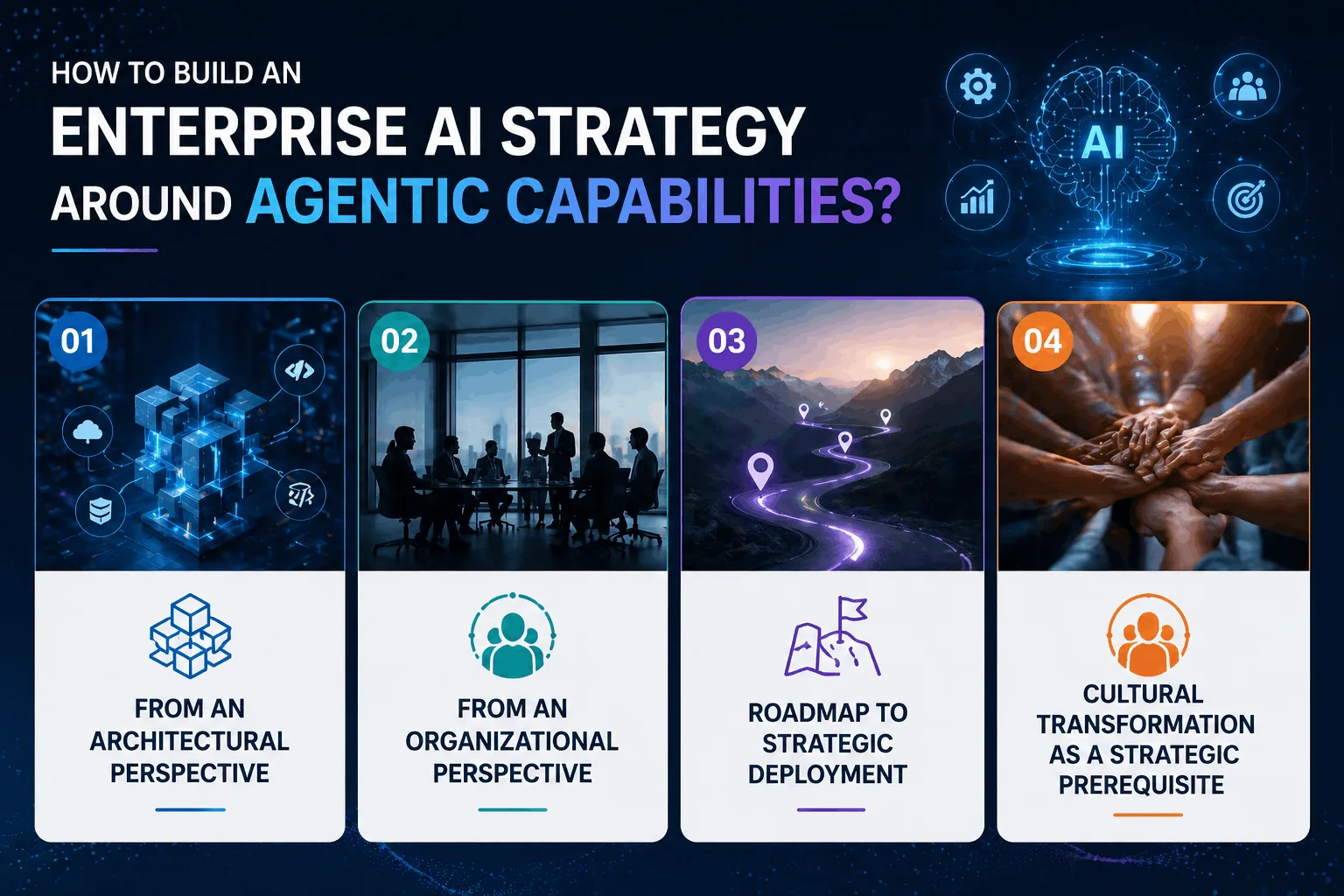
Roadmap to Strategic Deployment
Translating strategic intent into operational reality requires a disciplined implementation roadmap structured around four sequential but overlapping horizons.
The foundation horizon,
Typically spanning the initial six months of serious organizational engagement, the focus is on capability assessment, infrastructure readiness evaluation, and the selection and execution of two to three high-visibility pilot deployments in process domains where the value proposition is clear, the data foundations are adequate, and the governance requirements are manageable. The objective of this horizon is not the generation of financial returns at scale but the development of organizational learning and the demonstration of proof points that command executive confidence.
The scaling horizon,
Spanning months six through eighteen, focuses on applying the institutional knowledge and governance architecture developed during the foundation phase to a progressively broader portfolio of agent deployments across multiple functional domains. This horizon requires deliberate attention to cross-functional coordination: as AI agents begin to operate across organizational boundaries, the governance and escalation protocols that manage inter-agent handoffs and human-agent interactions become critically important.
The integration horizon,
Spanning the second and third years of the program, this focus on the orchestration of AI agent ecosystems that operate across the enterprise's end-to-end value chain, with seamless data flow, coordinated decision logic, and unified governance across what will by this point be a substantial and complex portfolio of deployed agentic systems.
The optimization horizon,
A permanent organizational capability for monitoring, improving, and evolving the enterprise's agentic AI infrastructure in response to changing business requirements, technological advances, and the iterative learning that deployed agents generate.
Cultural Transformation as a Strategic Prerequisite
No element of an agentic AI strategy is more frequently underweighted in executive planning than organizational culture. The transition from a human-orchestrated to an AI-orchestrated operating model requires meaningful shifts in how leaders, managers, and individual contributors conceptualize their roles, their authority, and their relationship to decision-making.
Leaders must cultivate organizational cultures that embrace data-driven accountability, are comfortable delegating execution authority to autonomous systems within defined parameters, and maintain the critical judgment required to identify when AI systems are operating outside acceptable boundaries. This is not a cultural disposition that emerges spontaneously from technology deployment. It requires deliberate investment in change management, leadership development, and the ongoing, transparent communication of the purpose, scope, and safeguards of agentic AI programs to all organizational stakeholders.
How Antino Can Transform Your Enterprise in the Era of Agentic AI?
Antino occupies a distinctive position in the agentic AI landscape, a leading AI consulting & Digital transformation partner with the engineering depth to architect and build production-grade agentic systems and the enterprise consulting acumen to translate complex AI capabilities into aligned, governance-embedded business transformation programs. For C-suite leaders navigating the transition from conventional AI adoption to agentic enterprise architecture, this combination of technical and strategic capability is not merely convenient. It is essential.
Antino's approach to enterprise agentic AI transformation is structured around the principle that sustainable value creation requires simultaneous investment across three dimensions: technological architecture, governance and risk management, and organizational capability.
Antino's engagement model is designed for enterprises that understand this urgency and are prepared to invest with the strategic intent, governance discipline, and organizational commitment that transformative technology programs demand.
From that foundation, Antino delivers the full spectrum of engagement required to translate the strategic roadmap into operational reality: architecture design, engineering execution, governance framework development, pilot deployment, scaling support, and the continuous optimization that deployed agentic systems require to sustain and expand their value contribution over time.
The Strategic Imperative is Now
Agentic AI is not a future consideration for enterprise leadership. It is a present-tense strategic imperative whose urgency is compounded by the path-dependent nature of the advantages it confers on early, deliberate movers. The organizations that will lead their industries in 2030 are not waiting for the technology to mature further or for the competitive landscape to provide clearer signals. They are building the architectural, governance, and organizational foundations of agentic enterprise capability today.
The transition from AI-augmented to AI-orchestrated enterprise operations is neither instantaneous nor risk-free. It requires strategic clarity, governance discipline, institutional commitment, and the right implementation partnership to navigate its complexity and unlock its full potential. But for enterprises that engage with the requisite seriousness and structured intent, the rewards are not incremental. They are structural, compounding, and decisive.
The question for enterprise leadership is not whether to engage with agentic AI. That question has been answered by the technology, by the competitive dynamics, and by the experience of organizations that have already begun the journey. The question is whether your organization will lead that journey or spend the following decade attempting to close the gap with those that did.
To explore how Antino can partner with your organization on its agentic AI transformation journey, contact our enterprise advisory team.