
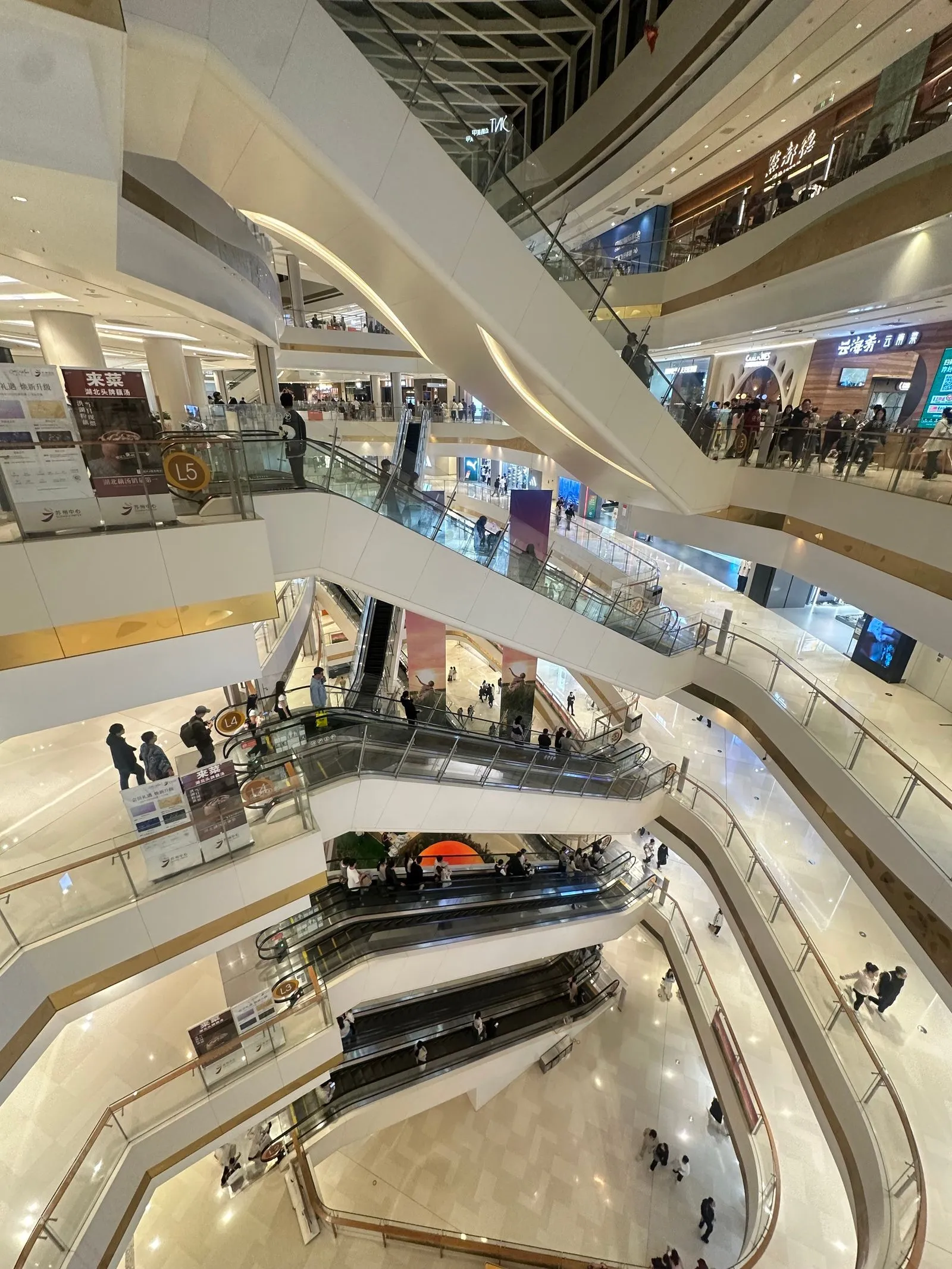
In the United States, the evolution of shopping malls is no longer just about retail, it has also become about experience, engagement, and intelligence. With more than 900 active shopping malls nationwide attracting millions of visitors annually, traditional brick-and-mortar destinations are battling shifting consumer preferences and rising digital expectations.
Today’s consumers are blending browsing with dining, entertainment, socializing, and convenience-driven digital interactions. Over 80% of shoppers visit malls at least once a month, and more than 45% use mobile devices to browse or purchase while on-site, underscoring the convergence of physical and digital behavior.
Meanwhile, mall foot traffic fluctuates with broader retail trends, and operators face heightened pressure to differentiate their offerings. As US malls reinvent themselves with vibrant experiences and omnichannel touchpoints, one force stands out as a game-changer, and that is Artificial Intelligence.
- What if you could unlock real-time insights into shopper behavior and preferences?
- What if predictive analytics could optimize tenant mix, targeted promotions, and spatial layout to drive higher dwell time and sales?
- And what if AI could help you transform a mall from a collection of individual stores into a dynamic, personalized destination?
Well, AI is becoming a strategic imperative for mall operators looking to de-risk expansion plans, uncover new revenue streams, and strengthen tenant performance. Advanced technologies such as footfall analytics, predictive consumer insights, and AI-driven layout optimization are beginning to reshape decision-making and execution across the industry.
For US CEOs and commercial leaders, the question is how quickly and effectively they will harness AI to redefine the future of retail environments.
5 Trends Reshaping the U.S. Shopping Mall Industry
As mall operators look ahead, five powerful trends are redefining how physical retail spaces compete, connect with consumers, and unlock new value. For US CEOs and commercial leadership teams, understanding and acting on these forces is strategic.
1. Demographic Shifts With Digital Natives & Multi-Generational Demand
The face of mall shoppers is changing fast. Younger generations, especially Gen Z and Millennials, are blending online and in-person shopping with social and lifestyle behavior. Nearly 60% of mall visitors in the U.S. are Millennials or Gen Z, underscoring that digital-native cohorts still value physical destinations when they deliver experiences that feel rewarding and social.
Gen Zs stay longer and engage more. One study shows Gen Z visitors dwell ~15% longer than older generations, often prioritizing entertainment, social connection, and discovery over pure transaction.
This has big implications for tenant mix, layout design, and digital engagement strategies. Malls that remain “just retail” risk alienating the very customers driving tomorrow’s spending.
2. New Commercial Relationships Through Experience-Driven Ecosystems
Traditional lease contracts, where tenants pay rent and that’s it, are giving way to performance-oriented partnerships. Today’s mall environment increasingly blends:
- Entertainment zones (cinemas, event spaces, live performances)
- Community assets (coworking spaces, libraries, fitness centers)
- Food & beverage ecosystems (gourmet halls, craft markets)
This shift helps malls drive redeployed footfall into longer visits and deeper spend. Statistics show that malls that add experiential tenants see ~30% higher visitation and repeat customers than traditional retail anchors.
Digital technology is also enabling this change. When landlords and tenants can share performance data transparently, they co-create value and jointly reap the benefits.
3. Digitally Driven Interactions
Today’s shoppers don’t live in silos. They research online, browse in-store, order via mobile, and pick up at a kiosk, often in the same visit. For instance, omnichannel engagement now accounts for more than 55% of Gen Z’s holiday shopping behavior, demonstrating how integrated experiences drive real conversions.
This means mall operators must invest not just in physical space, but in digital-physical integration, from seamless mobile navigation apps to real-time inventory and fulfillment infrastructure supporting services like Buy Online, Pick Up In Store (BOPIS). Facilities that enable this blend see customers make additional purchases 45% of the time upon pickup.
For US CIOs and tech leaders, powering omnichannel is a core operational requirement.
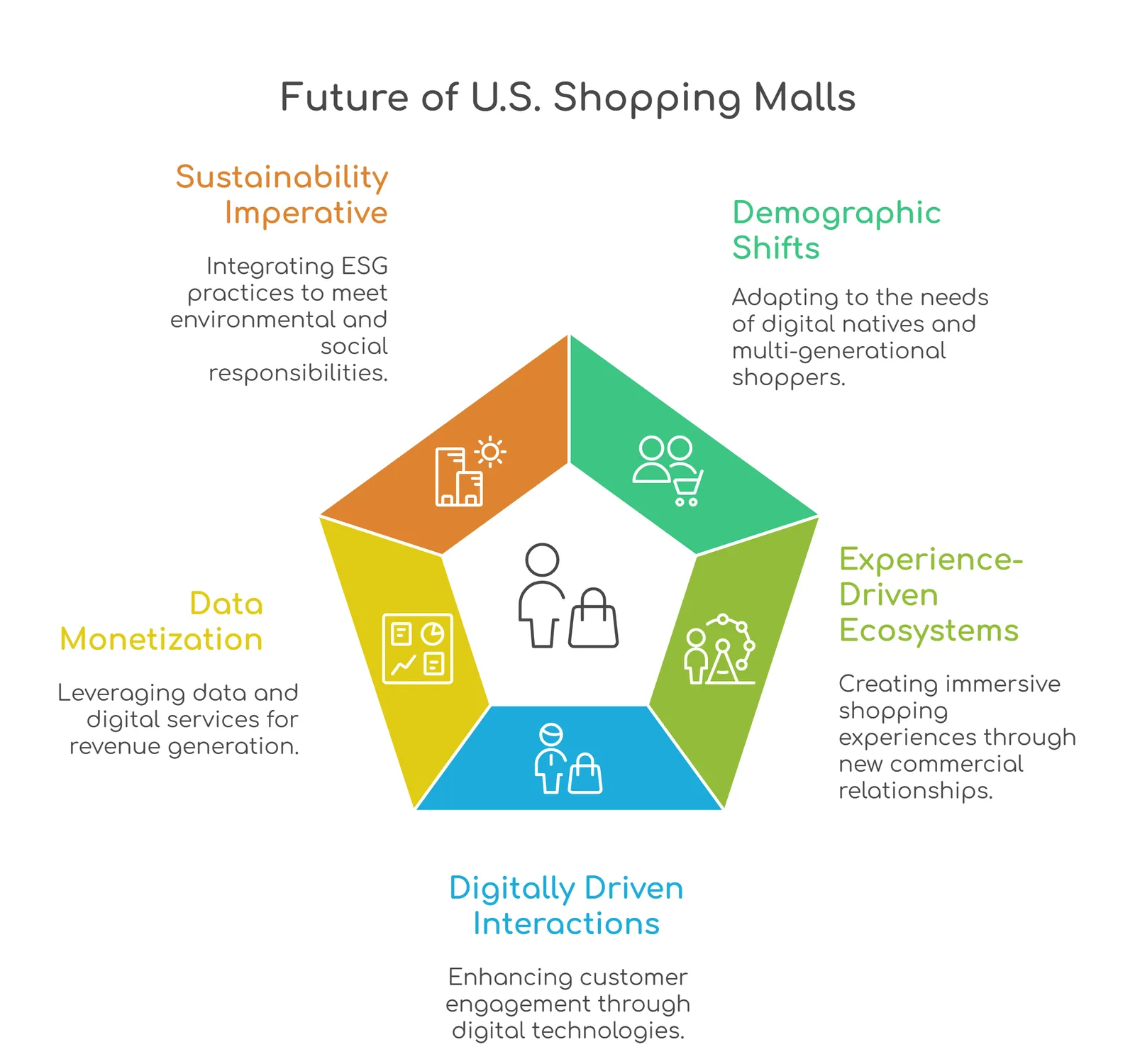
4. Monetizing Data & Digital Services
AI and digital tools are redefining what a mall is, shifting it from a static property to a dynamic, data-driven ecosystem.
Beyond improving tenant curation and layout optimization, AI unlocks new monetization opportunities such as:
- Selling anonymized footfall insights to retailers
- Targeted digital promotions via loyalty platforms
- Programmatic ad space on mall digital displays
As more malls adopt digital analytics platforms, the value of customer intelligence rises. Recent retail tech data shows widespread AI adoption, with 87% of retailers using AI in at least one domain and 80% planning further automation by 2025.
For mall COOs and strategy teams, this signals a shift from revenue solely via leases to a diversified mix of digital and service-based income streams.
5. The Sustainability Imperative With ESG as a Norm
Sustainability is a business driver. Today’s investors, tenants, and consumers expect environmental accountability as part of brand value.
Malls that invest in digital systems to monitor energy use, emissions, and waste not only reduce costs, but they also attract tenants and visitors who favor eco-responsible brands. Integrated sustainability tech also supports reporting transparency and operational resilience, traits increasingly tied to long-term valuations.
Notably, malls with sustainability features tend to see higher visit rates and customer loyalty, validating that green initiatives can fuel returns and reputation.
What This Means for U.S. Shopping Mall Leaders?
For leadership teams in the U.S., these trends converge into a clear strategic mandate:
- Reimagine mall ecosystems as digital-physical hybrids
- Invest in AI and analytics to unlock data arbitrage
- Transform tenant partnerships into shared-value collaborations
- Design with experience, community, and sustainability at the center
The malls that thrive in the next decade will be those that treat visitors not as shoppers, but as engaged participants in a lifestyle experience, supported by technology, powered by insights, and anchored in meaningful value creation.
How Is AI Redefining Decision-Making for Mall Leadership?
Understanding the forces reshaping shopping malls is only the first step. The real differentiator for U.S. mall operators over the next decade will be how effectively leadership teams convert insight into action, and this is where AI begins to fundamentally change decision-making.
Historically, mall leadership relied on lagging indicators like monthly footfall reports, quarterly tenant performance, and annual lease reviews. In a market shaped by volatile consumer behavior and omnichannel competition, that cadence is no longer sufficient.
AI enables real-time, forward-looking decisions.
For example, AI-powered footfall analytics can now predict peak traffic patterns days or weeks in advance, allowing operators to:
- Adjust tenant placement dynamically
- Schedule events when incremental footfall impact is highest
- Optimize staffing, security, and energy usage.
Malls using advanced analytics have reported up to 15–20% improvements in space utilization efficiency and measurable gains in tenant sales performance, not by expanding footprint, but by making smarter, faster decisions.
A Shift in the C-Suite Playbook
For CEOs and COOs, AI is less about automation and more about decision velocity.
Instead of asking:
“What happened last quarter?”
Leadership teams can ask:
- Which zones will underperform next month, and why?
- Which tenant categories are likely to benefit from experiential adjacencies?
- Which customer segments are at risk of attrition, and how do we re-engage them in-mall?
This shift allows mall operators to move from reactive asset management to predictive portfolio optimization.
Smarter Tenant Strategy Through AI
Tenant mix has always been a critical lever, but AI changes how it’s optimized.
By combining:
- Foot traffic data
- Dwell time analysis
- Conversion heatmaps
- Customer demographic patterns
Operators can identify which tenants benefit from proximity, which cannibalize demand, and which underperform due to layout, not brand strength.
This intelligence supports data-backed renegotiations, performance-linked leases, and shared growth models for strengthening landlord-tenant relationships while protecting long-term revenue.
Why Does This Matter Now?
U.S. malls are no longer competing only with neighboring centers, they are competing with every digital experience that offers convenience, personalization, and immediacy.
AI helps mall leadership:
- Reduce risk in capital planning
- Improve ROI on experiential investments.
- Create defensible differentiation through intelligence, not just infrastructure.
The winners will not be the malls with the largest footprints, but those with the sharpest insights and fastest execution loops.
AI Use Cases Every Mall Owner Should Be Piloting Today
For mall owners, AI is no longer an abstract innovation agenda; it’s a leadership lever. The most progressive mall operators in the U.S. are not asking if AI belongs in their strategy, but where to pilot it first to drive measurable outcomes.
Below are AI use cases that are delivering tangible value today and are increasingly becoming table stakes for competitive mall portfolios.
1. AI-Powered Footfall Intelligence & Layout Optimization
Footfall data alone is no longer enough. AI takes raw traffic data and converts it into predictive insights by identifying not just where people go, but why, how long they stay, and what triggers conversion.
What leaders gain?
- Forecast peak and low traffic periods
- Identify underperforming zones caused by layout, not demand.
- Optimize tenant adjacency to increase dwell time and spend
Real-world example
Large U.S. mall operators like Simon Property Group use advanced analytics platforms to understand traffic flows and shopper behavior across assets. These insights help guide leasing decisions, anchor placements, and capital investments by improving space productivity without expanding footprint.
Why does it matter?
AI-led layout optimization can improve sales density and space utilization by double-digit percentages, turning real estate decisions into data-backed growth strategies.
2. AI-Driven Tenant Mix & Performance Forecasting
Tenant selection has traditionally relied on historical sales, brand reputation, and intuition. AI augments this by modeling future performance scenarios based on demographic fit, traffic patterns, and category demand shifts.
What leaders gain?
- Predict which tenant categories will outperform in specific zones.
- Reduce vacancy risk by forecasting tenant success before onboardin.g
- Enable performance-linked lease models with confidence.
Real-world example
Unibail-Rodamco-Westfield (URW) has publicly emphasized data and digital intelligence as a core pillar of its asset strategy, using analytics to curate tenant mixes aligned with local consumer behavior across its U.S. and global portfolio.
Why does it matter?
This moves malls from reactive leasing to predictive asset management, protecting NOI while strengthening tenant partnerships.
3. Personalized Shopper Engagement & Loyalty Intelligence
Generic promotions are losing impact. AI enables malls to act like digital platforms by offering personalized, real-time engagement based on shopper behavior and preferences.
Use cases include
- AI-powered loyalty apps recommending stores, dining, or events
- Personalized offers triggered by location, visit frequency, or past spend
- Predictive churn models identifying at-risk customer segments
Real-world example
Several U.S. lifestyle centers and malls have adopted AI-enabled loyalty ecosystems that integrate parking, dining, retail, and events to increase repeat visits and average dwell time while giving operators first-party customer data.
Why does it matter?
Personalization increases engagement, but more importantly, it gives mall operators direct relationships with shoppers, reducing dependence on tenants for customer insights.
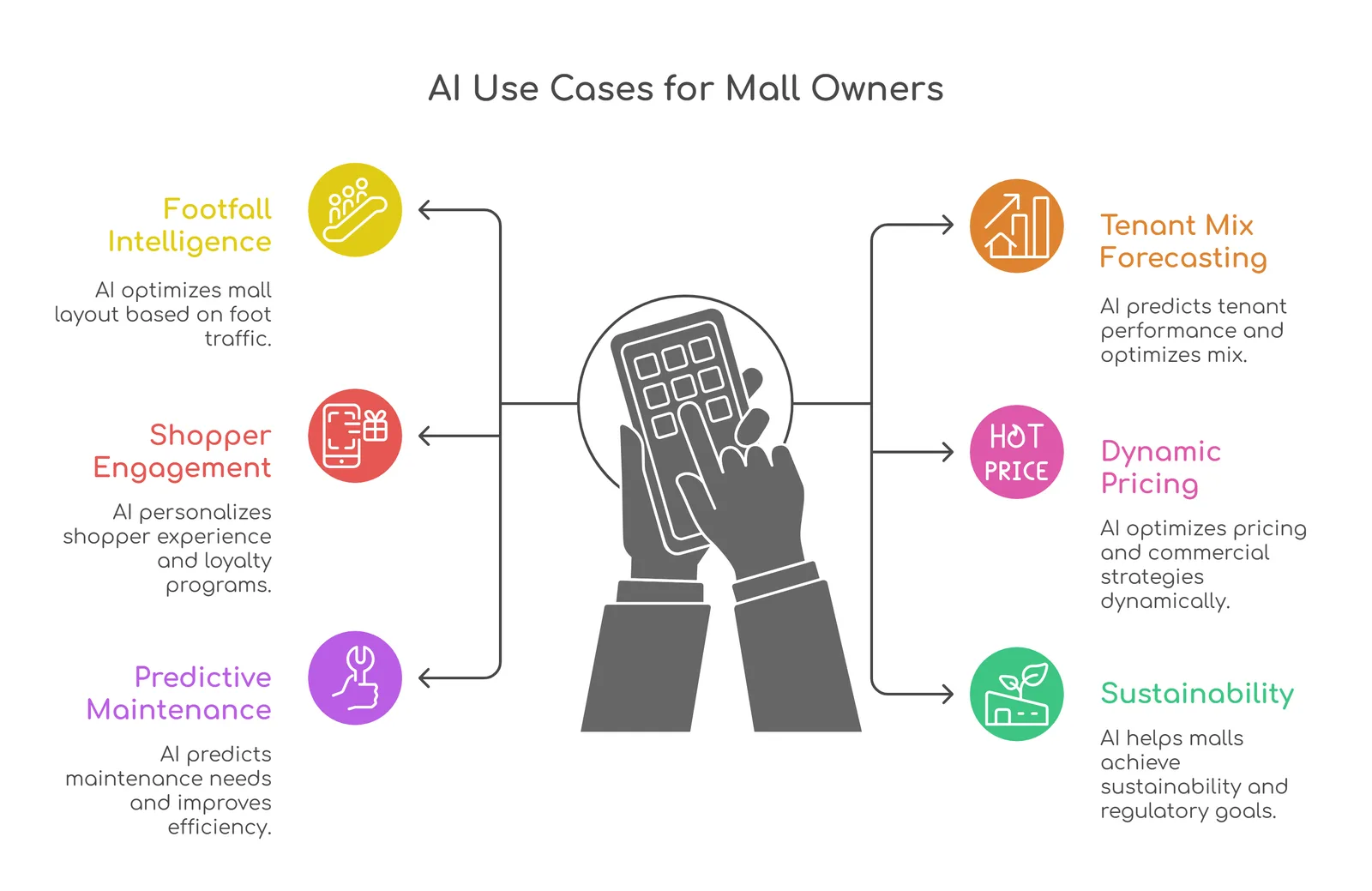
4. AI-Enabled Dynamic Pricing & Commercial Optimization
AI can analyze demand patterns to optimize:
- Short-term leasing
- Pop-up pricing
- Advertising inventory on digital screens
- Event sponsorships
What leaders gain?
- Monetize underutilized space dynamically
- Price assets based on demand, not static assumptions
- Unlock new, non-rent revenue streams.
Real-world example
Leading malls in the U.S. are increasingly treating digital out-of-home (DOOH) advertising as a programmatic asset, using AI to optimize pricing and placement based on audience demographics and time of day.
Why does it matter?
This diversifies revenue beyond leases, which is a critical resilience factor during retail cycles.
5. Predictive Maintenance & Operational Efficiency
AI-driven facilities management uses sensor data and machine learning to predict equipment failures before they occur.
What leaders gain?
- Reduced downtime for escalators, HVAC, and elevators
- Lower maintenance costs through proactive interventions
- Improved shopper experience and tenant satisfaction
Real-world example
Large mixed-use developments in the U.S. have implemented AI-powered building management systems that optimize energy usage and maintenance schedules for delivering cost savings while supporting sustainability goals.
Why does it matter?
Operational reliability directly impacts brand perception, safety, and ESG performance, areas increasingly scrutinized by investors.
6. AI for Sustainability, ESG & Regulatory Readiness
AI helps malls track and optimize:
- Energy consumption
- Carbon emissions
- Waste management
- Water usage
What leaders gain?
- Real-time ESG dashboards across assets
- Data-backed sustainability reporting
- Reduced operating costs through energy optimization
Real-world example
Several REIT-owned malls now use AI-enabled energy platforms to monitor emissions and share performance data with tenants, aligning sustainability goals across the ecosystem.
Why does it matter?
Sustainability influences tenant selection, investor confidence, and consumer loyalty.
In an era where malls compete with both digital platforms and experiential destinations, intelligence becomes the ultimate differentiator. The question for mall owners is no longer “Should we adopt AI?”, but “Which AI capability gives us an unfair advantage first?”
Building the AI-Ready Mall With Data, Talent & Governance
AI success in shopping malls is built on organizational readiness. Many mall operators experiment with AI pilots but struggle to scale them because foundational elements are missing. For leadership teams, the priority is not adopting more tools, but building the right operating model to support AI at enterprise scale.
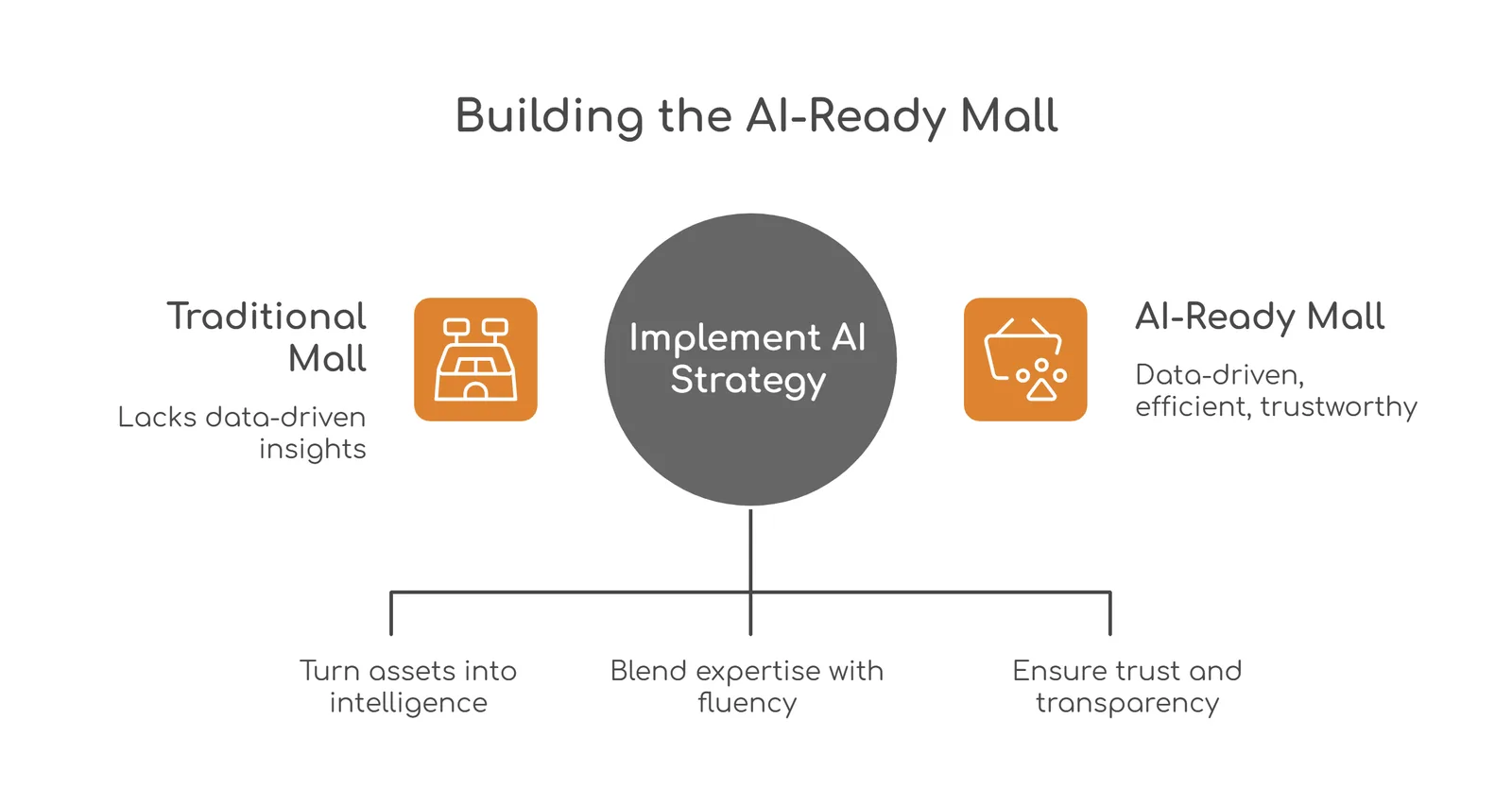
1. Turning Physical Assets into Intelligence Assets
Malls generate enormous volumes of data every day, from foot traffic and parking usage to tenant sales, energy consumption, and digital engagement. The challenge is that this data often sits in disconnected systems.
What AI-ready leaders do differently?
- Integrate physical and digital data into a unified platform.
- Treat data as a shared enterprise asset, not a departmental resource
- Prioritize data quality, governance, and interoperability.
When data flows across leasing, operations, marketing, and facilities, AI can uncover patterns that humans cannot by enabling faster and more confident decisions.
The most advanced mall operators are shifting from property-centric thinking to data-centric portfolio management, where insights drive everything from capital planning to tenant negotiations.
2. Blending Domain Expertise with Digital Fluency
AI does not eliminate the need for human judgment because it elevates it. However, this requires teams that understand both retail real estate dynamics and data-driven decision-making.
Critical talent shifts
- Upskilling commercial and operations teams to work with AI insights
- Embedding analytics translators who bridge business and technology
- Partnering with external AI specialists while building internal ownership
Rather than creating large in-house AI teams, many mall operators succeed by forming lean centers of excellence that guide use cases, standards, and scaling.
3. Trust, Transparency & Responsible AI
For mall leadership, AI governance is about risk management and trust, not bureaucracy. AI systems influence leasing, pricing, security, and customer engagement, making governance essential.
Key governance priorities
- Clear ownership of AI decisions and outcomes
- Transparent models that can be explained to tenants and regulators
- Strong data privacy and cybersecurity frameworks
Good governance ensures AI strengthens relationships with tenants, shoppers, and investors, instead of eroding confidence.
How Mall Leaders Can Justify AI Investments?
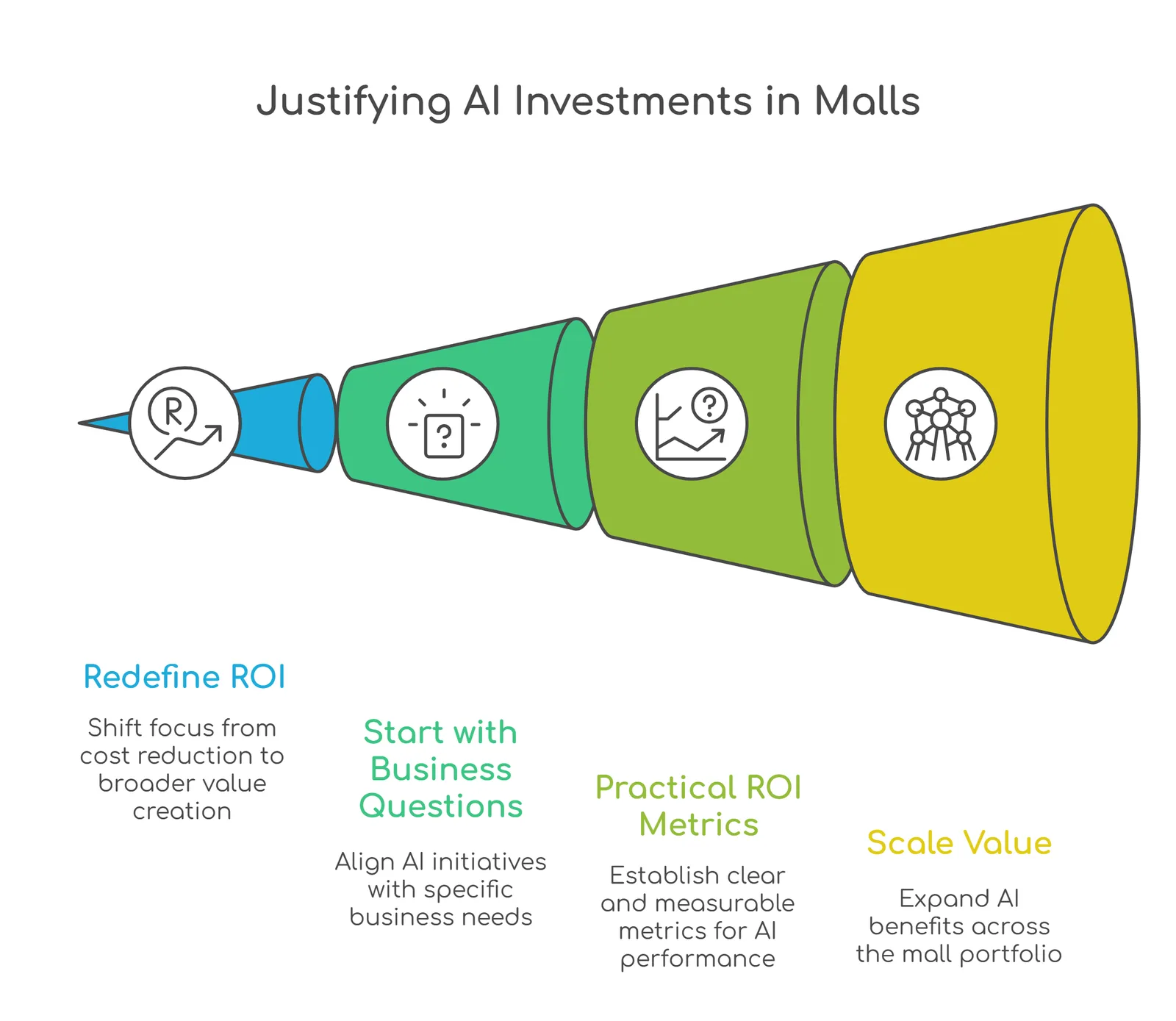
AI investments often fail because value isn’t measured in ways that leadership and boards recognize. Successful mall operators reframe ROI beyond cost savings to include growth, resilience, and strategic optionality.
1. Redefining ROI Beyond Cost Reduction
Traditional ROI focuses on expense reduction. AI’s impact in malls is broader:
- Increased tenant sales and lease renewal rates
- Higher dwell time and repeat visitation
- Reduced vacancy and better space productivity
- New digital and data-driven revenue streams
These outcomes directly influence net operating income (NOI) and long-term asset valuation. AI ROI should be linked to asset performance metrics, not IT budgets.
2. Start with Business Questions, Not Technology
The strongest AI business cases start with leadership questions such as:
- Where are we losing revenue due to poor space utilization?
- Which tenant categories will drive growth in the next 24 months?
- How do we increase weekday footfall without capital expansion?
AI becomes the means to answer these questions.
Best practice
- Tie each AI initiative to one or two executive KPIs
- Define success before deployment.
- Pilot in high-impact zones before scaling
3. Practical ROI Metrics
Mall leaders tracking AI ROI focus on metrics that resonate at the board level:
Revenue & growth
- Sales per square foot
- Advertising and digital monetization revenue
- Event-driven incremental footfall
Operational efficiency
- Maintenance cost reduction
- Energy optimization savings
- Staffing efficiency
Risk & resilience
- Vacancy risk reduction
- Faster leasing cycles
- Improved forecasting accuracy
These metrics provide a balanced ROI narrative.
4. Scaling Value Through Portfolio Thinking
AI returns compound when deployed across multiple assets. A pilot that improves tenant performance in one mall becomes exponentially more valuable when scaled across a portfolio.
This portfolio-level view is what enables:
- Shared insights across properties
- Consistent tenant experiences
- Stronger negotiating power with retailers and partners
For US mall leaders, the question is no longer “Can we afford AI?” It is “Can we afford to operate without intelligence in a market defined by speed, personalization, and experience?”
How Antino Helps Mall Operators Transform with AI?
Transforming a shopping mall with AI requires a partner who understands real estate economics, consumer behavior, and enterprise-scale execution. This is where Antino plays a decisive role that provides custom AI development solutions catering to businesses edge requirements.
Antino works with mall operators to reimagine physical retail spaces as intelligent, data-driven ecosystems. Our approach starts by aligning AI initiatives with leadership priorities, whether that is improving asset performance, strengthening tenant relationships, unlocking new revenue streams, or future-proofing portfolios against shifting consumer behavior.
Rather than offering off-the-shelf solutions, Antino designs custom AI frameworks tailored to each mall’s footprint, tenant mix, and regional demographics. From AI-powered footfall intelligence and layout optimization to predictive tenant performance models and personalized shopper engagement platforms, our solutions are built to solve real operational and commercial challenges, not just demonstrate innovation. So, contact our AI experts right away!