
Your AI demo went well. Everyone saw the potential. So why is your team still doing the same work manually 3 months later?
Maybe the assistant cannot access the right documents.
Maybe it gives a useful answer, but someone still has to copy it into the CRM.
Or perhaps people tried it twice, found a mistake, and went back to the process they trusted.
Who owns fixing that?
If you are struggling to answer, it is worth understanding what a forward deployed engineer does before opening another AI role.
OpenAI and Anthropic both advertise FDE positions that involve building directly with customers. On October 2, 2026, Anthropic also announced a $100 million commitment to Claude Frontier Academy, with a goal of training 10,000 Frontier Deployed Engineers by the end of 2027. This is a training programme for engineers, rather than an announcement of 10,000 jobs at Anthropic.
There is a good reason to pay attention. McKinsey’s 2026 State of AI survey found that 80% of respondents said AI improved their individual productivity. Only 37% reported a positive impact on their organisation’s earnings before interest and taxes. The research covered 1,719 people across 97 countries.
You might recognise that gap. People are getting useful answers, but the business process still takes too long.
This guide looks at how to hire forward-deployed engineers for that problem. We will cover costs, interviews, skills, and responsibilities, along with a few practical ways to judge whether a deployment is actually helping.
What Is a Forward Deployed Engineer?
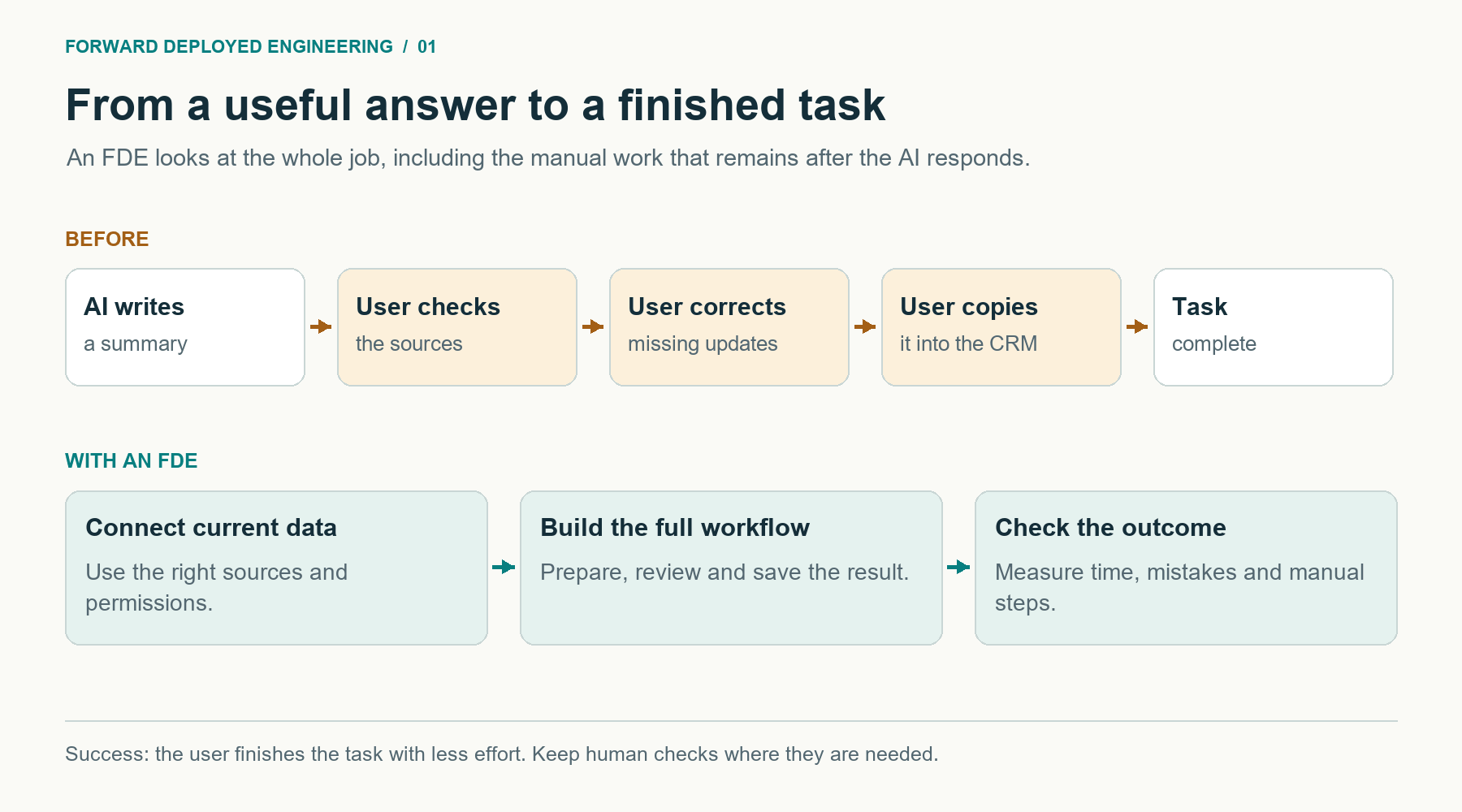
A forward deployed engineer is a software engineer who works closely with customers or internal business teams to build and deploy technology around the way they work. In AI projects, that can mean connecting data, adapting an application, testing its answers, and helping people use it in a live workflow.
They spend time with the people facing the problem. Then they write the code needed to solve it.
That proximity matters. A requirement that sounds straightforward in a planning meeting can look quite different when you sit beside the person doing the task.
What does an FDE do that an AI engineer might not?
Imagine your sales team wants an assistant that prepares account briefs before customer calls. This is an illustrative scenario.
Your AI engineer builds a system that searches documents, summarises account information, and returns a readable brief. They test the model, improve retrieval, and make the application available.
Then the sales team tries it.
“This says the implementation is complete. The customer told me yesterday that two issues are still open.”
The summary may accurately reflect the CRM. The problem is that CRM does not tell the whole story.
An FDE investigates where the missing information lives. They speak with delivery, connect the issue tracker, establish which records take precedence, and add links so the salesperson can check the evidence. They also work out what should happen when two systems disagree.
| Question | Typical AI engineering focus | Typical FDE focus |
| Does it answer correctly? | Model behaviour and evaluation | Accuracy in the customer’s situation |
| Can it access the information? | Retrieval and data services | Actual records, permissions, and ownership |
| Does it fit the job? | Application functionality | The steps a user takes before and after |
| Is it working? | Technical performance | Technical performance and useful completion |
The roles overlap. Plenty of AI engineers do this work too. What changes is who is explicitly responsible for carrying the solution through the customer’s day.
What exactly does a Forward Deployed Engineer do?
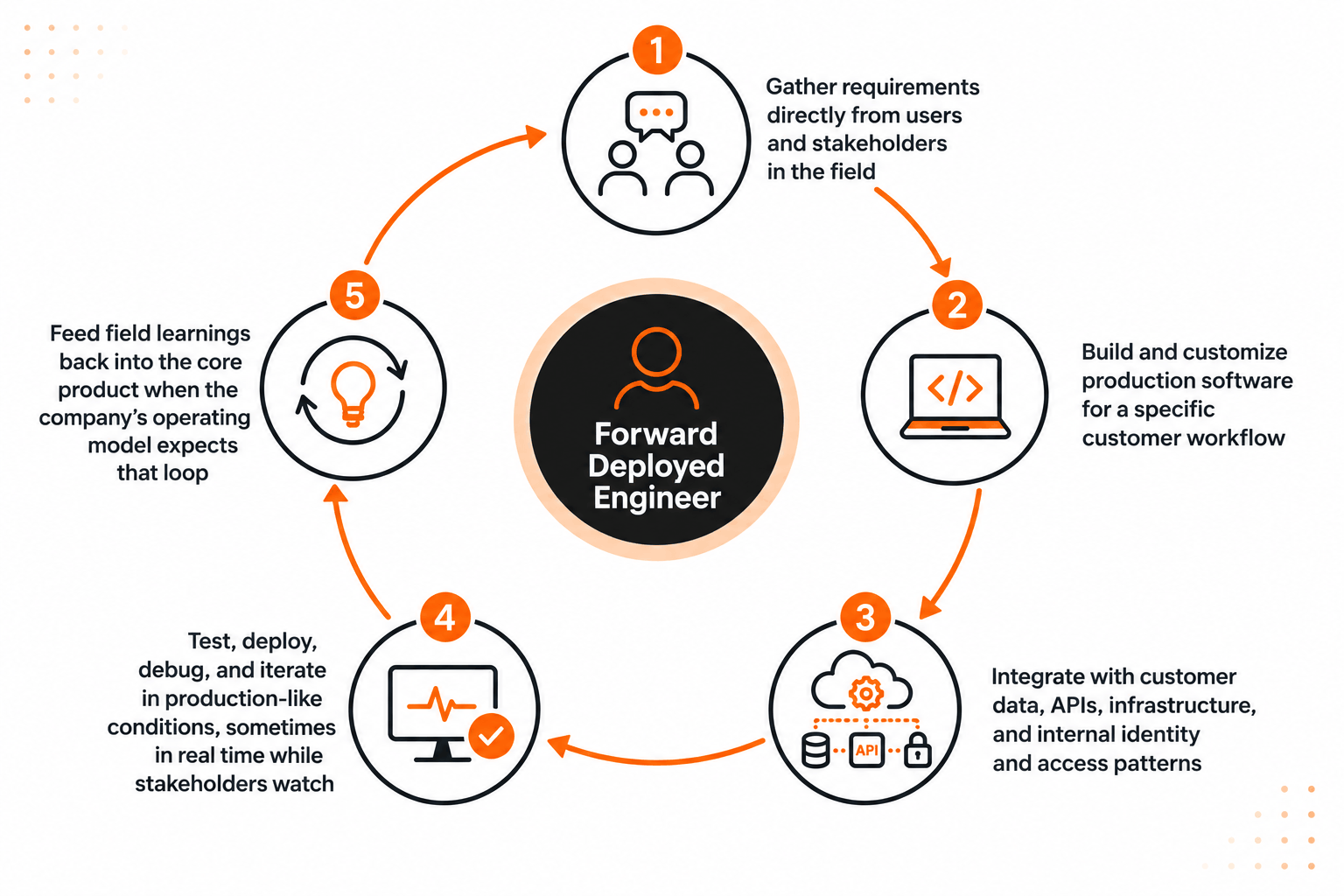
A Forward Deployed Engineer works directly with customers to turn operational requirements into working software within their technical environment.
1. Translate field requirements into technical specifications
Work with users and stakeholders to understand workflows, identify constraints, and define implementation requirements.
2. Build software for customer workflows
Develop and customize production software that addresses specific operational needs and fits the customer’s existing processes.
3. Integrate with the customer’s technology stack
Connect applications to customer data, APIs, and infrastructure while aligning with identity management and access controls.
4. Test, deploy, and troubleshoot
Validate software in production-like environments, debug issues, and iterate on implementations, sometimes alongside stakeholders in real time.
5. Feed implementation insights back into the product
Where the operating model supports it, translate field findings into reusable improvements that inform core product development.
How Much Does a Forward Deployed Engineer Cost?
The honest answer depends on what you expect the person to own.
Connecting one application to an existing platform is a different job from leading deployments across several enterprise customers. Location, seniority, travel, industry knowledge, and production support all affect the price.
For a published reference, OpenAI’s Seattle FDE listing showed an annual base salary of $185,000 to $300,000, plus equity, when checked on October 14, 2026. That is one company’s range for one location. It is not an average for all FDE engineers.
If you are hiring in India, compare current local offers and partner proposals against the same responsibilities. A converted US salary will tell you very little about what your particular role should cost.
Look beyond the salary
You will also need to budget for hiring, onboarding, benefits, travel where required, cloud and model usage, and support from your existing teams. Ask who will maintain the application after the first release.
A lower monthly quote can become expensive if your own engineers spend weeks filling gaps that were never included in the scope.
Common Mistakes to Avoid When Hiring FDEs
Here are some of the mistakes hiring managers typically make when seeking FDEs.
Being impressed by a demo without asking what happened next
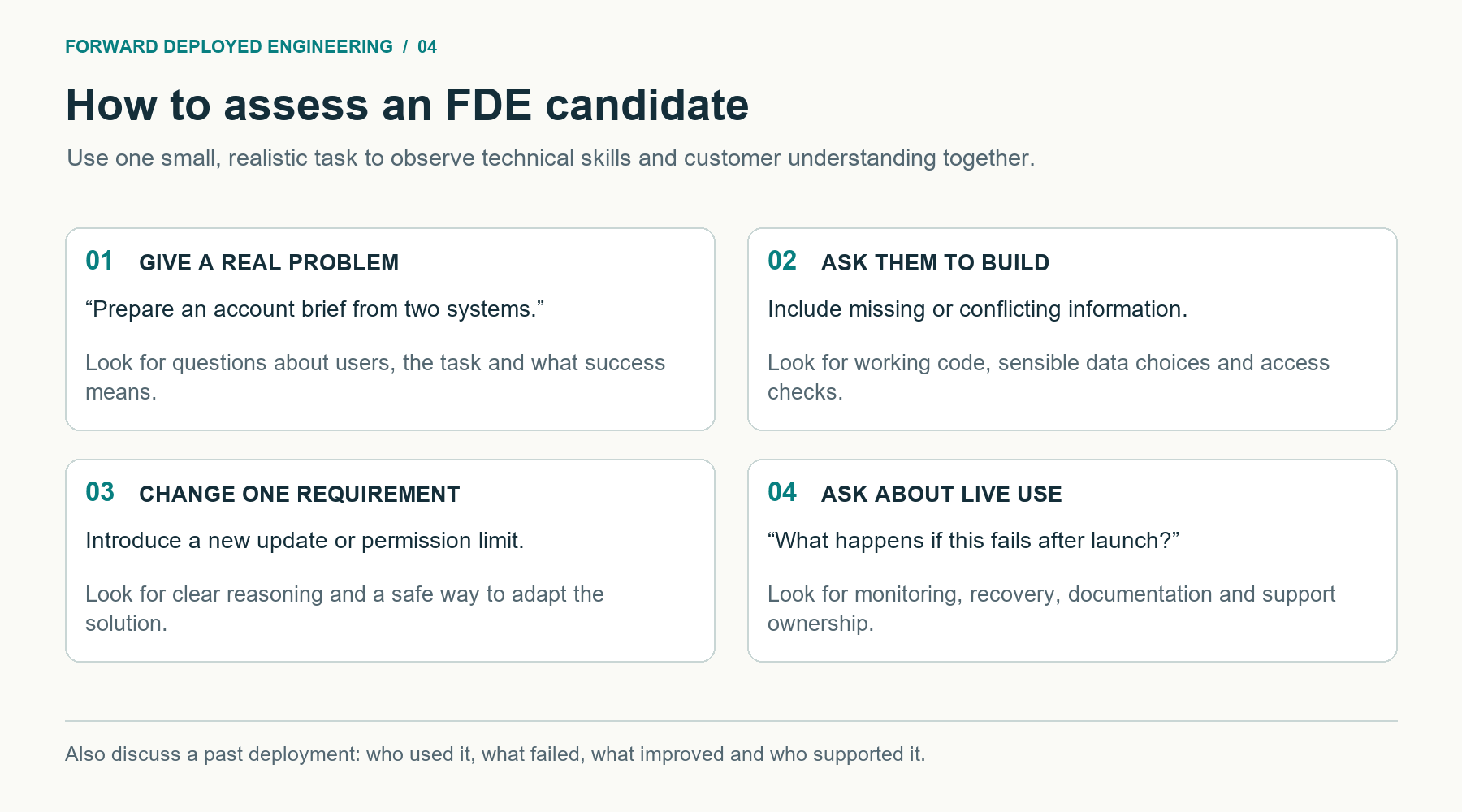
Ask the candidate who used the application after launch. What did users stop doing manually? What still needed checking? Who dealt with failures?
Someone who has lived through a deployment should be able to discuss the awkward parts without turning every answer into a success story.
Assuming a confident speaker understands the customer
Discovery is mostly about listening carefully. Give a candidate a vague request such as “we need an AI assistant for operations”. See whether they ask about the task, the people involved, the current delay, and the information available.
If they immediately recommend a model and a framework, bring them back to the problem.
Hiring someone before giving them access to decisions
An engineer can identify a conflicting business rule. They cannot always decide which rule the company should follow.
Name the person who can settle disagreements about data, permissions, and process. Otherwise, you can hire an excellent FDE and still spend a month waiting for someone to approve the next step.
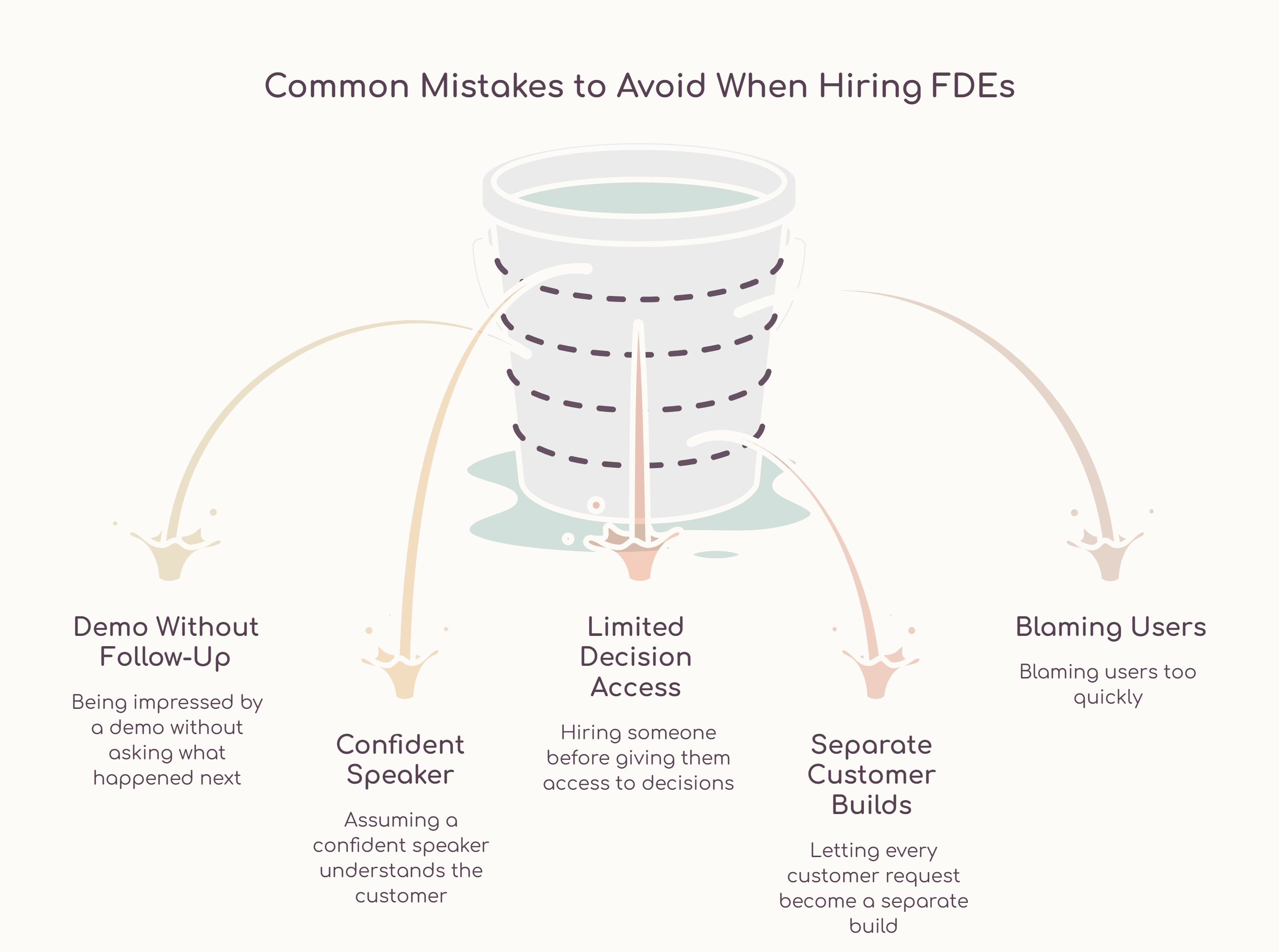
Letting every customer request become a separate build
Some customisation is necessary. But if every deployment creates another application that only its original engineer understands, your support burden will keep growing.
Ask candidates how they decide what belongs in the shared product and what should remain specific to one customer. Look for examples of both decisions.
Blaming users too quickly
“People are resistant to change” can become an easy explanation for low adoption. Sometimes the new tool takes longer, opens in the wrong place, or makes users check information they previously trusted.
An FDE should investigate those possibilities before recommending another training session.
What Does It Take to Hire a Forward Deployed Engineer?
Start with one workflow. You do not need a job description covering every possible AI use case.
Write down the problem in everyday language
“Our account managers spend Friday afternoon collecting updates from three teams” is a useful starting point. It tells you who is affected and where to investigate.
Then establish the baseline. How long does the task take? Where do mistakes happen? Who uses the result? What would make the new process acceptable?
Be clear about the working arrangement
Explain how much coding, customer interaction, travel, and support the role involves. Specify whether the FDE will work on one account or several, and who helps with infrastructure and security.
This avoids a familiar mismatch where you hire a strong engineer who expects product development and finds themselves in customer meetings all week.
Look beyond people who already have the title
A founding engineer or a software engineer with substantial customer ownership may be a strong candidate. Anthropic’s FDE posting considers software engineers with consulting or product experience and encourages former technical founders to apply.
Look for evidence that the person can build, explain, investigate, and stay with a problem through deployment.
Core Technical Skills to Look For in a Forward Deployed Engineer
Can they build something that works with your systems and keep it running when conditions change? These questions can help you assess their technical depth.
| Technical skill | What to look for | What to ask in the interview |
| Software engineering and debugging | Experience building maintainable software using your technology stack. Look for practical knowledge of APIs, databases, version control, testing and error handling. | “Tell us about a production issue you diagnosed. What did you investigate first, and how did you confirm the fix worked?” |
| AI application development | For AI-focused roles, experience with retrieval-augmented generation, tool calling, structured outputs and agent workflows. They should recognise when a simpler solution is sufficient. | “Which part of a recent project did you decide should not use AI, and why?” |
| AI evaluation and failure handling | Ability to test against real customer scenarios, detect unsupported answers, identify outdated information and define when human review is needed. | “The answer sounds correct but comes from an outdated document. How would you catch that before a customer reports it?” |
| Data integration and enterprise systems | SQL, API integration, data mapping and pipeline troubleshooting. They should understand duplicate records, changing data formats and differences between business systems. | “Two systems hold conflicting information about the same customer. How would you decide which record to use?” |
| Cloud deployment and reliability | Experience with cloud infrastructure, containers, CI/CD, monitoring and rollback procedures. Assess the tools relevant to your environment. | “A release fails halfway through a customer workflow. How would you detect the failure and recover safely?” |
| Security and access controls | Practical understanding of authentication, permissions, secrets management and audit logs. For AI systems, include prompt injection risks and restrictions on agent actions. | “Two employees ask the same question but have different access permissions. How should the system respond?” |
Key Challenges Forward Deployed Engineers Address
The difficult part often starts after the first useful answer appears on screen.
The answer is right, but the work is still unfinished
An assistant prepares a summary. Someone checks it, searches for the source, corrects a status, copies it into another system, and asks a colleague whether it is safe to send.
The summary worked. The whole task may barely have improved.
A useful measure is how many manual checks and transfers remain before the user can finish the job. This is a proposed way to evaluate your workflow, rather than a published industry benchmark. An FDE can map those steps and work with your team to remove the unnecessary ones.
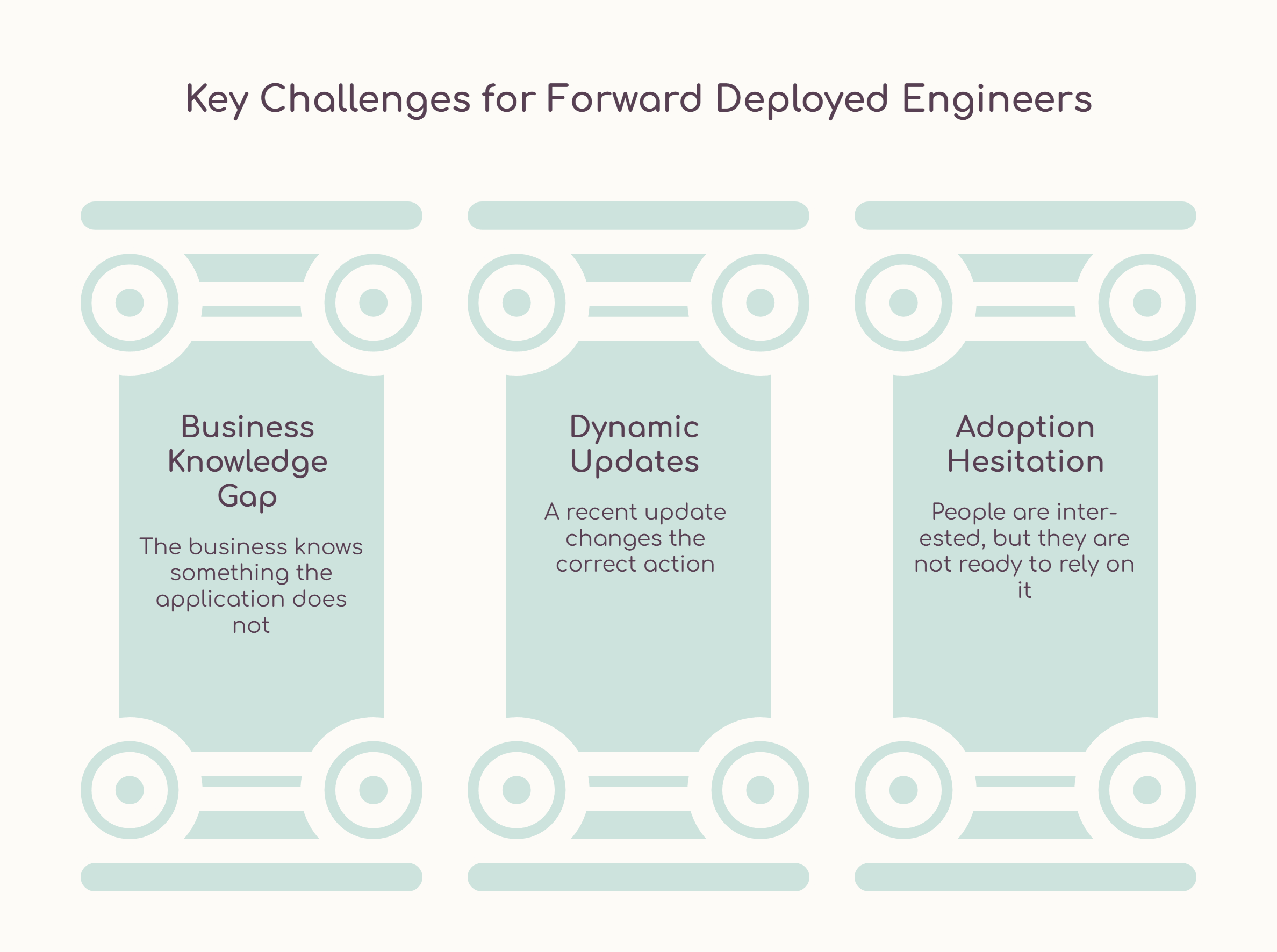
The business knows something the application does not
Think about the renewal example. Sales knows when the contract ends. Delivery knows what remains unresolved. The customer’s email explains why the timing matters.
That is where Company Brain fits into Antino’s perspective. Its focus on shared business memory brings attention to the relationships between information across people, systems, and workflows.
For an FDE, the practical question is whether the application can connect a promise made during sales with the work being delivered and the next customer conversation. Those connections need clear ownership, permission checks, and reliable updates.
As Vinay Krishna Gupta, our Co-Founder & CEO, said,
“When a customer asks about a commitment, the answer may sit across a sales conversation, a delivery update, and an email. Someone has to make those pieces work together. That is the responsibility I would want a forward deployed engineer to own, right through to the point where the team can rely on the result.”
A recent update changes the correct action
Here is another test developed for this guide. Run the same customer question twice, once before an unresolved issue is closed and once afterward. Should the recommendation change? Can the application explain which new information changed it?
If it cannot, you may have a system that retrieves information without reliably following the state of the work. That is worth investigating before allowing it to take consequential actions.
People are interested, but they are not ready to rely on it
EY-Parthenon’s 2026 Growth Survey found that 78% of respondents expected AI to accelerate organisational growth, while 63% primarily used it for efficiency and productivity. The survey covered 271 US corporate growth leaders at businesses with at least $500 million in annual revenue.
For your project, the next question is practical. What evidence would help a user trust this particular output? It might be a source link, a visible approval step, or a clear indication that information is missing.
The FDE Conversation at TechCrunch Disrupt 2026
What does it actually take to get AI working inside a customer’s business?
At TechCrunch Disrupt 2026 in San Francisco, this question came up in conversations involving Antino’s leaders, Vinay Krishna Gupta, Arka Baidya, and Harshad Bhardwaj.
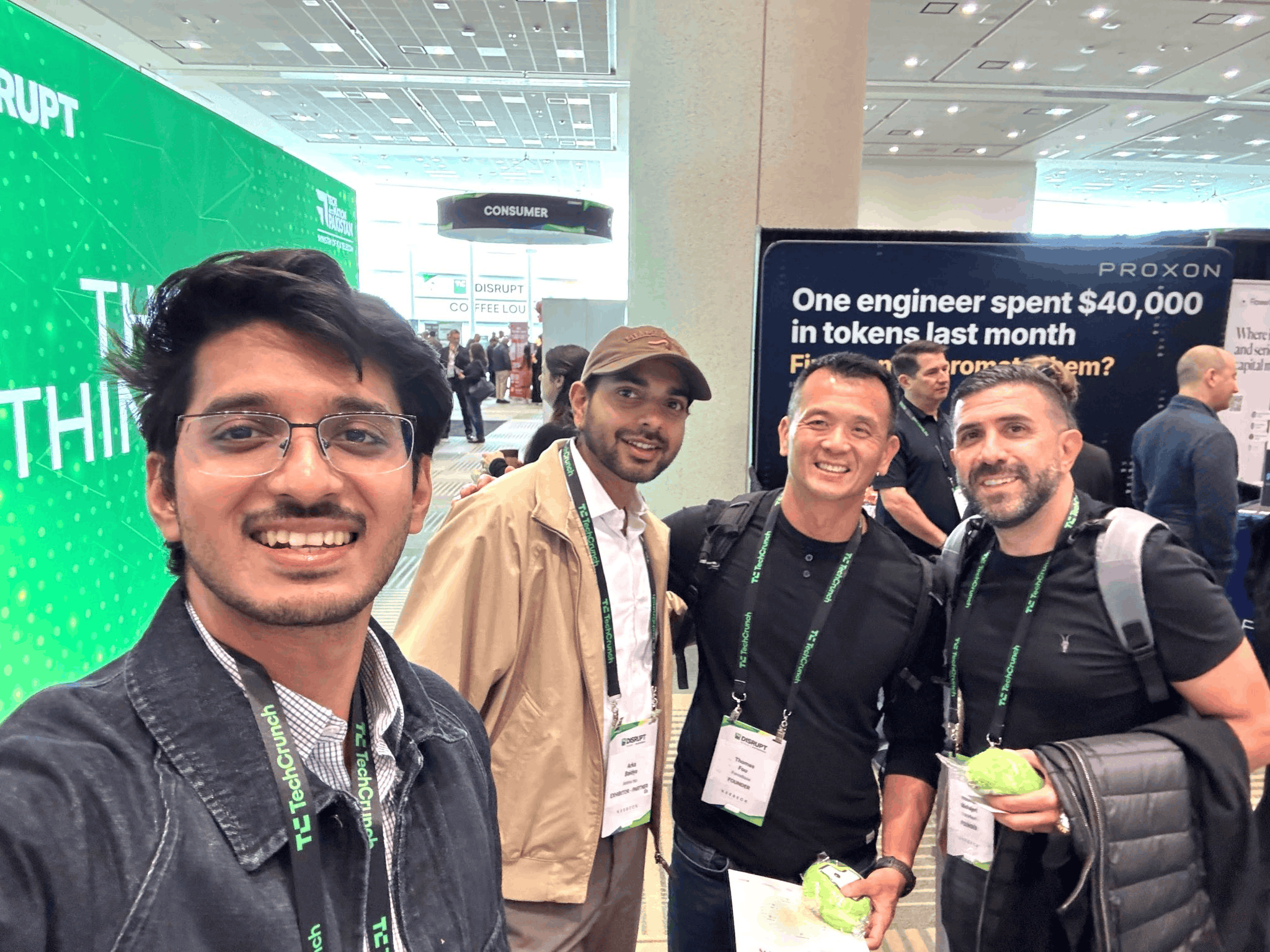
The discussion touched on a challenge that anyone hiring for enterprise AI should consider. Building a working app is part of the job. Connecting it to a customer’s systems, understanding how their teams work, and taking responsibility for deployment require a broader set of skills.
That is where forward deployed engineers enter the conversation.
For businesses considering their first FDE hire, the question becomes more specific. Who can sit with your users, understand what is getting in their way, and build a solution that works within your operating environment?
Core Responsibilities of a Forward Deployed Engineer
Before hiring, agree on what the person will leave at each step. That makes progress easier to review.
First, they should help you understand the current workflow. Expect conversations with users, a baseline, and a short list of problems worth solving. You should be able to recognise your business in their explanation.
Next comes the build. The engineer connects the necessary systems, implements the agreed workflow, and makes the important decisions visible. If two sources disagree, someone should be able to explain how the application handles it.
Before release, they test normal tasks and awkward cases. Missing information, expired access, unavailable services, and conflicting updates all deserve attention. Agree on which failures should stop the workflow and which can be handed to a person.
After launch, the FDE should spend time with users again. Watch a real task from beginning to end. Where do people hesitate? What do they recheck? Which steps still happen outside the application?
Finally, they should help your team take ownership. That includes documentation, monitoring, support arrangements, and a record of what should improve next.
Try a simple handover exercise. Ask another engineer to investigate a failed task using only the documentation and available logs. If they cannot tell what happened, the handover needs more work.
Conclusion
If you want to hire forward deployed engineers, start with the part of the work that still frustrates your team. The missing information. The repeated checking. The useful answer that never reaches the system where someone needs it.
Those details give you a much better hiring brief than asking for someone who “knows AI”.
You need an engineer who can understand the problem with your people, build around the constraints, and keep improving the solution after it goes live. Give them access to the right teams and clear business ownership, and you give the engagement a better chance of succeeding.
Antino helps businesses build FDE teams around their deployment needs. Company Brain adds a focus on connected business context, so the conversation includes how sales commitments, delivery updates, and customer relationships should inform the work.
What is the first workflow you want your team to stop struggling with?
Build your FDE team with Antino.
FAQs
When should a company hire a forward deployed engineer?
Consider hiring an FDE when an application needs significant work to fit your customer’s systems and processes.
They can help when projects get stuck because of data access, system connections, or people struggling to use the tool.
Make sure someone in the business can make the decisions the engineer needs.
How is an FDE different from a solutions architect?
A solutions architect usually plans how systems should work together.
An FDE usually spends more time building, fixing, and changing the software while working with users.
Job titles vary. Ask who will write the code and who will handle problems after launch.
Can an existing software engineer become an FDE?
Yes.
A strong software engineer can become an FDE if they also enjoy working with customers and understanding unfamiliar business problems.
Start with a clearly defined project and support from an experienced colleague.
Check how they handle unclear requirements, feedback, and problems after launch.
How should you interview an FDE?
Discuss projects they have already delivered. Then give them a small, realistic task with some information missing.
Watch the questions they ask, the code they write, and how they explain their choices.
Change one requirement during the exercise to see how they respond.
Should you hire one FDE or build a team?
One FDE may be enough for a focused project if your existing engineers and business teams can help.
You may need a team for several system connections, multiple customer launches, or heavy support needs.
Be clear about who supports the FDE. One person should not have to handle every technical and business issue alone.
Can Antino help build an FDE team?
Antino helps organisations build FDE teams for their AI projects.
Start by explaining the process you want to improve, the systems you already use, and the skills available in your team.
This helps define the responsibilities, the systems that need connecting, and what the first release should do.