

The online learning explosion has exposed a massive gap…
The numbers are staggering.
The global e-learning market, valued at approximately USD 299.67 billion in 2024, is projected to surpass USD 842.64 billion by 2030, growing at a CAGR of 19.0%.
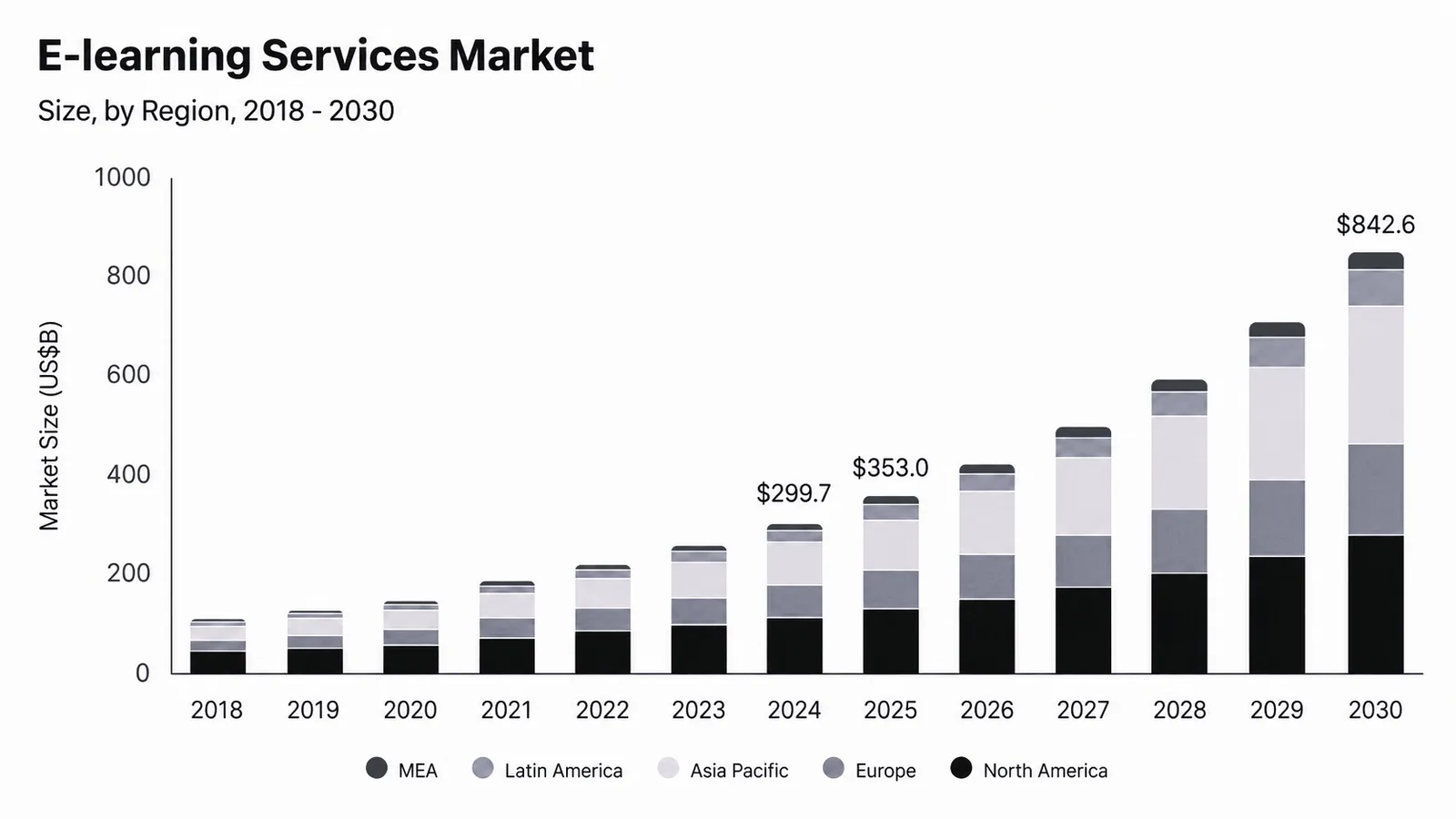
In India alone, the online education and corporate training market is expected to reach $30 billion by 2030, driven by a massive working-age population, aggressive digital adoption, and a government push through initiatives like Skill India and the National Education Policy 2020.
Yet, here is the uncomfortable truth that most enterprise leaders discover too late: the platforms powering much of this growth were not built for them.
Off-the-shelf Learning Management Systems (LMS) are engineered for the average organization. They are built to work reasonably well for a broad range of companies, which also means they work exceptionally well for almost none of them.
A 500-person manufacturing company in Pune with multilingual shop floor workers has fundamentally different training needs than a 5,000-person IT services firm in Bengaluru with globally distributed teams. A fintech startup onboarding 200 employees a quarter needs a completely different approach to learning management system development than a pharmaceutical giant running compliance training across regulated functions.
Forward-thinking organizations in India and globally are waking up to this reality. They are investing in custom learning management system development to build platforms that mirror their organizational culture, plug directly into their HR tech stack, serve content in the languages their learners actually speak, and deliver measurable outcomes that connect directly to business performance.
This is not a technology story. It is a business strategy story. And if your organization is still trying to squeeze its unique learning needs into a pre-packaged box, this guide is for you.
Why do you Need a Custom LMS?
Before investing in custom LMS software development, the critical question is: why can't a ready-made platform do the job? The answer lies in 5 persistent pain points that off-the-shelf LMS platforms consistently fail to solve for complex organizations.
Your workflows are unique, and a generic LMS does not understand them
Most standard LMS platforms operate as standalone systems. They do not natively integrate with your ERP, your performance management system, your CRM, or your payroll platform. This creates data silos where learning activity lives in one system and business outcomes live in another. You end up with administrators manually exporting reports, cross-referencing spreadsheets, and building workarounds that consume enormous time and produce data that no one fully trusts. A custom LMS is built from the ground up to integrate with your specific ecosystem.
Scalability becomes a crisis, not a feature
When Reliance Retail rapidly scaled its workforce during its e-commerce expansion, the training volume exploded. Generic platforms often struggle with concurrent users, content delivery across geographies, and bandwidth optimization for learners in Tier 2 and Tier 3 cities with variable internet connectivity. A custom LMS can be architected specifically for your scale requirements, your user geography, and your content delivery needs.
Compliance is not optional, and generic platforms leave dangerous gaps
For organizations in banking, pharmaceuticals, chemicals, or any regulated sector in India, compliance training is a legal obligation with serious consequences for non-completion. SEBI, RBI, IRDAI, and FSSAI all have mandatory training requirements. A custom LMS can be built with compliance workflows at its core: automated reminders, manager escalations, audit-ready reporting, and direct integration with regulatory reporting systems.
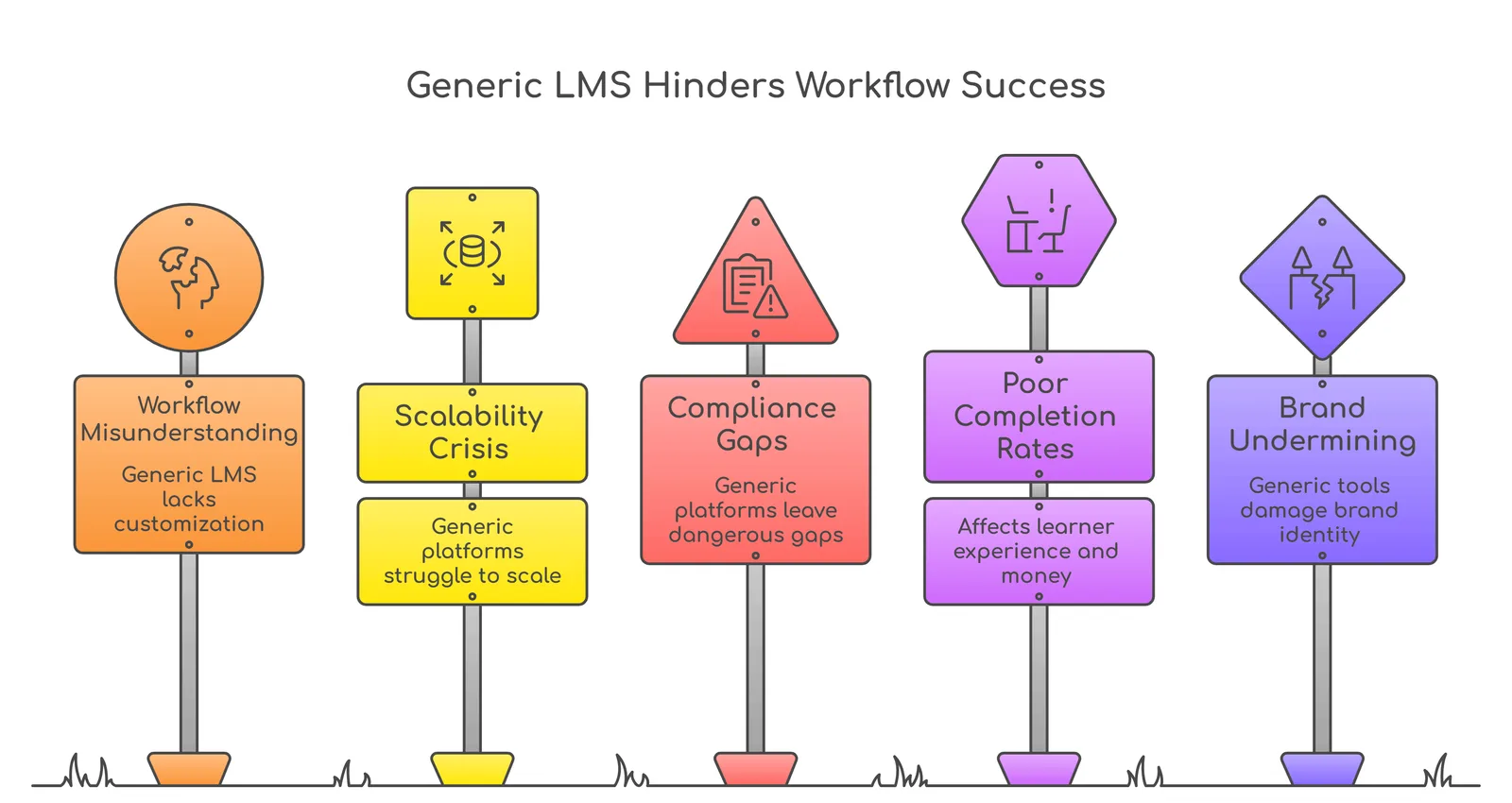
Learner experience directly affects completion rates, and poor completion rates waste money
Research consistently shows that learner engagement and course completion rates are heavily influenced by the quality of the learning experience. Generic platforms are often cluttered, confusing for frontline workers, and not optimized for mobile access. In a country where over 700 million people access the internet primarily through mobile devices, a mobile-first custom LMS can dramatically improve completion rates and training effectiveness.
Your brand and culture matter, and a white-labeled generic tool undermines them
When employees log into a learning platform that looks like a third-party tool, it signals that learning is an afterthought. A customizable LMS that carries your organization's visual identity, speaks in your organizational language, and reflects your values sends a powerful message: we take learning seriously enough to invest in it properly. Unlike rigid off-the-shelf tools, a customizable LMS grows and adapts as your organization evolves, without forcing you into a vendor's product roadmap.
In a 2024 LinkedIn Workplace Learning Report, 91% of L&D professionals said that helping employees build skills for the future is a top priority. Yet, 52% of organizations reported that their existing learning technology was not adequate for their current needs. That gap is exactly where custom LMS development lives.
Types of Custom LMS: Which One do you Need?
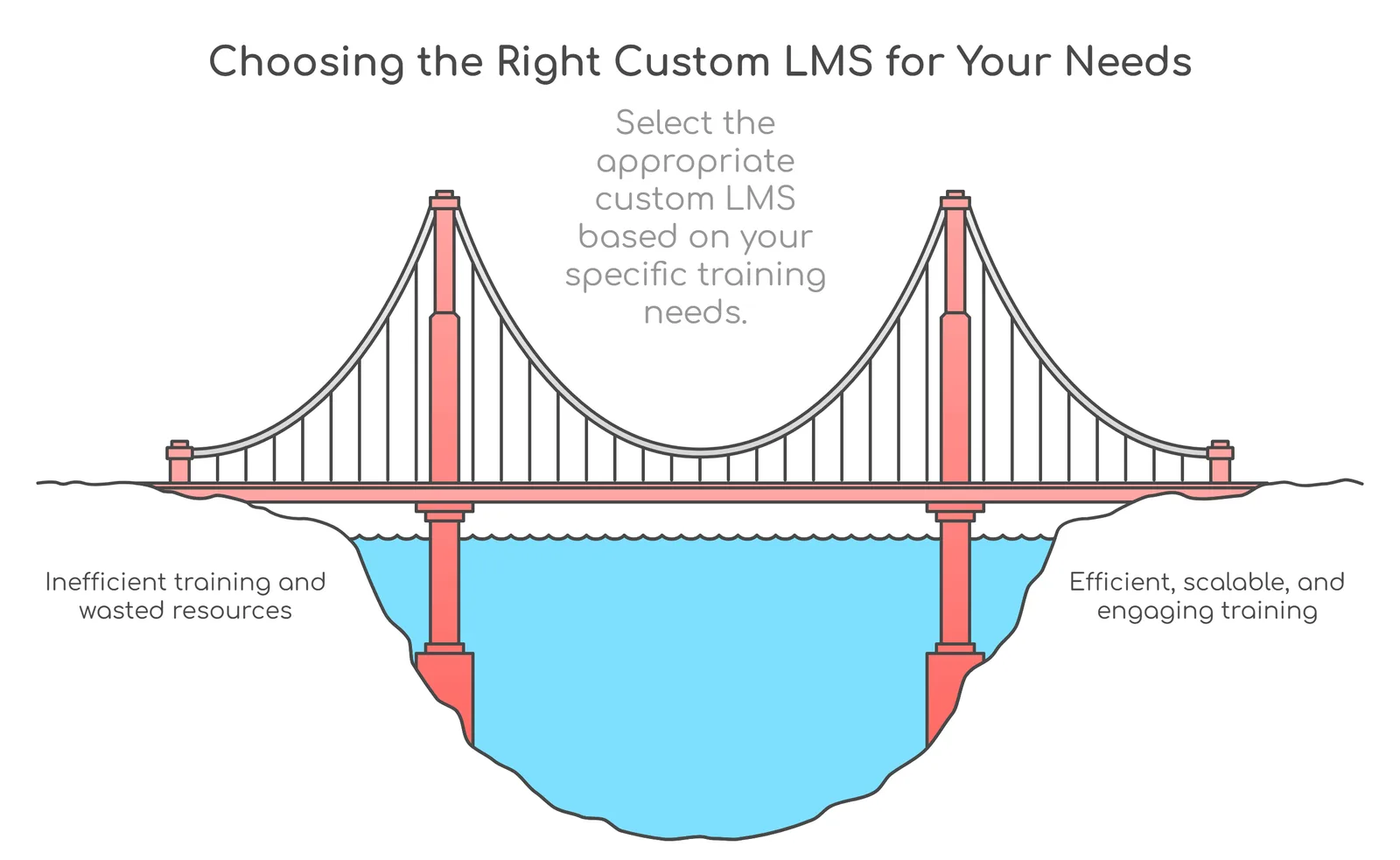
Not all custom LMS platforms are built the same way, and not all organizations need the same type of solution. Understanding the landscape helps you make the right architectural decision before spending a single rupee on LMS development.
Corporate Training LMS
This is the most common type of custom build for businesses. It is designed entirely around employee learning: onboarding, skill development, leadership programs, product training, and compliance. The focus is on structured learning paths, manager dashboards, and integration with HR systems like SAP SuccessFactors, Oracle HCM, or Darwinbox.
Companies like Wipro and HCL Technologies operate their own proprietary corporate learning platforms that manage training for hundreds of thousands of employees globally. For most Indian enterprises beginning their custom LMS journey, this is the starting point.
Customer Education LMS
This LMS is built for organizations that need to train their customers, not their employees. Software companies, fintech platforms, and B2B service providers use this model to onboard customers, drive product adoption, and reduce support costs.
Zoho, the Chennai-based SaaS company, runs extensive customer education programs through its own digital learning infrastructure. A customer education LMS typically integrates with CRM systems, supports self-enrollment, and tracks training completion as part of customer success metrics.
Partner and Channel Training LMS
It serves organizations with large dealer, distributor, or franchise networks. Automobile companies like Maruti Suzuki and Hero MotoCorp need to train thousands of service technicians and sales staff across dealerships without bringing them to a central location. A partner LMS supports external users, often with a tiered access model where different partner tiers access different content libraries.
Extended Enterprise LMS
Well, this LMS combines all of the above: internal employees, customers, and external partners, all managed within a single platform with different portals, access controls, and content libraries. This is the most complex build in the LMS software development spectrum and is typically suited for large conglomerates or organizations with genuinely multi-dimensional training needs.
Marketplace or Academic LMS
This is for organizations that want to monetize learning content by selling courses to external learners. EdTech companies like PhysicsWallah, Vedantu, and UpGrad have built highly sophisticated custom platforms in this category, complete with subscription management, content monetization, instructor marketplaces, and adaptive learning engines.
The right type for your organization depends on who you are training (employees, customers, partners, or all three), whether learning is a cost center or a revenue opportunity, and the complexity of your integration requirements.
Cost to Develop a Custom LMS
Cost is the question every decision-maker asks first, and it deserves a transparent, structured answer. Custom LMS development costs in India vary significantly based on complexity, feature set, team composition, and timeline. Here is a clear breakdown across three tiers.
Basic Custom LMS: INR 15 Lakhs to INR 40 Lakhs (approximately $18,000 to $48,000)
A basic custom LMS typically includes core functionality: user authentication and role management, course creation and content upload (video, PDF, SCORM), a learning dashboard for learners and administrators, basic progress tracking and reporting, email notifications, and a mobile-responsive design.
This tier is appropriate for organizations with 500 to 2,000 users, relatively standardized training content, and limited integration requirements. Development typically takes 4 to 6 months with a team of 4 to 6 developers.
Advanced Custom LMS: INR 40 Lakhs to INR 1.2 Crore (approximately $48,000 to $145,000)
An advanced LMS adds meaningful sophistication to the core learning management system development foundation: learning path automation, HRMS and payroll system integration, multi-language support (critical for Indian organizations training in Hindi, Tamil, Marathi, Bengali, and regional languages), advanced analytics and reporting dashboards, gamification systems, live virtual classroom integration, and mobile application development for iOS and Android.
This is the most common tier for mid-to-large Indian enterprises. Development typically takes 8 to 12 months with a team of 8 to 12 people, including backend engineers, frontend developers, UI/UX designers, QA engineers, and a project manager.
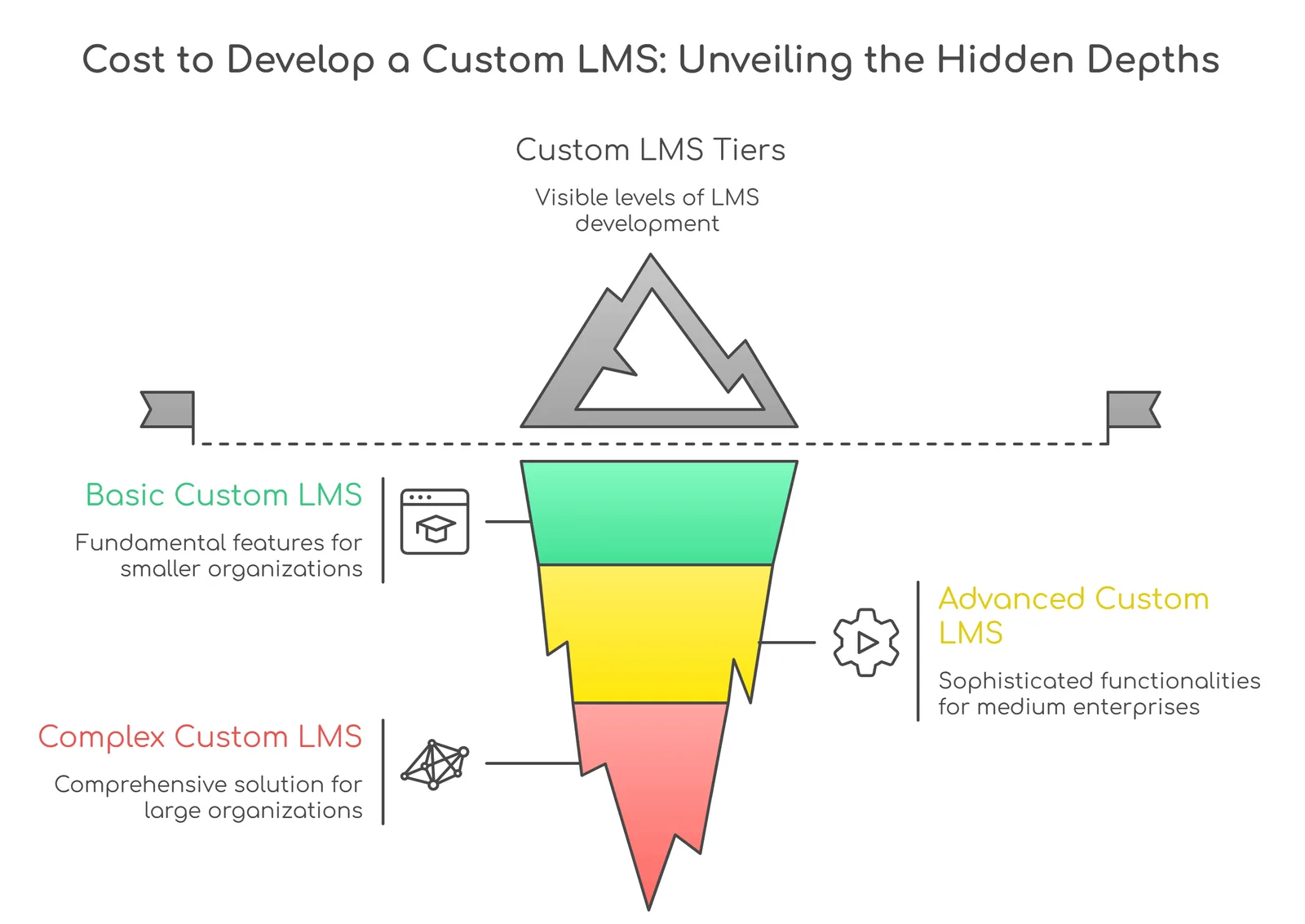
Complex Custom LMS: INR 1.2 Crore to INR 4 Crore and above (approximately $145,000 to $480,000+)
A complex, enterprise-grade build involves AI-powered adaptive learning, large-scale microservices architecture, custom video streaming infrastructure, advanced compliance management with regulatory reporting, multi-tenant architecture for enterprise clients, deep ERP and performance management integration, real-time analytics, and potentially white-labeling capabilities for resale.
This level of LMS software development is suited for large PSU banks running mandatory training for tens of thousands of employees, or EdTech platforms building commercial learning marketplaces. Development timelines range from 12 to 24 months with teams of 15 to 30 or more.
It is important to understand that the build cost is only part of the total cost of ownership. Organizations should budget for annual maintenance (typically 15 to 20% of the build cost), content creation and migration, user training and change management, server infrastructure (AWS, Azure, or Google Cloud), and ongoing feature development as needs evolve. A custom LMS is not a one-time project; it is a living platform that requires sustained investment.
Must-Have and Advanced Features for Your Custom LMS
The feature set of your custom LMS software should be driven by your learner demographics, your content strategy, and your business outcomes. Here is a structured view of what belongs in every custom LMS and what separates good platforms from great ones.
- User management with role-based access control
Your platform needs to handle administrators, instructors, managers, learners, and potentially external users with different permission levels and content visibility. Single Sign-On (SSO) integration with your existing identity provider (Microsoft Azure AD, Okta, or Google Workspace) eliminates friction for learners and reduces IT overhead.
- Multiple content formats
Course creation and content management must support multiple content formats: SCORM 1.2 and SCORM 2004, xAPI (Tin Can), video content, PDF documents, interactive quizzes, and assignments. A built-in authoring tool or integration with tools like Articulate 360 or iSpring Suite allows your instructional designers to build content directly within the platform.
- Progress tracking and completion reporting
Learners need to see where they are in their learning journey, and managers need to see who has completed what. Automated certificate generation and expiry tracking are particularly important for compliance-heavy industries.
- Notification and reminder systems
Notification and reminder systems keep learners engaged and ensure deadlines are met. Automated email and push notifications for upcoming deadlines, new course assignments, and achievement milestones dramatically improve completion rates without requiring manual follow-up.
- Mobile-first UI/UX
A mobile-first design or dedicated mobile application is essential in India's mobile-dominant internet landscape. Your custom LMS should function flawlessly on Android devices with variable connectivity, supporting offline content access where possible.
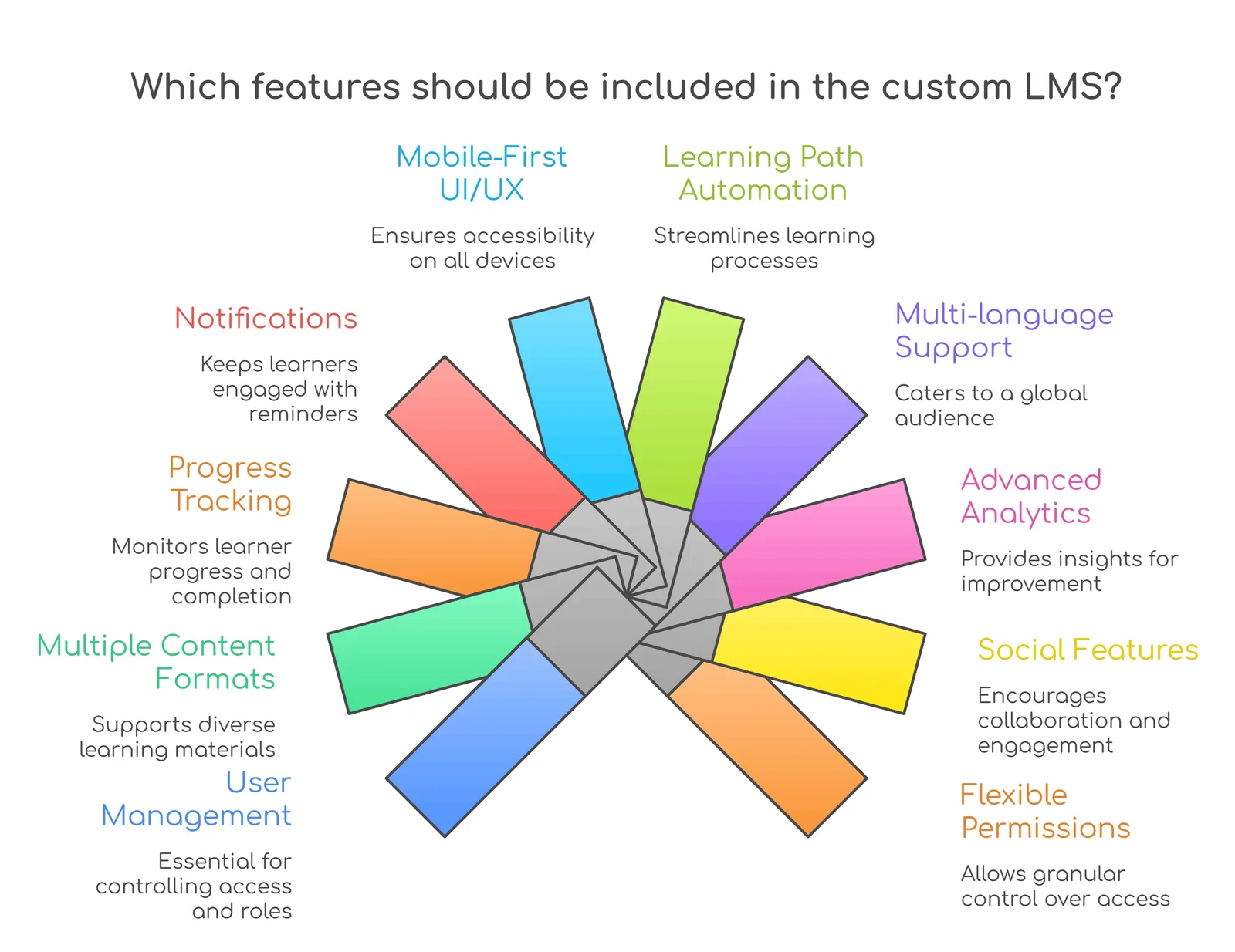
- Learning path automation
This allows administrators to create sequential or conditional learning journeys. A new sales hire might be automatically enrolled in a product knowledge course, then a sales methodology program, then a compliance module, with each step triggered by the completion of the previous one. This reduces administrative burden and creates a structured onboarding experience.
- Multi-language and localization support
A manufacturing company with plants in Tamil Nadu, Maharashtra, and Gujarat needs to deliver the same safety training in Tamil, Marathi, and Gujarati. A custom LMS can be built with full localization, including right-to-left language support for Urdu-speaking learners.
- Advanced analytics with custom dashboards
They give L&D leaders insight into content effectiveness (which modules have high drop-off rates), learner engagement patterns (when during the day do most learners engage with content), skill gap analysis, and training ROI connected to business performance metrics.
- Social and collaborative learning features
Features including discussion forums, peer rating systems, user-generated content, and collaborative assignments transform learning from a solitary consumption activity into a community-driven experience. This is particularly effective for knowledge worker populations in IT services and consulting.
- Flexible permissions engine
A truly customizable LMS also needs a flexible permissions engine, configurable branding across departments or business units, and an open API layer that makes future integrations straightforward as your tech stack evolves.
Gamification and Engagement: The Most Important Aspect of Any LMS
Here is a fact that should alarm any L&D leader: the average completion rate for online corporate training courses is between 5% and 15%. You can invest in the most sophisticated custom LMS software development available, but if learners are not engaging with the platform, you have built an expensive content library that nobody visits.
Gamification is not about making learning childish or trivial. It is about applying the behavioral psychology that makes games compelling (achievement, progress, competition, reward, and social recognition) to a learning context. When done well, gamification can increase learner engagement by up to 60% and improve knowledge retention by as much as 40%, according to research by Talent LMS.
- Points and Experience Systems
Points and Experience Systems assign numerical value to learning activities. Completing a module, scoring above a threshold on an assessment, finishing ahead of a deadline, and helping a colleague in a discussion forum: all of these actions can earn points.
Points create a visible measure of learning investment and effort that learners can track over time. For Deloitte India, a points-based system in their learning platform contributed to a 46% increase in the number of users returning to the site per week.
- Badges and Achievement Recognition
Badges and Achievement Recognition provide milestone markers that learners can display on their profiles and share externally. A "POSH Compliance Champion" badge or a "Leadership Foundations" badge carries real social currency within an organization.
When organizations integrate LMS badges with LinkedIn profiles (increasingly supported by custom platforms), the social recognition value extends beyond the organization.
- Leaderboards and Team Competitions
Leaderboards and Team Competitions leverage social comparison and healthy competition. When a learner can see that they are third in their department on the learning leaderboard, the motivation to complete one more module and move to second becomes concrete and immediate. Team leaderboards encourage peer accountability, with managers and colleagues invested in collective team performance.
- Streaks and Learning Habits
Streaks and Learning Habits reward consistency rather than just volume. A learner who spends 15 minutes learning every day for 30 days is building genuine habits. Streak tracking, with visual reinforcement and notifications when a streak is at risk, helps build the daily learning behavior that produces lasting skill development.
- Level Progression and Learning Journeys
Level Progression and Learning Journeys create a narrative arc that makes the overall learning program feel like a journey with stages, challenges, and milestones rather than a list of courses to complete. This is particularly effective in new hire onboarding, where the transition from "Apprentice" to "Contributor" to "Expert" can be visualized and celebrated.
A real-world Indian example: Bajaj Finserv implemented gamified learning elements in its internal training platform, resulting in a measurable improvement in course completion rates and learner satisfaction scores among its field sales workforce, a notoriously difficult population to engage with traditional e-learning.
For organizations investing in custom LMS development, gamification should not be bolted on as an afterthought. It needs to be architected into the core database schema, the notification engine, and the frontend UX from the beginning. Retrofitting gamification into a platform not designed for it produces a disjointed experience that learners see through immediately.
Trendy AI Features That Businesses Are Including and Your Custom LMS Should Too
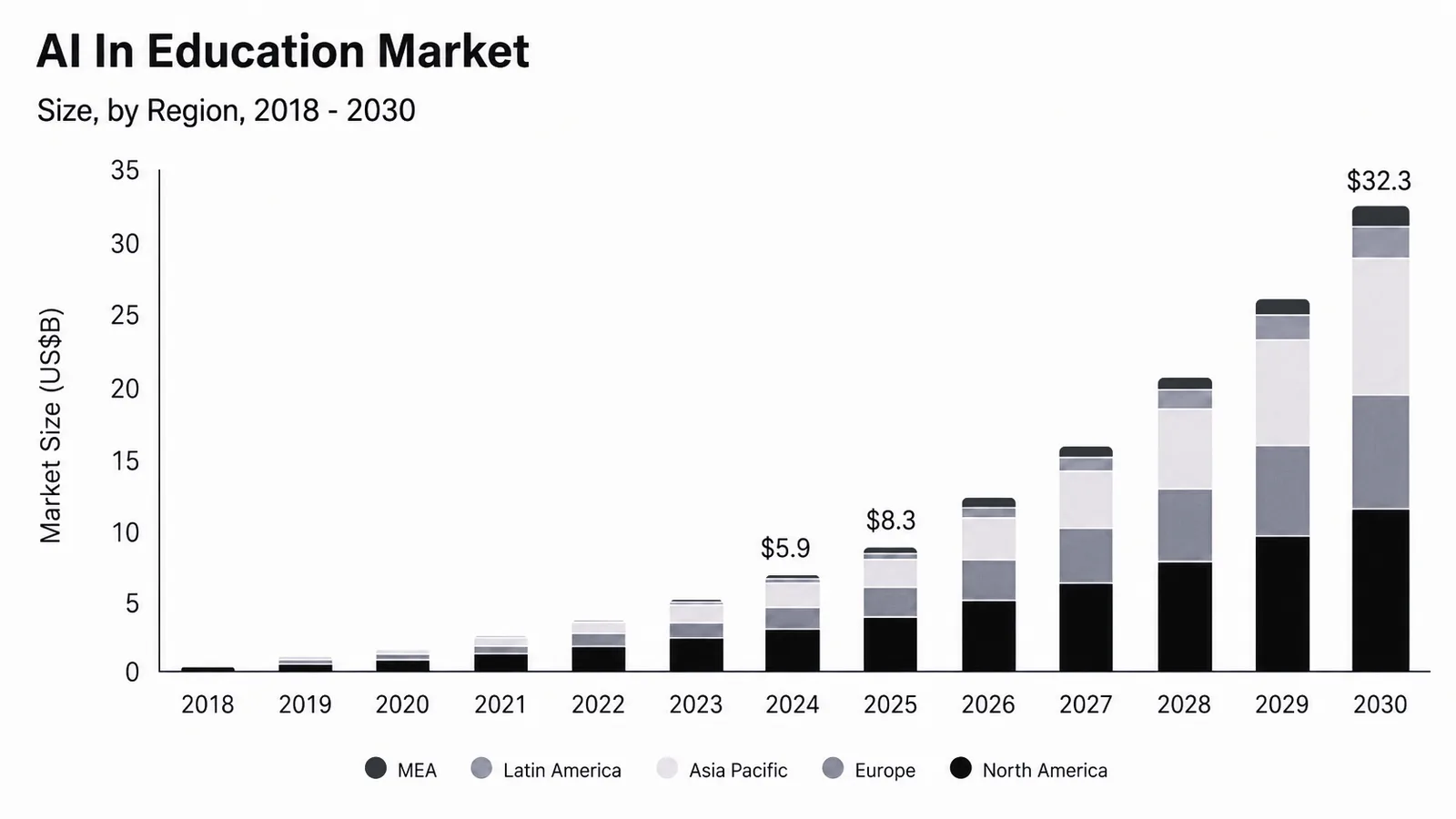
Artificial intelligence is no longer a futuristic concept in learning technology. It is a present-day differentiator that is reshaping what learners expect and what organizations can deliver. By 2030, the AI in education market is projected to reach USD 32.27 billion globally, and its penetration in LMS software development is accelerating rapidly.
- Adaptive Learning Engines
Adaptive Learning Engines are the most transformative AI application in custom LMS development. Instead of every learner following the same linear course sequence, an adaptive engine continuously analyzes individual performance data (quiz scores, time spent on content, error patterns, engagement signals) and adjusts the learning path dynamically.
A learner who demonstrates proficiency in a concept moves forward faster. A learner struggling with a module is served remedial content, alternative explanations, or peer resources before advancing. This personalization at scale is impossible without AI.
- AI-Powered Content Recommendations
AI-Powered Content Recommendations work similarly to Netflix or Spotify recommendations, but for learning content. The system analyzes a learner's role, past learning history, current skill gaps (often derived from performance review data), and the behavior patterns of similar learners, then surfaces content recommendations that are genuinely relevant. This transforms the learner's experience from searching a content library to being presented with a curated learning feed.
- Automated Content Creation and Curation
Automated Content Creation and curation are rapidly maturing. Generative AI tools can now assist instructional designers in creating quiz questions, generating course summaries, producing translated content, and even drafting video scripts.
Organizations with large and frequently updated content libraries (legal updates in financial services, product updates in technology companies, safety protocol changes in manufacturing) are using AI to dramatically reduce content development timelines. This is one of the clearest areas where custom LMS software development delivers an ROI advantage over off-the-shelf tools, since proprietary AI integrations can be tuned to your specific content formats and business context.
- Conversational AI and Learning Chatbots
Conversational AI and Learning Chatbots provide 24/7 learner support without scaling the L&D team. A learner stuck on a compliance concept at 11 PM can ask the LMS chatbot for clarification, additional resources, or guidance on next steps. More advanced implementations use AI tutors that can engage in Socratic dialogue, probing learner understanding rather than simply providing answers.
- AI-Powered Assessment and Skills Verification
AI-Powered Assessment and Skills Verification goes beyond multiple-choice quizzes. Natural Language Processing (NLP) enables AI evaluation of written responses, case study analyses, and even spoken answers in language learning applications. For organizations in consulting, law, and professional services where scenario-based judgment is critical, AI assessment can evaluate nuanced responses at scale.
- Predictive Analytics and Early Warning Systems
Predictive Analytics and Early Warning Systems use machine learning to identify learners at risk of disengagement or non-completion before it happens. By analyzing behavioral signals (declining login frequency, lower time-on-content, declining quiz scores), the system can trigger manager notifications or automated intervention nudges early enough to make a difference.
This is particularly valuable for organizations with compliance training deadlines where a late non-completion has regulatory consequences.
- Video AI Features
Video AI features, including automatic transcription, keyword tagging, and searchable video content, are now standard expectations for enterprise LMS platforms. Learners can search within video content for specific topics, AI generates chapter markers, and accessibility features like auto-generated subtitles are produced without manual effort. For multilingual organizations in India, AI-powered translation of video captions across regional languages is increasingly viable and cost-effective.
By 2030, industry analysts project that 60% of all corporate learning content will be either AI-generated or AI-personalized to some degree. Organizations that build AI capability into their custom LMS now are creating a durable competitive advantage in their ability to develop talent.
How Antino can help you Build your Custom LMS?
Building a custom LMS is a significant undertaking that demands more than technical capability. It requires a development partner who understands both the technology and the human behavior at the center of effective learning. Getting the architecture wrong at the start costs organizations months of rework and millions in avoidable expense. Getting the learner experience wrong at launch costs you adoption, and a learning platform that nobody uses is the most expensive kind.
Antino has spent years working with enterprises, EdTech companies, and mid-market organizations across India and globally to design, develop, and scale custom LMS software. Whether you are building a corporate training platform for 10,000 employees across multiple states, a customer education portal to drive product adoption, or an AI-powered adaptive learning engine that personalizes at scale, Antino's engineering and product teams have the experience to move you from concept to launch without the costly detours that come from working with development partners who are learning on your budget.
If your organization is ready to move beyond the limitations of off-the-shelf solutions and begin proper custom LMS development, the conversation starts with a single step. The organizations that invest in purpose-built learning technology today are building the talent pipelines that will define their competitive position through 2030 and beyond. Let Antino help you build yours.
Key takeaways
The explosion of online learning globally is not a trend. It is a structural shift in how organizations develop people, and the data confirms that this shift is accelerating. By 2030, the organizations with the most effective learning infrastructure will have a talent development advantage that is extremely difficult for competitors to close. The question is no longer whether to invest in learning technology. It is whether to invest in technology built for someone else, or in a purpose-built custom LMS that is engineered for your organization, your learners, and your outcomes.
Custom learning management system development is not the right answer for every organization. But for organizations with unique workflows, complex compliance requirements, multilingual workforces, large scale, or genuine ambition to use learning as a competitive differentiator, investing in LMS software development built specifically for your needs is not a luxury. It is a strategic necessity.
The market is moving. Your learners are waiting. The only real risk is standing still.