
AI…AI…AI…
Everyone, literally every single person, is talking about how AI is transforming industries, how it is taking jobs, how it is redefining the business pathways, and whatnot. But have you ever wondered what exactly AI does? Because just talking about AI will not take you anywhere near the actual work of AI.
If this is an eye-opener for you, then we would definitely want you to read ahead and find out the real work of AI, but this time we’ll be diving deep into how AI demand forecasting helps in optimizing the inventory.
What is AI Demand Forecasting?
AI demand forecasting is about using artificial intelligence to predict what your customers will want, when they’ll want it, and how much of it they’ll need, before it actually happens.
Now, if you’re in the C-suite, you already know forecasting isn’t new. You’ve been doing it for years with historical data, spreadsheets, and maybe a few dashboards. But the market today doesn’t behave like the past anymore.
Customer preferences shift overnight. Trends go viral in hours. Supply chains get disrupted without warning. And suddenly, what worked last quarter feels completely irrelevant.
That’s where AI changes the game.
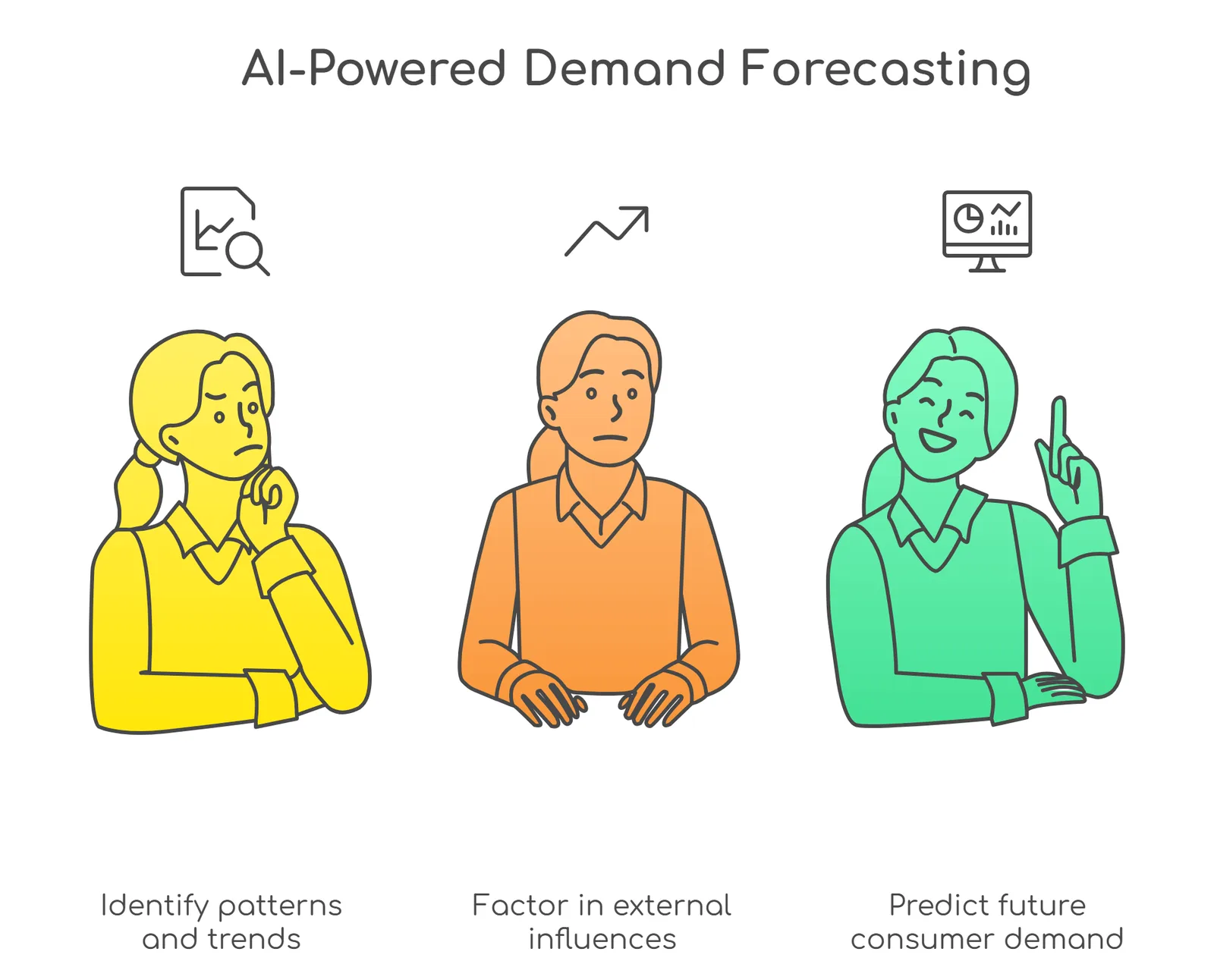
Instead of just looking at past sales, AI pulls signals from everywhere, including real-time demand patterns, seasonality shifts, external factors like weather or economic changes, and even behavioral trends. It connects dots that traditional models usually miss.
Think of it like this:
- Your traditional forecast says: “We sold X last quarter, so let’s plan for X + 5%.”
- AI says: “Demand for this category is about to spike in the next 10 days because of these 6 signals you’re not tracking.”
That’s a very different level of visibility.
For leadership teams, it’s about control and confidence.
- Fewer stockouts when demand spikes unexpectedly
- Less overstock sitting idle and blocking working capital.
- Smarter production and inventory planning
- Better alignment between sales, supply chain, and finance
And most importantly, it helps you move from reacting to demand and then anticipating it.
Because in today’s market, the companies that win aren’t the ones with the best products. They’re the ones who show up at the right time with the right supply, consistently. That’s exactly what AI demand forecasting is built for.
Now, to make it simpler, let’s reframe Demand Forecasting in the context of Artificial Intelligence.
Let’s look at demand forecasting through a slightly different lens.
Traditionally, demand forecasting has been about looking back to predict forward by analyzing past sales, identifying patterns, and making educated assumptions about what might happen next. It worked well in stable environments. But today’s market doesn’t follow predictable patterns anymore.
When you bring AI into the picture, demand forecasting shifts from being historical and reactive to real-time and adaptive.
Instead of relying only on what has already happened, AI continuously learns from what is happening right now. It processes multiple data streams at once, including customer behavior, buying trends, external market signals, seasonality shifts, and updates forecasts dynamically as new information comes in.
A simpler way to think about it:
- Traditional forecasting asks: “What did we sell before?”
- AI-driven forecasting asks: “What is changing right now, and what does that mean for demand next?”
This shift is important for leadership teams because it directly impacts how decisions are made.
With AI, forecasting is no longer a static report that gets reviewed once in a while. It becomes a living system, one that constantly refines itself and supports decisions across functions like supply chain, operations, sales, and finance.
It also changes the role of forecasting within the organization. Instead of being just a planning tool, it becomes a decision engine:
- Helping operations adjust supply in near real time
- Enabling sales teams to prioritize high-demand products
- Allowing finance teams to plan with greater accuracy
- Giving leadership a clearer view of what’s coming next
In simple terms, AI completely redefines forecasting.
It turns demand forecasting from a backward-looking exercise into a forward-looking capability that evolves with your business, making it far more aligned with the speed and complexity of today’s market.
Demand Forecasting Use Cases Enabled by AI
Once AI is introduced into demand forecasting, it stops being just a planning function and starts influencing real business decisions across the organization. Instead of working in silos, forecasting becomes deeply connected with operations, sales, supply chain, and finance, helping teams act faster and with more confidence.
Here are some of the most practical and high-impact use cases where AI-driven demand forecasting is making a difference.
Real-Time Inventory Planning
One of the most immediate applications of AI demand forecasting is in inventory management.
Traditionally, companies either overstock to avoid running out or understock and risk losing sales. Both scenarios hurt the business. AI helps strike the right balance by continuously adjusting inventory levels based on live demand signals.
For example, if demand for a product suddenly starts rising in a specific region, AI can detect the trend early and recommend increasing stock in that location. On the flip side, if demand slows down, it can prevent over-ordering.
For leadership, this translates into:
- Lower holding costs
- Reduced stockouts
- Better working capital management
Demand-Supply Alignment Across the Value Chain
Forecasting directly affects how well your entire supply chain operates.
AI helps align demand signals with production schedules, procurement plans, and logistics. Instead of operating on fixed forecasts, supply chain teams can respond dynamically to changing demand patterns.
For example, manufacturers can adjust production volumes based on updated forecasts, while logistics teams can optimize distribution routes based on regional demand shifts.
The result? A more synchronized and responsive supply chain that avoids last-minute disruptions.
Dynamic Pricing and Revenue Optimization
Pricing is a demand-driven decision that should never be taken lightly.
AI-enabled demand forecasting allows organizations to adjust pricing based on real-time demand fluctuations, customer behavior, and market conditions.
For instance, if demand is expected to spike for a particular product, pricing strategies can be optimized to maximize margins. If demand is slowing, targeted discounts can help stimulate sales without eroding overall profitability.
This approach helps businesses:
- Maximize revenue during high-demand periods
- Reduce losses during slow-moving cycles.
- Make pricing decisions based on data, not assumptions.
Sales and Demand Planning Alignment
Sales teams often work with targets, while operations teams work with forecasts, and the two don’t always match.
AI bridges this gap by creating a single, data-driven view of demand that both teams can rely on. Forecasts become more accurate and aligned with actual market behavior, making it easier to plan sales strategies and meet targets realistically.
For example, sales teams can focus efforts on products or regions where demand is expected to grow, rather than pushing inventory that may not move.
This alignment improves:
- Forecast accuracy
- Sales planning efficiency
- Cross-functional collaboration
New Product Launch Forecasting
Launching a new product is always a gamble because there’s little to no historical data to rely on.
AI helps reduce this uncertainty by analyzing similar product launches, customer behavior patterns, market trends, and even competitor activity. Based on these inputs, it can generate more informed demand estimates for new offerings.
This helps businesses:
- Plan production and inventory more accurately
- Reduce the risk of overproduction or underproduction.
- Improve go-to-market strategies
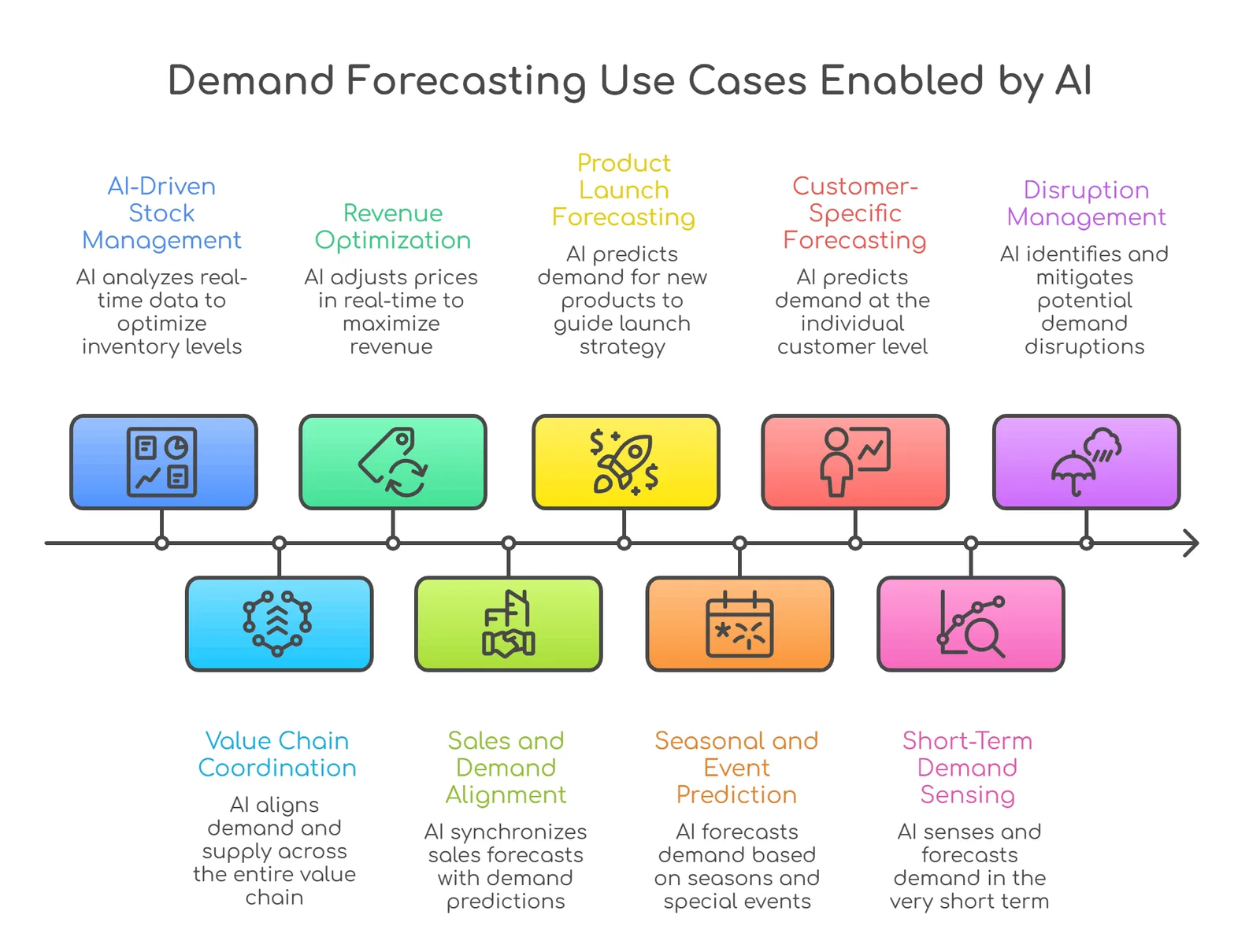
Seasonal and Event-Based Demand Prediction
Certain industries rely heavily on seasonal demand, retail during holidays, travel during peak seasons, or specific products during weather changes.
AI goes beyond basic seasonality by factoring in real-time external signals such as weather patterns, local events, economic shifts, and even cultural trends.
For example, it can predict spikes in demand during festive periods or anticipate changes due to unexpected events.
This allows organizations to:
- Prepare inventory in advance
- Optimize staffing and operations.
- Capture peak demand opportunities more effectively
Customer-Level Demand Forecasting
Not all customers behave the same way. Some are frequent buyers, some are seasonal, and some respond strongly to promotions.
AI enables granular demand forecasting at the customer or segment level. By analyzing purchase history, browsing behavior, and engagement patterns, it can predict what different customer groups are likely to buy.
This supports:
- Personalized marketing campaigns
- Better product recommendations
- More targeted sales strategies
Demand Sensing and Short-Term Forecasting
While long-term forecasting is important, businesses also need short-term visibility to react quickly.
AI-powered demand sensing focuses on near-term demand by analyzing the latest data, including recent sales, market signals, and external factors. It continuously updates forecasts for the coming days or weeks.
This is especially useful in fast-moving industries where demand can change quickly.
The benefit is simple:
- Faster response to demand shifts
- Reduced reliance on outdated forecasts
- Better short-term planning
Risk Mitigation and Disruption Management
Unexpected disruptions, whether supply chain issues, economic shifts, or global events, can significantly impact demand.
AI helps organizations anticipate and respond to such disruptions by identifying early warning signals and simulating different scenarios.
For example, if a disruption is expected to impact supply, AI can help assess how demand will shift and what adjustments are needed.
This improves:
- Business continuity planning
- Resilience against market shocks
- Decision-making under uncertainty
What makes AI-powered demand forecasting powerful is not just its accuracy, but its ability to connect decisions across the business.
It ensures that inventory, pricing, production, and sales are all working from the same, continuously updated understanding of demand.
For C-suite leaders, this means moving away from fragmented planning toward a more unified, responsive, and data-driven operating model.
In a market where timing and precision matter more than ever, AI-driven demand forecasting becomes more of a strategic advantage.
Why Traditional Demand Forecasting Falls Short?
For years, traditional demand forecasting has been the backbone of planning for most organizations. It relies on historical sales data, fixed models, and periodic reviews to estimate future demand. While this approach worked in relatively stable environments, it struggles to keep up with how markets operate today.
The challenge is not that traditional forecasting is wrong. The problem is that it is no longer enough.
Relies Too Heavily on Historical Data
Traditional forecasting looks at past performance to predict future demand. This assumes that patterns will repeat themselves.
But in reality, demand today is influenced by factors that change quickly. Customer preferences shift, trends emerge overnight, and external events can disrupt markets without warning.
When forecasts are based mostly on historical data, they often miss these real-time changes, leading to gaps between expected and actual demand.
Cannot Keep Up with Real-Time Changes
Most traditional forecasting models are updated at fixed intervals, such as monthly or quarterly.
In fast-moving markets, this creates a delay. By the time forecasts are updated, the situation on the ground may have already changed.
This lag makes it harder for businesses to respond quickly to demand spikes, sudden drops, or unexpected disruptions.
Works in Silos
In many organizations, forecasting is handled by a single team, often disconnected from sales, marketing, and supply chain functions.
This creates fragmented views of demand. Sales teams may have on-ground insights that never make it into forecasts, while operations teams may plan based on outdated assumptions.
Without a unified view, decisions across the business become misaligned.
Struggles with Complex and External Variables
Modern demand is influenced by far more than just past sales.
Factors like promotions, competitor activity, economic conditions, weather changes, and even social trends can impact demand. Traditional models are not designed to process and combine all these variables effectively.
As a result, forecasts often fail to capture the full picture.
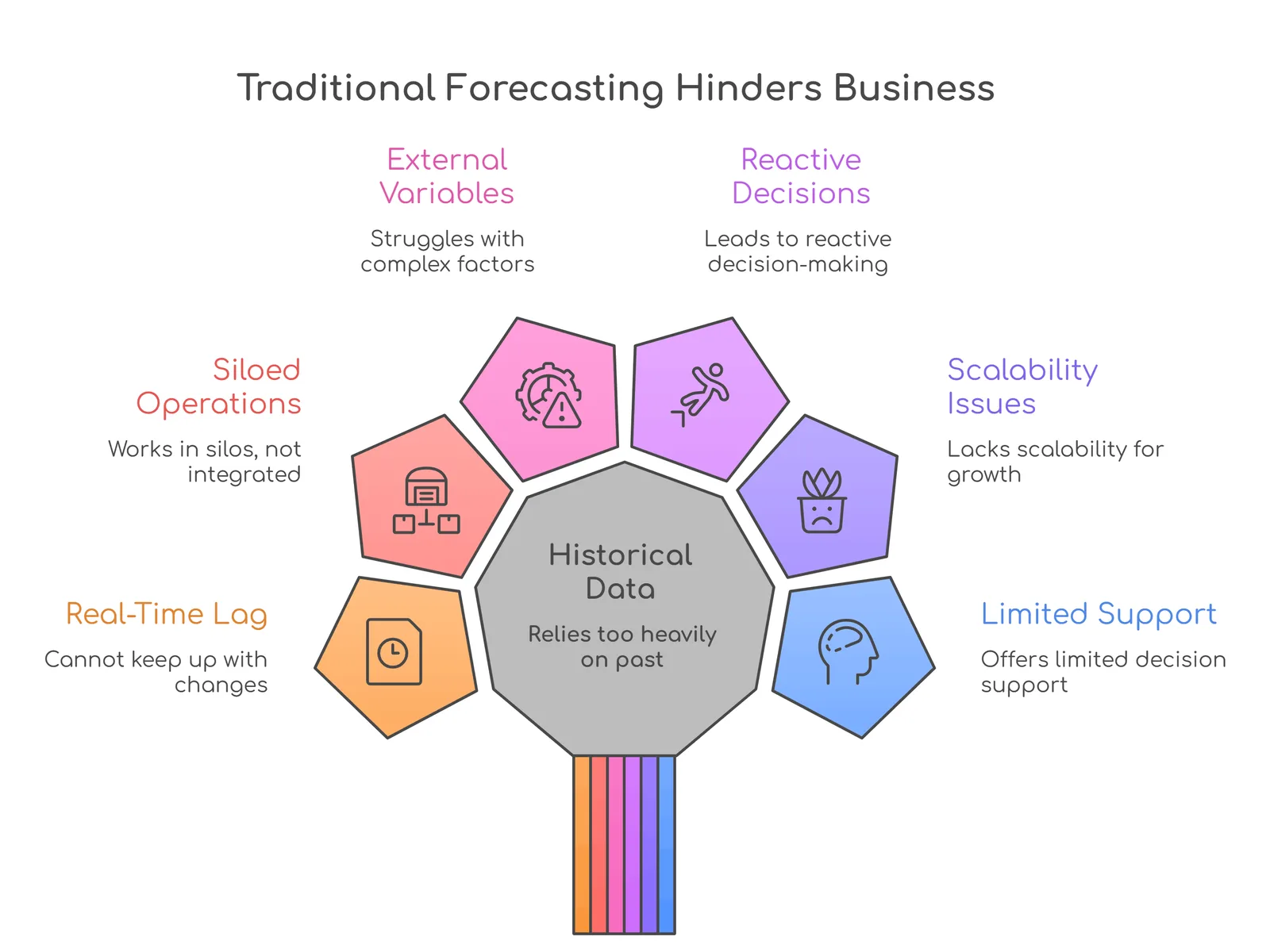
Leads to Reactive Decision-Making
Because traditional forecasting is slower and less adaptive, businesses often end up reacting to demand instead of anticipating it.
This shows up in familiar ways:
- Stockouts when demand rises unexpectedly
- Excess inventory when demand slows down
- Last-minute adjustments in production or supply chain
Instead of planning ahead, teams are constantly trying to catch up.
Lacks Scalability
As businesses grow, so does the complexity of forecasting.
Managing forecasts across multiple products, regions, and customer segments becomes difficult with manual processes and static models. Scaling traditional methods often requires more effort without delivering better accuracy.
This makes it hard for organizations to maintain consistency as they expand.
Offers Limited Decision Support
Traditional forecasts are often presented as reports rather than actionable insights.
They tell you what might happen, but not necessarily what to do next. This puts the burden back on teams to interpret data and make decisions, which can slow things down and introduce inconsistencies.
Traditional demand forecasting was built for a time when markets were more predictable, and data was limited. Today, businesses operate in an environment that is faster, more complex, and constantly changing. In this context, relying only on static, historical models creates blind spots.
To stay competitive, organizations need forecasting approaches that are dynamic, connected, and capable of adapting in real time. That is why many are moving beyond traditional methods and adopting AI-driven forecasting to better align with the realities of modern demand.
Establishing a Performance Measurement Framework for AI Demand Forecasting
So, once AI demand forecasting is in place, the next obvious question is simple.
Is it actually working?
Not just in terms of prediction accuracy, but in terms of real business impact.
Because the reality is this. A highly accurate forecast that does not influence decisions is just another dashboard. What leadership teams need is clarity on how forecasting is improving outcomes across the business. This includes inventory, revenue, responsiveness, and efficiency.
That is where a structured performance measurement framework becomes important.
Start with What the Business Actually Cares About
Before getting into metrics, it is important to define what success looks like.
For some organizations, success means fewer stockouts. For others, it means better use of working capital or improved service levels. The framework should always connect back to business priorities, not just technical performance.
Ask questions like:
- Are we meeting demand more consistently?
- Are we reducing excess inventory?
- Are teams making faster and more confident decisions?
These answers help shape what should be measured.
Go Beyond Accuracy and Measure Decision Impact
Forecast accuracy is important, but it should not be the only focus.
Two forecasts can show similar accuracy but lead to very different outcomes depending on how they are used. That is why it is important to measure how forecasts are influencing decisions.
For example:
- Are inventory decisions improving because of better forecasts?
- Is production planning more aligned with actual demand?
- Are pricing and promotion strategies becoming more effective?
This shifts the focus from “Was the prediction correct?” to “Did it help us make a better decision?”
Track Operational Improvements
AI demand forecasting should make operations more efficient and easier to manage.
This can be seen through:
- Reduction in stockouts and lost sales
- Lower levels of excess or obsolete inventory
- Faster response to demand changes
- Better coordination between teams
These are practical indicators that show whether forecasting is making a real difference on the ground.
Measure Responsiveness Along with Stability
Traditional forecasting often focuses on stability. In today’s environment, responsiveness matters just as much.
AI models update continuously based on new data. So the more relevant question is how quickly the system adapts when demand changes.
Organizations should track how fast forecasts respond to:
- Sudden spikes or drops in demand
- Market disruptions
- Seasonal or external changes
A system that adapts quickly helps the business stay ahead instead of reacting late.
Evaluate Financial Impact Clearly
At the leadership level, impact is often measured in financial terms.
AI demand forecasting should contribute to:
- Higher revenue by reducing missed sales opportunities
- Lower carrying costs by avoiding overstock
- Improved margins through better pricing and inventory decisions
These outcomes should be tracked and, where possible, quantified. This makes it easier to justify investments and scale initiatives.
Create Visibility Across Teams
Different teams often measure success in different ways.
Sales focuses on targets. Supply chain focuses on inventory. Finance focuses on costs. A strong framework brings all of this together into a shared view.
This can be done through:
- Centralized dashboards
- Common KPIs across teams
- Regular reviews based on forecasting outcomes
When everyone works from the same data, alignment improves naturally.
Build Feedback Loops into the System
AI models improve over time, but only if they receive the right feedback.
A strong framework includes continuous learning:
- Where did forecasts differ from actual demand?
- What signals were missed?
- How can the model improve going forward?
This creates a cycle where forecasting becomes more accurate and useful with each iteration.
Keep It Practical and Focused
It is easy to overcomplicate measurement frameworks with too many metrics.
The goal is not to track everything. The goal is to track what actually drives decisions.
A practical approach includes:
- A few metrics for accuracy
- A few for operational impact
- A few for financial outcomes
This balance gives a clear view without overwhelming teams.
A well-defined performance measurement framework turns AI demand forecasting into a true business capability. It ensures that forecasting is not just advanced, but also actionable and aligned with business goals.
For leadership teams, it answers a key question clearly: Is forecasting helping us run the business better? When the answer is yes, AI demand forecasting moves from being a technical upgrade to becoming a real driver of growth and efficiency.
Now, here’s a structured approach to implementing AI Demand Forecasting at scale
Once the foundation and measurement framework are clear, the next step is execution. Scaling AI demand forecasting is not about deploying a model and expecting results overnight. It requires a structured approach that connects data, teams, and decision-making across the organization.
Here’s how leading organizations are approaching it in a practical and scalable way.
Start with a Clear Business Use Case
Before getting into models or tools, define where AI forecasting will create the most value.
It could be reducing stockouts in a high-demand category, improving forecast accuracy for a specific region, or optimizing inventory for fast-moving products. Starting with a focused use case helps demonstrate impact quickly and builds internal confidence.
Instead of trying to solve everything at once, begin where the business pain is most visible.
Build a Strong Data Foundation
AI forecasting is only as good as the data behind it.
Organizations need to bring together data from multiple sources, such as sales history, inventory levels, customer behavior, promotions, and external signals like seasonality or market trends. Just as important is ensuring that this data is clean, consistent, and accessible.
At scale, this often means moving away from siloed datasets to a more unified data environment where information flows seamlessly across systems.
Choose the Right Models for the Right Context
There is no single model that works for every business scenario.
Different products, regions, and demand patterns require different approaches. Some may benefit from time-series models, while others may require machine learning models that can factor in multiple external variables.
The key is to remain flexible. Start with models that fit the current use case, and refine them as more data and insights become available.
Integrate Forecasting into Business Workflows
Forecasts only create value when they are used.
This means embedding AI forecasting outputs directly into operational workflows such as inventory planning, procurement, production scheduling, and sales planning. With company knowledge base teams can quickly access these insights and make decision.
For example, inventory teams should be able to act on forecasts without needing to interpret complex data separately. The more seamlessly forecasting integrates into daily decisions, the higher its adoption.
Enable Cross-Functional Collaboration
Demand forecasting does not belong to one team.
It sits at the intersection of sales, supply chain, operations, and finance. For AI forecasting to scale, these teams need to work with shared data and aligned objectives.
Creating common KPIs, shared dashboards, and regular alignment meetings helps ensure that everyone is working from the same version of demand.
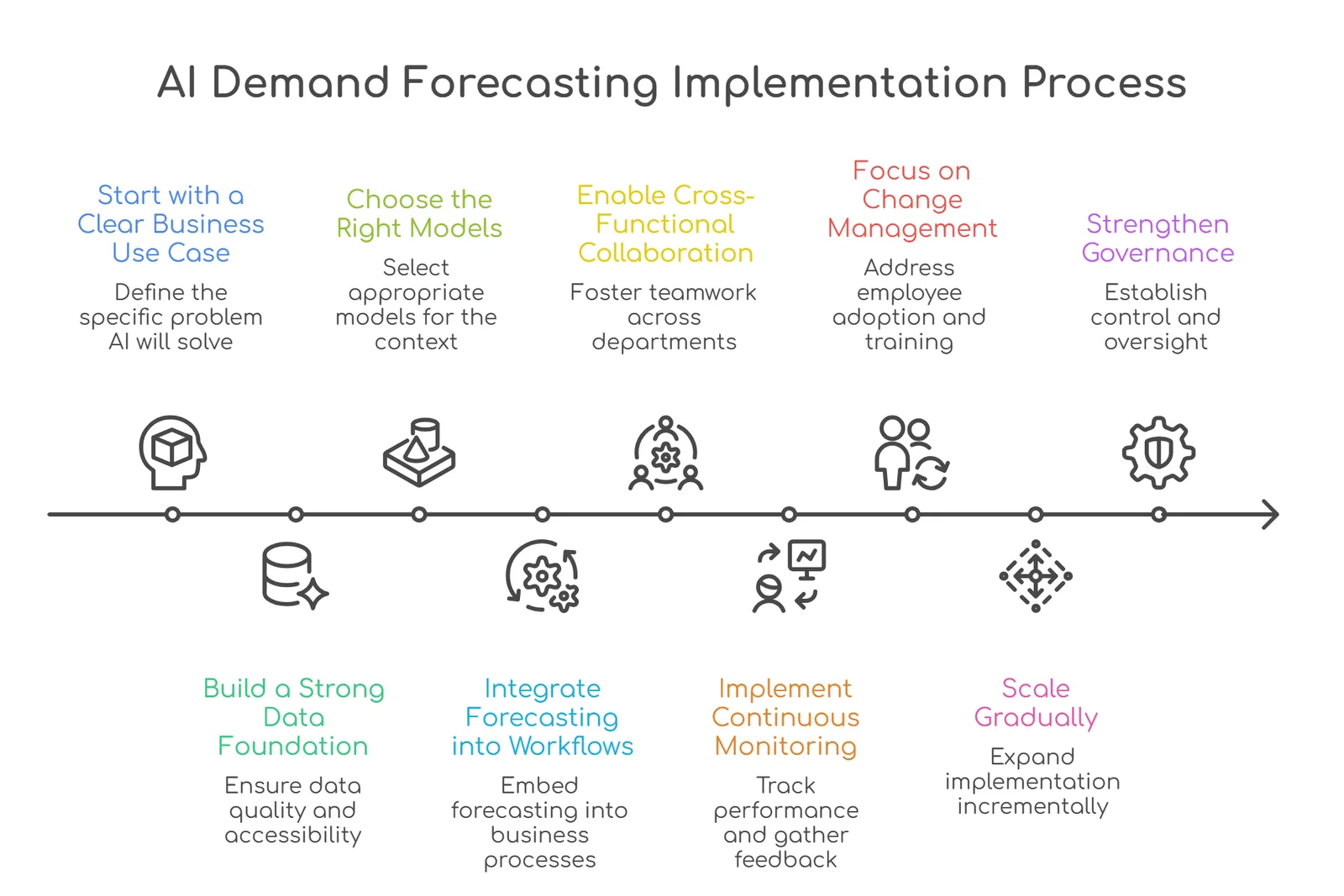
Implement Continuous Monitoring and Feedback
Markets change, customer behavior shifts, and new variables emerge. AI models need to keep up.
This requires continuous monitoring of forecast performance and regular feedback loops. When forecasts deviate from actual demand, teams should analyze why and use those insights to improve the models.
This ongoing refinement is what allows AI forecasting to stay relevant over time.
Focus on Change Management and Adoption
Technology alone does not drive transformation. People do.
Teams need to trust the forecasts and understand how to use them in their day-to-day roles. This may involve training, clear communication, and gradual adoption rather than forcing a complete shift all at once.
When users see consistent value, adoption happens naturally.
Scale Gradually, Then Expand
Once the initial use case proves successful, the next step is scaling.
This could mean expanding to more product categories, regions, or business units. It could also involve adding more advanced capabilities, such as real-time demand sensing or scenario-based forecasting.
Scaling should be done in phases, ensuring that each step delivers measurable value before moving to the next.
Strengthen Governance and Control
As AI forecasting expands across the organization, governance becomes critical.
Organizations need clear guidelines on how models are developed, validated, and monitored. This includes ensuring data privacy, maintaining transparency in decision-making, and managing risks associated with automated predictions.
A strong governance layer ensures that forecasting remains reliable and aligned with business and regulatory expectations.
Implementing AI demand forecasting at scale is not a one-time initiative. It is an ongoing process that evolves with the business.
When done right, it connects data, technology, and teams into a single system that continuously learns and improves. The result is a more responsive organization that can anticipate demand, act faster, and make decisions with greater confidence. For leadership teams, this structured approach ensures that AI forecasting is embedded into how the business operates every day.
Client Outcome: See how we implemented AI-Driven Load Balancing for ENEready
For the ENEReady project, a Singapore-based EV charging platform, we at Antino worked on building an intelligent, future-ready system to improve how energy is distributed across EV charging networks. The core focus was to bring AI-driven load balancing into the platform, ensuring that power is allocated efficiently across multiple chargers, even during peak demand.
Here’s how we approached it:
- AI-Powered Management System
We designed and developed a centralized platform that manages both EV chargers and users in a seamless way. By embedding AI into the system, we enabled smarter monitoring and real-time decision-making, allowing the platform to distribute load efficiently without manual intervention.
- Real-Time Energy Optimization
Our solution leverages advanced energy management capabilities to dynamically adjust power distribution based on live demand and charger availability. This ensures that energy is not only utilized efficiently but also prevents overloading or underutilization across the network.
- Multi-Brand Charger Integration
One of the key challenges was ensuring compatibility across different EV charger brands. We built the platform as an open and flexible system that can integrate with multiple charging infrastructures, enabling centralized control and consistent load balancing across a diverse ecosystem.
- Scalable PaaS and API-First Architecture
To support long-term scalability, we implemented a Platform-as-a-Service model with an API-first approach. This allows the system to easily connect with external hardware, third-party services, and power grid systems, making it adaptable as the network expands.
- Automated Billing and Monitoring
Beyond energy distribution, we streamlined operational workflows by enabling automated billing, payment processing, and reporting. The platform provides clear summaries and insights, reducing manual effort and improving overall efficiency.
Supporting Technology Stack
To ensure the platform remains secure, scalable, and reliable, we integrated a strong technology foundation:
- AWS Amplify for secure and seamless user authentication
- Stripe for handling complex payment flows and automated billing cycles.
Enhanced User Experience
We also focused on making the platform intuitive and user-friendly by introducing features such as:
- EV charger locator for easy discovery
- Slot reservation to reduce wait times
- QR-based charger scanning for quick and seamless access
By combining AI-driven load balancing with a scalable and integrated platform, we helped ENEReady build a system that not only optimizes energy distribution but also simplifies operations and enhances the overall EV charging experience.
So, How can Antino help you optimize the inventory with futuristic AI demand forecasting?
If inventory decisions still rely on static forecasts and delayed signals, you are likely carrying more risk than visibility. Antino is a leading AI development company that helps organizations shift from reactive inventory planning to intelligent, AI-driven demand forecasting that adapts in real time. By combining advanced analytics, machine learning models, and unified data ecosystems, we enable businesses to predict demand with greater precision, reduce excess stock, and avoid missed sales opportunities. The result is a more responsive supply chain where inventory moves in sync with actual demand, not assumptions.
Our approach goes beyond just forecasting. We work with your teams to embed AI directly into planning workflows, ensuring that insights translate into action across procurement, operations, and sales. Whether you are looking to optimize stock levels, improve demand visibility, or scale forecasting across regions and product lines, Antino helps you build a future-ready system that delivers measurable business outcomes. If you are ready to make inventory a strategic advantage instead of a challenge, now is the time to start the conversation.
Short on time? Here’s the summary…
- AI demand forecasting shifts you from reactive to proactive planning, helping you anticipate demand instead of catching up with it.
- Traditional forecasting falls short due to its reliance on historical data, lack of real-time adaptability, and siloed decision-making
- AI connects multiple data signals in real time, including customer behavior, market trends, and external factors, to deliver more accurate and dynamic forecasts.
- Inventory optimization becomes more precise, reducing stockouts, minimizing excess inventory, and improving working capital efficiency.
- AI enables end-to-end alignment across teams, bringing sales, supply chain, operations, and finance onto a single demand view.
- Key use cases include real-time inventory planning, dynamic pricing, demand-supply alignment, new product forecasting, and demand sensing.
- AI-managed forecasting improves responsiveness, allowing businesses to adapt quickly to demand spikes, disruptions, and market shifts.
- Performance measurement is critical, focusing not just on accuracy but also on decision impact, operational efficiency, and financial outcomes.
- Successful implementation requires a structured approach, including strong data foundations, workflow integration, cross-functional collaboration, and continuous model improvement.
- Scalability depends on governance and adoption, ensuring models remain reliable, transparent, and aligned with business goals.
- Real-world implementations like ENEReady highlight Antino’s capability to build AI-driven, scalable systems that optimize complex resource distribution.
- With the right partner like Antino, AI demand forecasting becomes a strategic advantage, helping organizations build smarter, faster, and more resilient supply chains.