

Want to buy something? Pay it online.
Want to transfer money? Do it online.
Want to book tickets? Just book it online.
Want to split the bill? That happens online, too!
Take a moment to think about all the people transacting digitally on a daily basis. Digital payment volume has already exceeded trillions of dollars each year and is projected to continue to rise through 2026. Digital Payments have become an integral part of how companies can compete, scale, and retain customers.
Today’s payments infrastructure has now become an actual competitive advantage for businesses. As a result, fintechs and enterprises alike are investing heavily in their own payment gateway development, thereby decreasing dependency on other entities, increasing their profit margins, and providing faster, seamless experiences when conducting transactions.
That’s why many businesses are transitioning away from relying entirely on outside gateways to a more adaptable, customized solution. Now, you must be wondering, if every type of transaction is possible online, then what exactly drives this whole process?
Well, this is where the payment gateway comes into the limelight.
Each year, trillions of online transactions happen worldwide (And we’re not joking!!). We buy things online all the time and most of the time don’t realize that there is a lot of new technology working behind the scenes. One of the most important technologies supporting online purchases is the payment gateway. Payment gateways allow customers to transfer funds to merchants through their banking institutions securely.
Here are some numbers to break it down better…
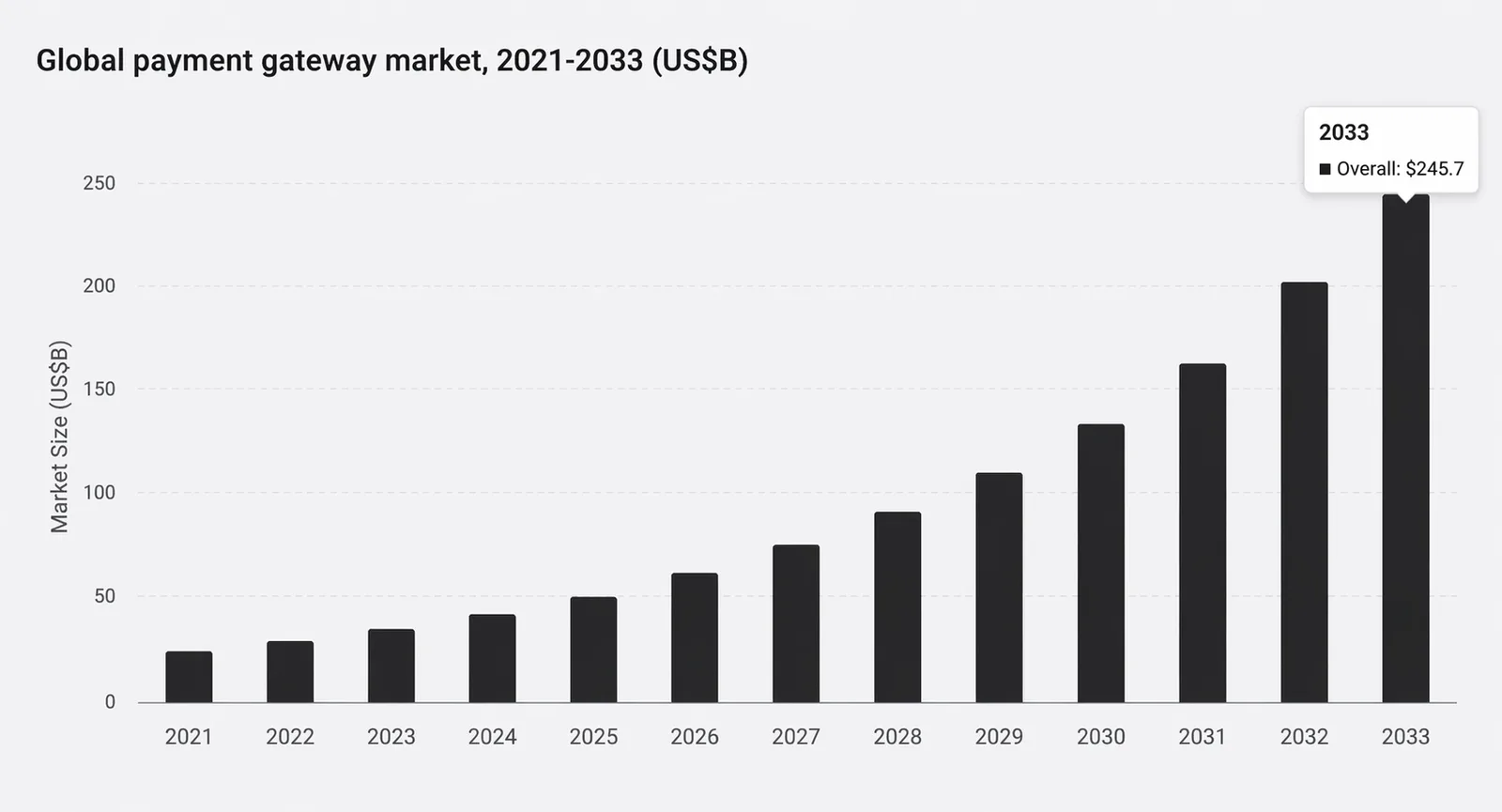
- The payment gateway market size is estimated to be, in the year 2025, worth $48.2 billion and is projected to reach $245.7 billion by 2033, growing 22.7% CAGR from the period of 2026 through 2033.
- Digital payment volume is expected to grow from 206 billion transactions in FY25 to 617 billion transactions in FY30, and digital payment value is expected to grow from INR 299 trillion in FY25 to INR 907 trillion in FY30, approximately 3x over five years.
- In a country such as India, companies using UPI for payment will continue to account for over 60% of total payment volume processed through a payment gateway, and thus, will result in significant amounts of real-time transaction processing volume for payment gateway processors.
- By the year 2030, AI/ML will have a significant impact on the way that payment gateways leverage technology to identify risk on a real-time basis, as well as detect and prevent fraud.
Aren’t you surprised, after looking at these numbers? Well, we all are! And, according to our FinTech head & VP - Technology, Mr. Aditya Pranav, these numbers are only going to rise in the near future, and this is just the beginning…
Increasing role of Payment Gateways with the rise of digital payments
Digital payments are no longer just a convenience. They have become the default. From everyday purchases to high-value transactions, everything now moves through digital rails. And at the center of this entire ecosystem sits one critical layer that most people rarely think about: the payment gateway software development.
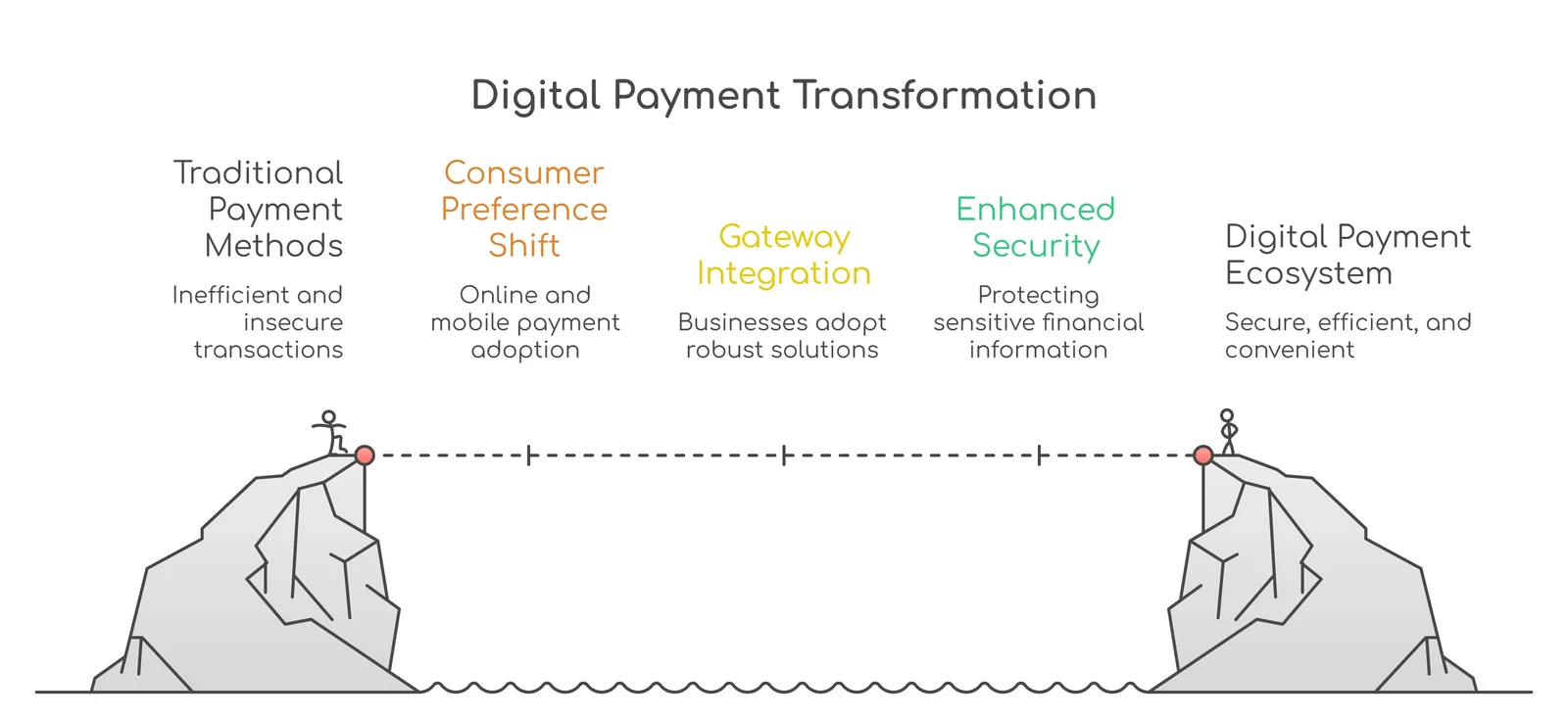
A payment gateway is not just a tool that “processes payments.” It is the engine that makes digital commerce possible. As digital transactions continue to grow at scale, the role of payment gateways has expanded far beyond basic authorization and settlement.
Acts as a Business Enabler
Earlier, payment gateways were seen as a simple bridge between a customer’s bank and a merchant. Today, they are deeply embedded in the entire customer journey.
Modern payment gateways now handle:
Real-time transaction processing
Fraud detection and risk management
Currency conversions for global payments
Subscription billing and recurring payments
Data insights and reporting
What changed?
Businesses realized that payments are not the last step in a transaction. They are a key part of the user experience.
A slow or failed payment can directly impact conversions. A smooth, fast checkout can increase revenue instantly.
Powering Seamless Customer Experiences
Think about how people pay today. One-click checkouts, saved cards, UPI, wallets, BNPL, subscriptions. All of this is powered by advanced payment gateway capabilities.
Customers expect:
Faster checkout
Multiple payment options
Zero friction
Payment gateways make this possible by integrating directly into apps, websites, and even offline systems.
Example: When you tap your phone to pay or complete a purchase in seconds without entering details, it is the gateway optimizing that experience in the background.
Supporting the Growth of Fintech and Digital Businesses
For fintech companies and digital-first businesses, payment gateways are not just infrastructure. They are part of the product.
They enable:
Embedded finance experiences
Instant payouts and settlements
Cross-border transactions
Real-time transaction tracking
This is why many companies are now building custom payment stacks instead of relying entirely on third-party solutions.
Data is the Crux
Here is something most people do not realize.
Payment gateways are sitting on some of the richest real-time data in any business.
Every transaction tells a story:
What customers are buying
When they are buying
How they prefer to pay
Where drop-offs happen
Businesses that leverage this data can:
Optimize pricing strategies
Improve checkout flows
Personalize offers
Predict customer behavior
In many ways, payment gateways are quietly becoming powerful analytics engines.
Orchestration and Routing
One thing that often goes unnoticed is how modern payment gateways decide how a transaction gets processed.
Behind the scenes, advanced gateways:
Route transactions through different processors
Optimize success rates by choosing the best path
Reduce failures by switching networks in real time
Example: If one payment route fails, the system can instantly retry through another, without the customer even noticing.
This invisible layer of intelligence plays a huge role in improving payment success rates and revenue.
Security and Trust
With the rise in digital payments, security has become non-negotiable.
Payment gateways now handle:
Encryption of sensitive data
Tokenization of card details
Fraud detection using AI
Compliance with global standards
Without this layer, digital payments at today’s scale would simply not be possible.
As digital payments continue to grow, payment gateways are becoming far more than just a backend utility. They are shaping how businesses operate, how customers experience transactions, and how revenue flows.
The interesting part? Most of this happens silently in the background.
And the businesses that truly understand this are not just using payment gateways. They are leveraging them as a strategic advantage.
How to develop a Payment Gateway?
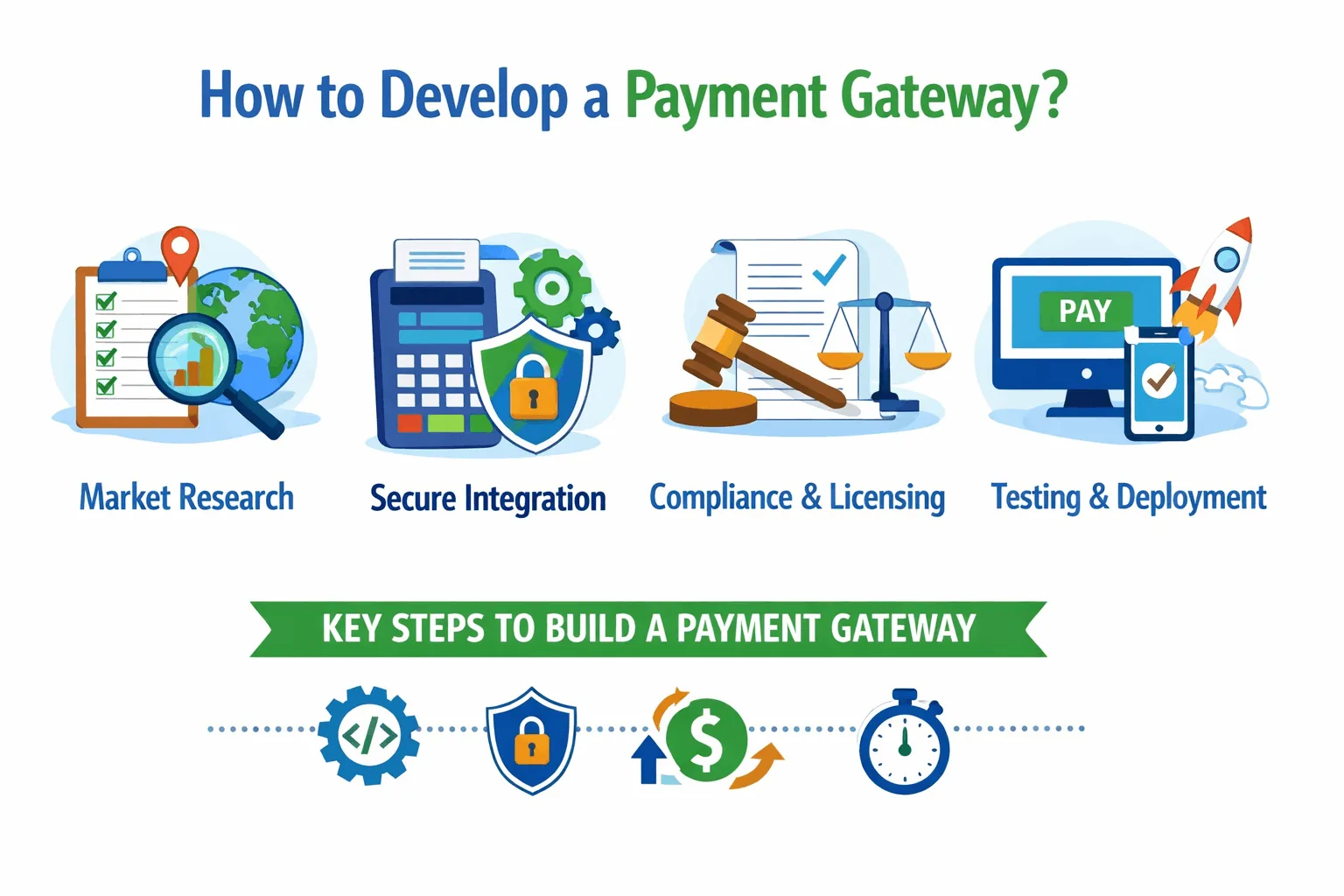
Building a payment gateway is not just about enabling transactions. It is about creating a secure, reliable, and scalable system that can handle money movement in real time without errors or risks. From compliance to integrations, every step needs to be planned carefully because even a small gap can impact trust and revenue.
Here is a detailed, step-by-step breakdown of how a payment gateway is developed…
1. Define Your Business Model and Scope
Start by getting clear on what you are building and for whom.
Ask questions like:
- Will this be for your own platform or offered as a service to other businesses?
- Do you want to support local payments, global payments, or both?
- Will you handle one-time payments, subscriptions, or payouts as well?
This step decides your entire architecture and compliance requirements.
2. Understand Compliance and Legal Requirements
Payments involve sensitive financial data, so compliance is critical from day one.
You need to align with:
- PCI-DSS standards for handling card data
- KYC and AML regulations
- Local financial and regulatory guidelines
Skipping this step can lead to legal issues and security risks later.
3. Choose the Right Technology Stack
Your tech stack should support speed, scalability, and security.
Key components include:
- Backend for transaction processing
- Frontend for checkout experience
- Database for storing transaction data
- APIs for integrations
Also, decide whether you want a cloud-based setup or an on-premise infrastructure.
4. Build a Secure Payment Flow
This is the core of your gateway.
A typical flow includes:
- Customer enters payment details
- Data is encrypted and sent securely
- The request is forwarded to the acquiring bank
- The card network validates the transaction
- The issuing bank approves or declines
- The response is sent back to the user
Every step must be fast and secure.
5. Integrate with Banks and Payment Networks
To process payments, your gateway must connect with:
- Acquiring banks
- Card networks
- Alternative payment providers (UPI, wallets, etc.)
These integrations ensure that transactions can be authorized and settled correctly.
6. Implement Strong Security Measures
Security is the backbone of any payment system.
Key features include:
- End-to-end encryption
- Tokenization of card data
- Multi-factor authentication
- Fraud detection systems
The goal is to protect both the business and the customer at all times.
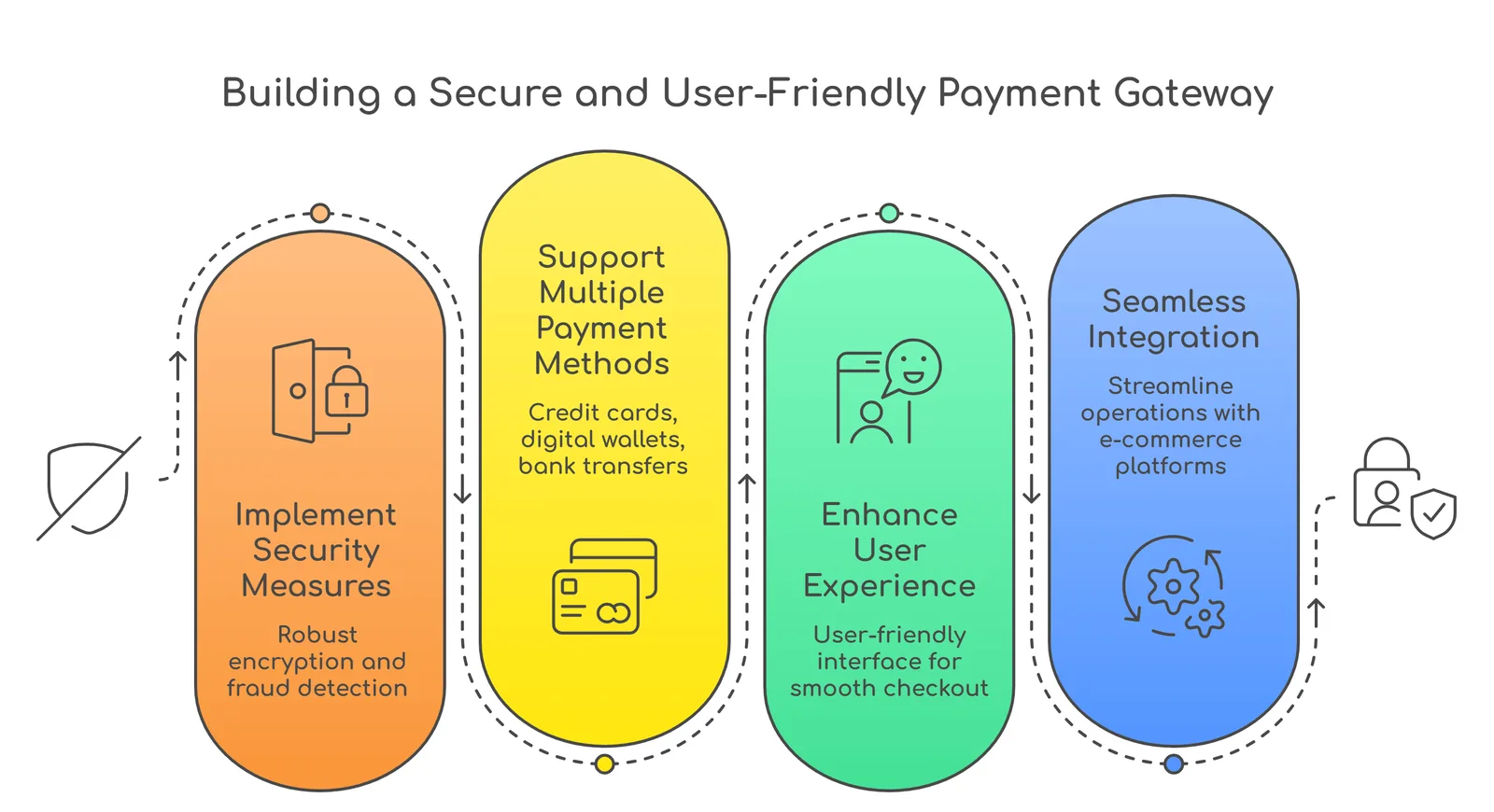
7. Enable Multiple Payment Methods
Customers expect flexibility in how they pay.
Your gateway should support:
- Credit and debit cards
- UPI and bank transfers
- Digital wallets
- Buy Now Pay Later options
More payment options usually mean higher conversion rates.
8. Build a Smooth Checkout Experience
A complicated checkout leads to drop-offs.
Focus on:
- Fast loading time
- Minimal steps
- Mobile-friendly design
- One-click or saved payment options
The easier it is to pay, the better your results.
9. Add Payment Routing and Optimization
Advanced gateways use smart routing to improve success rates.
This means:
- Choosing the best payment route automatically
- Retrying failed transactions through alternate paths
This improves reliability without affecting the user experience.
10. Develop Reporting and Analytics
Businesses need visibility into their transactions.
Your system should provide:
- Real-time transaction tracking
- Settlement reports
- Failure analysis
- Customer insights
This helps in better decision-making.
11. Test Everything Thoroughly
Before going live, testing is critical.
Test for:
- Transaction success and failure scenarios
- Security vulnerabilities
- Load handling under high traffic
- Integration stability
A small bug in payments can lead to major losses.
12. Deploy and Monitor Continuously
Once live, your work is not done.
You need to:
- Monitor transactions in real time
- Track failures and optimize performance
- Update security measures regularly
- Scale infrastructure as demand grows
13. Plan for Scalability and Future Growth
As your business grows, your gateway should grow with it.
Think about:
- Handling higher transaction volumes
- Expanding to new geographies
- Adding new payment methods
- Integrating new technologies like AI
Developing a payment gateway is a complex but highly rewarding process. It requires a strong focus on security, performance, and user experience. The key is to build a system that not only processes payments but also enhances how your business operates. Because in today’s digital world, payments are a core part of your product experience.
Custom Payment Gateway v/s Third-Party Solutions
When it comes to handling payments, businesses usually face one big decision. Do you build your own payment gateway or use a third-party solution like a money transfer app?
At first, third-party gateways feel like the obvious choice. They are quick to set up, easy to use, and require minimal effort. But as businesses grow, payment needs become more complex. This is where the limitations start to show, and many companies begin exploring custom-built solutions.
Let’s break this down in a way that actually helps you decide.
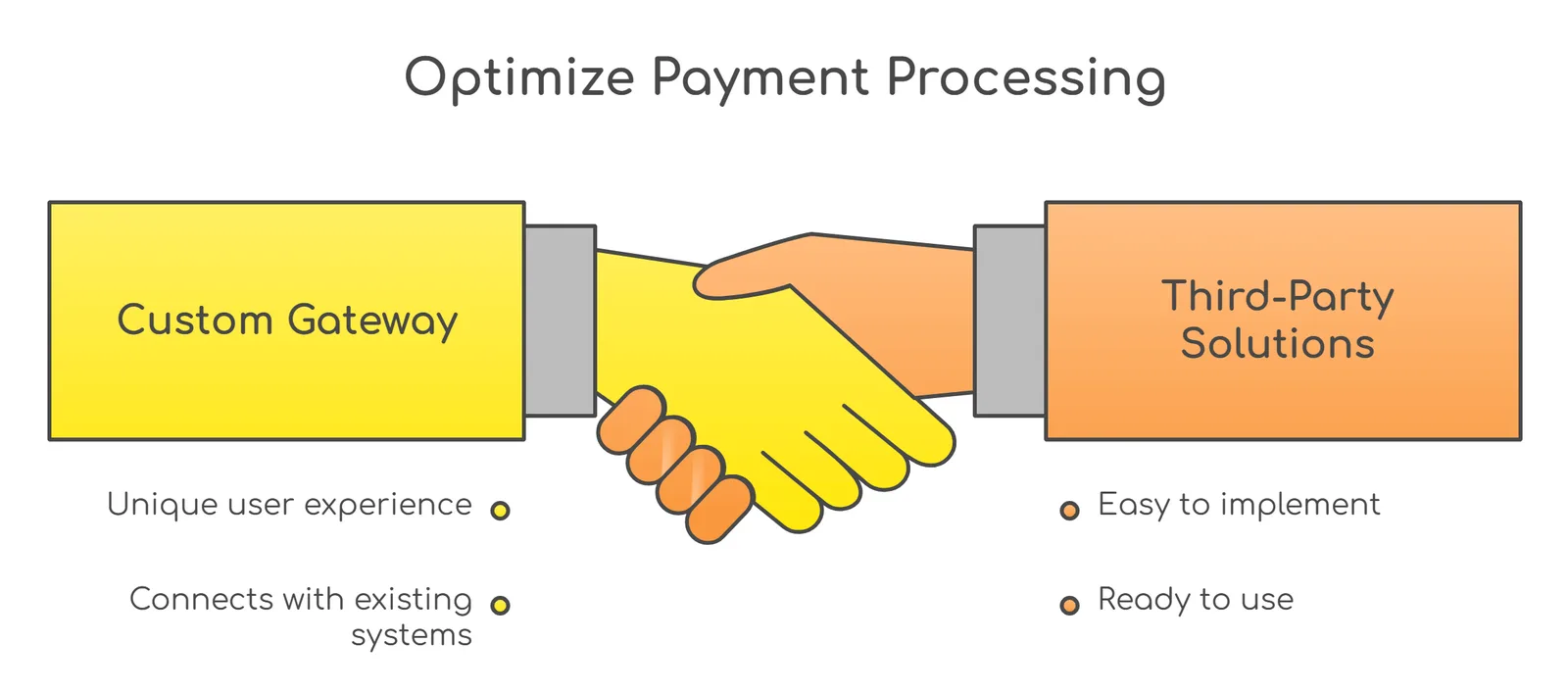
Third-Party Payment Gateways
These are ready-made solutions that allow businesses to start accepting payments almost instantly.
Why do businesses choose them?
- Quick integration and faster go-live
- No need to manage infrastructure
- Built-in compliance and security
- Ideal for startups and small businesses
Where do they fall short?
- Limited customization
- Transaction fees on every payment
- Less control over user experience
- Dependency on external providers
Example: If you are just starting an e-commerce store, a third-party gateway helps you go live without worrying about technical complexity.
Custom Payment Gateway
A custom payment gateway is built specifically for your business needs. It gives you full control over how payments are processed, managed, and optimized.
Why do businesses go custom?
- Tailored checkout experience
- Better control over transaction flow
- Ability to optimize routing and reduce failures
- Lower long-term costs at scale
- Deeper data insights and analytics
Challenges to consider
- Higher initial investment
- Longer development time
- Requires ongoing maintenance and compliance management
Example: A large fintech platform is building its own gateway to manage high transaction volumes and reduce dependency on third parties.
| Factor | Custom Payment Gateway | Third-Party Gateway |
| Setup Time | Longer | Quick and easy |
| Initial Cost | High | Low |
| Transaction Fees | Lower at scale | Higher per transaction |
| Customization | Fully customizable | Limited |
| Control | Full control over payments and data | Dependent on the provider |
| Scalability | High, built for growth | Can become restrictive |
| Security Control | Managed internally | Managed by the provider |
| Maintenance | Requires ongoing effort | Handled by the provider |
So, what should you choose?
If you are in the early stages, speed matters more than control. A third-party gateway makes sense.
But if payments are becoming a core part of your business, and you want better control, flexibility, and long-term efficiency, a custom payment gateway becomes a smarter move.
There is no one-size-fits-all answer here. It depends on where your business stands today and where you want to go. The real shift happens when you stop seeing payments as just a feature and start treating them as a strategic advantage.
Must-have features of a Payment Gateway
A payment gateway today is not just about completing transactions. It plays a direct role in customer experience, conversion rates, security, and even business insights. With digital payments becoming the default, businesses expect their payment systems to be fast, flexible, and intelligent.
If you are building or choosing a payment gateway, here are the features that are no longer optional.
1. Multi-Payment Support
Customers want flexibility in how they pay.
A modern gateway should support:
- Credit and debit cards
- UPI and bank transfers
- Digital wallets
- Buy Now Pay Later options
The more options you provide, the easier it becomes for customers to complete a transaction.
2. Seamless and Fast Checkout Experience
Checkout is where most drop-offs happen.
Your gateway should ensure:
- Minimal steps
- Quick loading time
- Mobile-first design
- One-click payments or saved details
A smooth checkout can directly improve conversion rates.
3. Advanced Security and Compliance
Handling payments means handling sensitive data.
Essential security features include:
- End-to-end encryption
- Tokenization of card data
- Multi-factor authentication
- Compliance with global standards
Without strong security, trust breaks instantly.
4. Smart Payment Routing
Not all transactions succeed on the first attempt.
Modern gateways use intelligent routing to:
- Choose the best payment processor
- Retry failed transactions automatically
- Improve overall success rates
This happens in the background without affecting the user experience.
5. Real-Time Analytics and Reporting
You cannot improve what you cannot see.
A good payment gateway should offer:
- Real-time transaction tracking
- Success and failure rate insights
- Settlement reports
- Customer behavior data
This helps businesses make faster and smarter decisions.
6. AI-Powered Fraud Detection
Fraud is becoming more sophisticated, and traditional rule-based systems are no longer enough.
AI-driven systems can:
- Detect unusual transaction patterns
- Flag suspicious activities in real time
- Learn and adapt to new fraud tactics
This adds an extra layer of protection without slowing down transactions.
7. Personalized Payment Experience (AI-Driven)
Payment gateways are now becoming more customer-aware.
With AI, they can:
- Recommend preferred payment methods
- Offer dynamic checkout experiences
- Apply personalized offers or discounts
Example: A returning user might automatically see their most-used payment option at the top.
8. Recurring Payments and Subscription Management
For businesses with subscription models, this is critical.
The gateway should support:
- Automated recurring billing
- Flexible billing cycles
- Easy upgrades and downgrades
This ensures a smooth experience for both businesses and customers.
9. Cross-Border Payment Support
If you are operating globally, your gateway should handle:
- Multiple currencies
- Local payment methods
- Currency conversion
This removes barriers for international customers.
10. API-First Architecture
Flexibility matters when integrating payments into different platforms.
An API-first gateway allows:
- Easy integration with apps and websites
- Custom workflows
- Faster deployment
This is especially important for growing businesses.
11. Scalability and High Performance
Your payment system should grow with your business.
It should be able to:
- Handle high transaction volumes
- Maintain speed during peak times
- Scale without downtime
12. Embedded Payments Capability
Payments are increasingly becoming part of the product experience.
Gateways should allow:
- In-app payments
- Invisible or background transactions
- Smooth integration into user journeys
13. Voice and Contactless Payment Support
With evolving user behavior, payment methods are also changing.
Modern gateways are starting to support:
- Voice-initiated payments
- Tap-to-pay and contactless transactions
This improves speed and convenience.
14. Intelligent Reconciliation and Automation
Managing transactions manually can be time-consuming.
Advanced gateways offer:
- Automated reconciliation
- Smart matching of transactions
- Reduced manual effort in accounting
In 2026, a payment gateway is a critical part of your business strategy. The difference between an average and a great payment experience often comes down to these features. And as AI continues to evolve, the gateways that adapt faster will not just process payments better, they will help businesses grow smarter.
What does it take to build a bulletproof payment gateway?
Building a payment gateway is one thing. Building a bulletproof one is a completely different game.
When money is involved, there is zero room for failure. A single glitch can lead to lost revenue, broken trust, or even compliance issues. So the focus is not just on making payments work, but on making them secure, reliable, and seamless under any condition.
Here is what it actually takes…
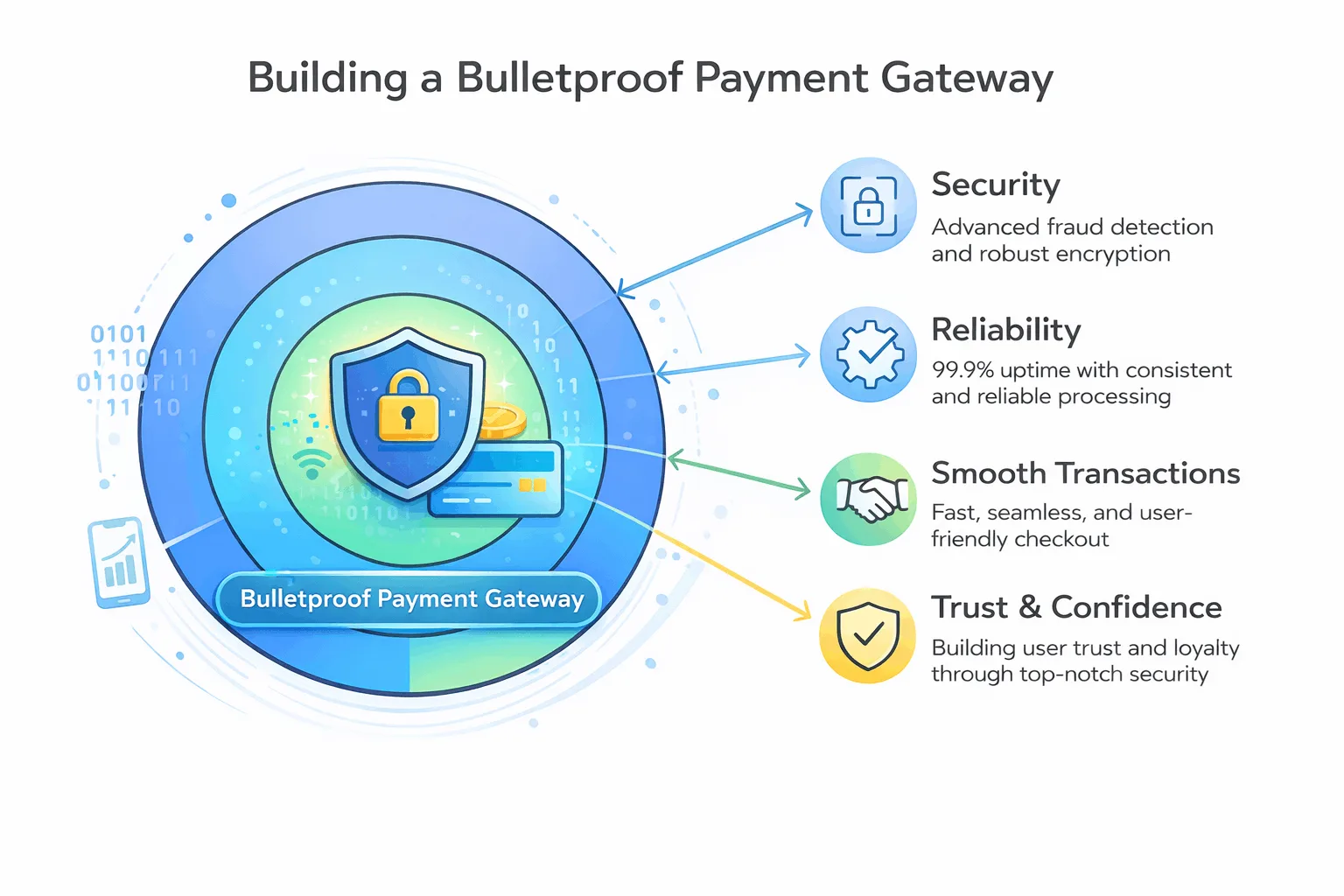
1. Rock-Solid Security at Every Layer
Security is the foundation. Without it, nothing else matters.
A bulletproof gateway must include:
- End-to-end encryption for all transactions
- Tokenization to protect sensitive card data
- Multi-factor authentication
- Real-time fraud detection systems
It is not just about preventing attacks, but about staying ahead of evolving threats.
2. High Reliability and Uptime
Payments cannot afford downtime.
Your system should be designed for:
- Near 100% uptime
- Failover mechanisms in case of system issues
- Redundant servers and backup systems
Example: If one server fails, another should take over instantly without affecting transactions.
3. Intelligent Payment Routing
Not all transactions succeed through the same route.
A strong gateway uses smart routing to:
- Choose the best-performing payment processor
- Retry failed transactions automatically
- Improve overall success rates
This directly impacts revenue without the user even noticing.
4. Speed and Performance
Even a few seconds of delay can cause users to drop off.
A bulletproof system ensures:
- Fast transaction processing
- Minimal latency
- Smooth checkout experience
Speed is not just a technical factor; it is a business advantage.
5. Compliance and Regulatory Readiness
Payments are heavily regulated.
Your gateway must align with:
- Global and local compliance standards
- Data protection regulations
- Financial security requirements
This ensures long-term sustainability and trust.
6. Scalability for Growth
Your gateway should handle growth without breaking.
It must be able to:
- Process high volumes of transactions
- Scale during peak traffic
- Support expansion into new markets
7. Seamless Integration Capabilities
A payment gateway does not work in isolation.
It needs to connect with:
- Banking systems
- Payment networks
- Business applications like CRM or ERP
An API-first approach makes this easier and faster.
8. Real-Time Monitoring and Alerts
You cannot fix what you cannot see.
A robust system should provide:
- Real-time transaction monitoring
- Instant alerts for failures or anomalies
- Performance tracking dashboards
This helps teams respond quickly to any issue.
9. Data Intelligence and Insights
A bulletproof gateway does more than process payments. It helps you understand them.
With the right data, businesses can:
- Identify drop-off points
- Improve conversion rates
- Understand customer behavior
10. Exceptional User Experience
At the end of the day, the user experience matters most.
A strong gateway ensures:
- Simple and intuitive checkout
- Multiple payment options
- Minimal friction
Because even the most secure system fails if users abandon the process.
11. Continuous Testing and Upgrades
Building it once is not enough.
A bulletproof gateway requires:
- Regular security testing
- Performance optimization
- Updates to handle new technologies and threats
A bulletproof payment gateway is not built overnight. It is the result of careful planning, strong architecture, and continuous improvement. It is where security meets speed, and reliability meets user experience.
And in a world where digital payments are at the core of every business, getting this right is not optional. It is what separates businesses that simply process payments from those that truly own the experience.
Cost to develop a custom payment gateway
Building a custom payment gateway is a serious investment, but it is also what gives businesses full control over their payment experience, costs, and scalability. Unlike plug-and-play solutions, a custom gateway is designed around your workflows, your users, and your growth plans.
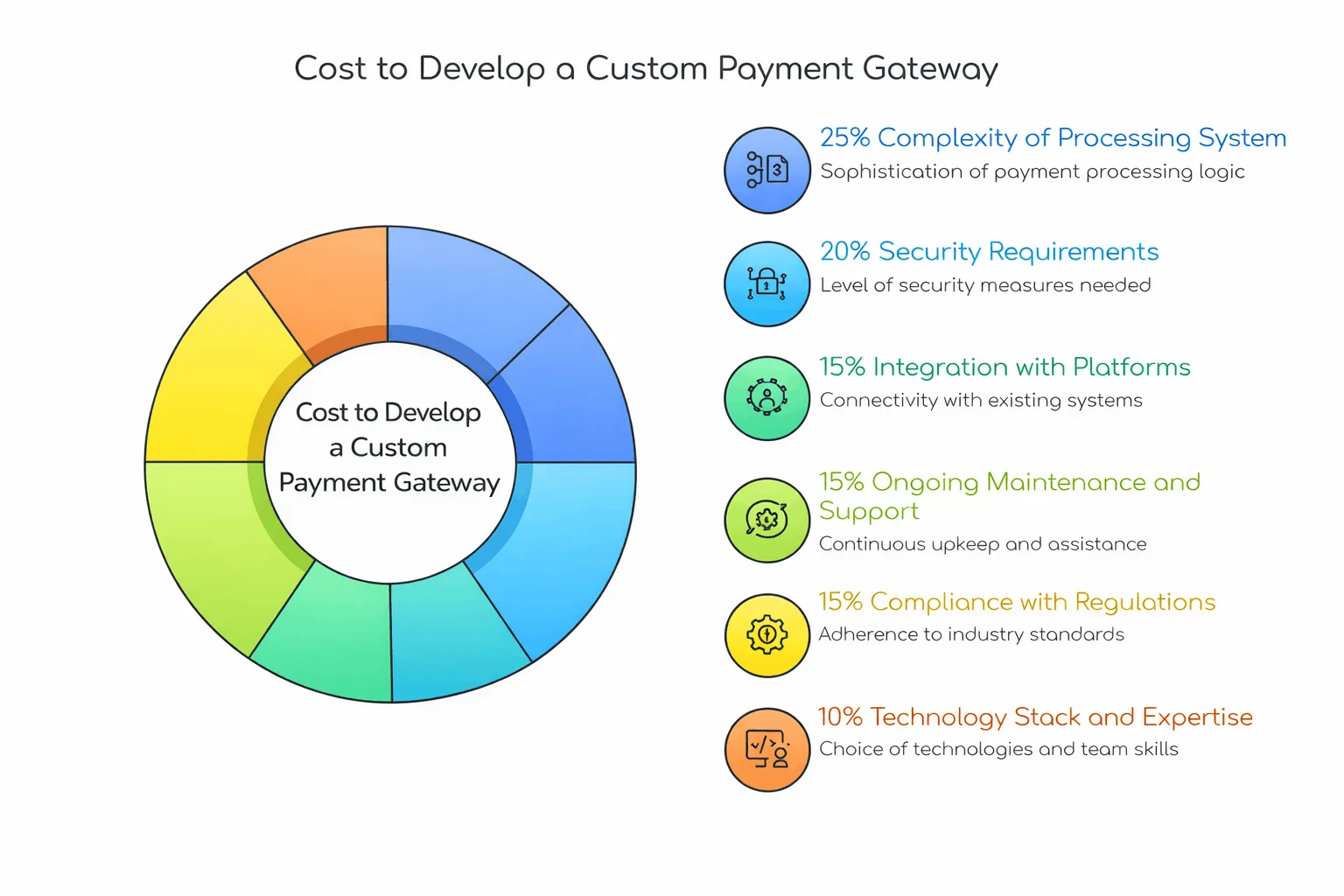
The cost can vary a lot depending on what you are building. A simple gateway that supports basic transactions will cost far less than a feature-rich platform with AI, fraud detection, global payments, and smart routing. So instead of looking at one fixed number, it is better to understand what drives the cost.
What impacts the cost?
Here are the main factors that influence how much you will spend:
- Features and complexity
Basic payment processing is cheaper. Adding subscriptions, analytics, AI, and routing increases cost.
- Security and compliance
Implementing PCI-DSS, encryption, tokenization, and fraud detection requires time and expertise.
- Integrations
Connecting with banks, card networks, UPI, wallets, and third-party systems adds complexity.
- UI/UX and checkout experience
A smooth, conversion-focused checkout requires proper design and testing.
- Scalability requirements
Systems built for high transaction volumes or global markets cost more.
- AI and advanced capabilities
Features like fraud detection, personalization, and predictive analytics increase investment.
- Maintenance and upgrades
Ongoing monitoring, updates, and security enhancements are part of the long-term cost.
Cost comparison based on complexity
| Level | What It Includes | Estimated Cost (USD) | Timeline |
| Basic Gateway | Payment processing, limited payment methods, basic security, simple checkout | $20,000 - $50,000 | 2 - 4 months |
| Advanced Gateway | Multi-payment support, integrations, analytics, better security, and routing | $50,000 - $120,000 | 4 - 8 months |
| Feature-Rich Gateway | AI fraud detection, smart routing, global payments, subscriptions, full control | $120,000 - $300,000+ | 8 - 12+ months |
What does each level look like?
- Basic Gateway
Best for startups or businesses testing their payment flow. It covers essential functionality but may rely on limited features.
Example: Simple checkout with card and UPI payments.
- Advanced Gateway
Suitable for growing businesses that need better control, integrations, and insights.
Example: Multi-payment options with analytics and improved success rates.
- Feature-Rich Gateway
Designed for enterprises or fintech platforms where payments are a core part of the product.
Example: AI-driven fraud detection, global transactions, smart routing, and personalized checkout experiences.
Ongoing costs to consider
Building the gateway is just the beginning. You also need to plan for:
- Infrastructure or cloud hosting
- Compliance updates and audits
- Security upgrades
- Feature enhancements
- Monitoring and support
A custom payment gateway is not just a technical build. It is a long-term investment in control, performance, and customer experience. If payments are a core part of your business, going custom can help you reduce dependency, improve margins, and create a smoother, more reliable experience for your users. The key is to start with the right scope and scale it as your business grows.
Compliance & Licensing Requirements: USA v/s UAE v/s UK v/s India
Building or operating a payment gateway is not just a technical challenge. It is equally about navigating regulations, licenses, and compliance frameworks that vary from country to country. Each market has its own rules around how payments are processed, how data is handled, and who is allowed to operate.
If you are planning to launch or scale a payment gateway globally, understanding these differences is critical.
United States
The US has one of the most complex regulatory environments because rules can vary at both the federal and state levels.
Key requirements
- Money Transmitter Licenses (MTLs) in multiple states
- Registration with financial authorities
- Strict compliance with anti-money laundering and KYC regulations
- PCI-DSS compliance for handling card data
What makes it challenging?
You may need separate licenses for different states, which increases both time and cost.
United Arab Emirates
The UAE is becoming a strong fintech hub, with clear but strict regulatory frameworks.
Key requirements
- Licensing from the Central Bank of the UAE
- Compliance with local payment regulations
- Strong focus on AML and KYC processes
- Data protection and cybersecurity standards
What stands out?
The UAE is proactive in supporting fintech innovation but expects high compliance standards from day one.
United Kingdom
The UK has a well-structured and fintech-friendly regulatory environment.
Key requirements
- Authorization from the Financial Conduct Authority (FCA)
- Compliance with payment services regulations
- Strong data protection standards under GDPR
- Safeguarding of customer funds
What makes it attractive?
Clear guidelines and a supportive ecosystem make it easier for fintech companies to operate and scale.
India
India’s digital payments ecosystem is growing rapidly, but it is also tightly regulated.
Key requirements:
- Authorization from the Reserve Bank of India (RBI)
- Compliance with KYC and AML norms
- Data localization requirements (storing payment data within India)
- Adherence to guidelines for payment aggregators and gateways
What to note?
India focuses heavily on data security and local compliance, especially with the rise of UPI and digital payments.
Quick Comparison
| Factor | USA | UAE | UK | India |
| Regulatory Body | Federal + State Authorities | Central Bank of the UAE | FCA | RBI |
| Licensing Complexity | High (state-wise licenses) | Moderate | Moderate | Moderate to High |
| Data Regulations | Strict | Strict | Very Strict (GDPR) | Strict (Data localization) |
| AML/KYC Requirements | Mandatory | Mandatory | Mandatory | Mandatory |
| Market Accessibility | Complex | Growing & supportive | Structured & fintech-friendly | Fast-growing but regulated |
Compliance is not something you figure out later. It shapes how your payment gateway is built from the beginning. Each region has its own priorities. The US focuses on layered regulation, the UAE on controlled innovation, the UK on structured compliance, and India on data security and rapid digital growth.
If you are planning to operate across multiple markets, the smartest approach is to design your payment infrastructure with compliance in mind from day one. That way, scaling globally becomes a lot smoother and far less risky.
Future Trends in Payment Gateway Technology
Payment gateways are evolving fast. What used to be a simple transaction layer is now becoming a smart, adaptive system that directly impacts revenue, customer experience, and security. As digital payments continue to scale globally, gateways are moving towards being more intelligent, invisible, and deeply integrated into everyday interactions.
Here are the key trends shaping the future of payment gateway technology…
1. AI and Machine Learning at the Core
Artificial intelligence is no longer an add-on. It is becoming the backbone of modern payment systems.
Gateways are now using AI and machine learning to:
- Detect fraud in real time by analyzing user behavior and spotting unusual patterns within milliseconds
- Personalize checkout experiences based on customer preferences
- Optimize transaction routing to improve success rates
Example: If a transaction looks slightly different from a user’s usual behavior, the system can flag or verify it instantly without interrupting the entire flow.
2. Embedded and Invisible Payments
Payments are slowly disappearing from the user journey.
Instead of redirecting users to a separate page or requiring multiple steps, payments are now being built directly into the experience. Often referred to as “no-click” or invisible payments, this approach reduces friction significantly.
Impact: Businesses adopting this model are seeing noticeable improvements in conversion rates, sometimes increasing by around 30-35%.
Example: Take the example of ride-hailing or subscription platforms, where payments happen automatically without manual input every time.
3. Tokenization and Biometric Authentication
Security is evolving to become both stronger and simpler.
Instead of storing sensitive card details, tokenization replaces them with secure digital tokens. At the same time, biometric authentication like fingerprint scans or facial recognition is replacing traditional passwords and OTPs.
Why does this matter?
- Faster checkout
- Lower risk of data breaches
- Better user trust
4. Payment Orchestration Platforms (POPs)
Relying on a single payment gateway is becoming outdated.
Businesses are now adopting orchestration layers that sit above multiple payment providers. These platforms intelligently route transactions based on performance, cost, and success rates.
What does this enable?
- Higher transaction success rates
- Reduced dependency on one provider
- Built-in redundancy in case of failures
5. Growth of Alternative Payment Methods (APMs)
Customers today expect more than just cards.
Payment gateways are rapidly expanding to include:
- Local payment methods like UPI or regional systems
- Digital wallets
- Buy Now, Pay Later options
Why does this matter?
Different regions prefer different payment methods. Supporting local options improves accessibility and conversion rates.
6. Blockchain and Digital Currencies
Cross-border payments have always been slow and expensive.
Blockchain-based systems and digital currencies are starting to change that by enabling:
- Faster settlements
- Lower transaction fees
- Greater transparency
While still evolving, this trend is gaining attention, especially for international transactions.
7. Hyper-Personalized Checkout Experiences
Payment gateways are becoming more aware of user behavior.
Using real-time data, they can:
- Show preferred payment options first
- Offer dynamic discounts or rewards
- Adjust checkout flows based on user patterns
This turns the payment step into a conversion driver rather than a friction point.
8. Real-Time Payments and Instant Settlements
Waiting days for settlements is becoming a thing of the past.
Modern gateways are moving towards:
- Instant payment confirmations
- Faster merchant settlements
- Real-time transaction visibility
This improves cash flow and overall business efficiency.
9. Voice and IoT-Enabled Payments
As devices become smarter, payments are expanding beyond screens.
Gateways are starting to support:
- Voice-initiated payments
- Payments through connected devices
Example: Smart devices enable purchases through voice commands.
The future of payment gateways is not just about processing payments faster. It is about making payments smarter, safer, and almost invisible. As AI, automation, and new payment methods continue to evolve, the real winners will be businesses that treat payments as a strategic layer, not just a backend function.
Power Every Transaction with Secure Checkouts by Antino
A checkout is the moment where trust is either built or lost. Antino, is a leading fintech development company that focus is on creating secure, seamless, and high-performing checkout experiences that not only protect transactions but also improve conversions. From advanced encryption and tokenization to intelligent fraud detection, every layer is designed to ensure that your customers can pay with complete confidence. At the same time, the experience remains fast, smooth, and effortless, because security should never come at the cost of convenience.
If you are looking to build a payment experience that is both secure and scalable, Antino helps you get there with the right mix of technology and strategy. Whether it is optimizing checkout flows, integrating multiple payment methods, or building a custom payment infrastructure, the goal is to help you create a system that works reliably at scale. Want to level up your checkout experience? Let’s connect and make your payments smarter!