

Sending money today feels effortless. But pause for a second, when was the last time you used cash for a transfer or stood in a queue for a wire transfer?
Exactly.
Digital remittances and peer-to-peer payments are growing at an incredible pace across the globe. What used to take hours or even days, with high fees and multiple intermediaries, now happens in seconds. Cross-border transfers, splitting bills, paying freelancers, everything has shifted to real-time, mobile-first experiences.
And this shift is only getting bigger.
So what changed?
The way we move money has evolved faster than most industries. Reports suggest the global money transfer app market is set to grow by over $52 billion by 2030, with steady double-digit growth. Well, this is a clear signal. Businesses are investing heavily because user behavior has already shifted. That’s why focusing on an advanced money transfer app development has become of utmost importance to the FinTech market.
But the real question is,
Are users comparing your app to a bank anymore? Or are they comparing it to the best digital experiences they use every day?
Because today, speed is expected. Transparency is expected. People want to know where their money is, how long it will take, and what it will cost, instantly. If your app cannot deliver that, someone else will.
This shift is opening doors for everyone. Startups now have a chance to enter spaces that were once dominated by legacy systems. At the same time, traditional financial institutions are under pressure to rethink their entire payment infrastructure, not just to keep up, but to stay relevant.
But building in this space is not as simple as moving fast and launching an app.
How do you handle compliance from day one?
How do you ensure transactions are secure at scale?
How do you build something that can grow without breaking?
These are the real challenges.
In the sections ahead, we will break down exactly how to approach money transfer app development in 2026, step by step, with a clear focus on technology, compliance, and building something that actually lasts.
Rise of Money Transfer Apps in India
Let’s be honest. When was the last time you paid someone in cash?
Or waited hours for a bank transfer to go through?
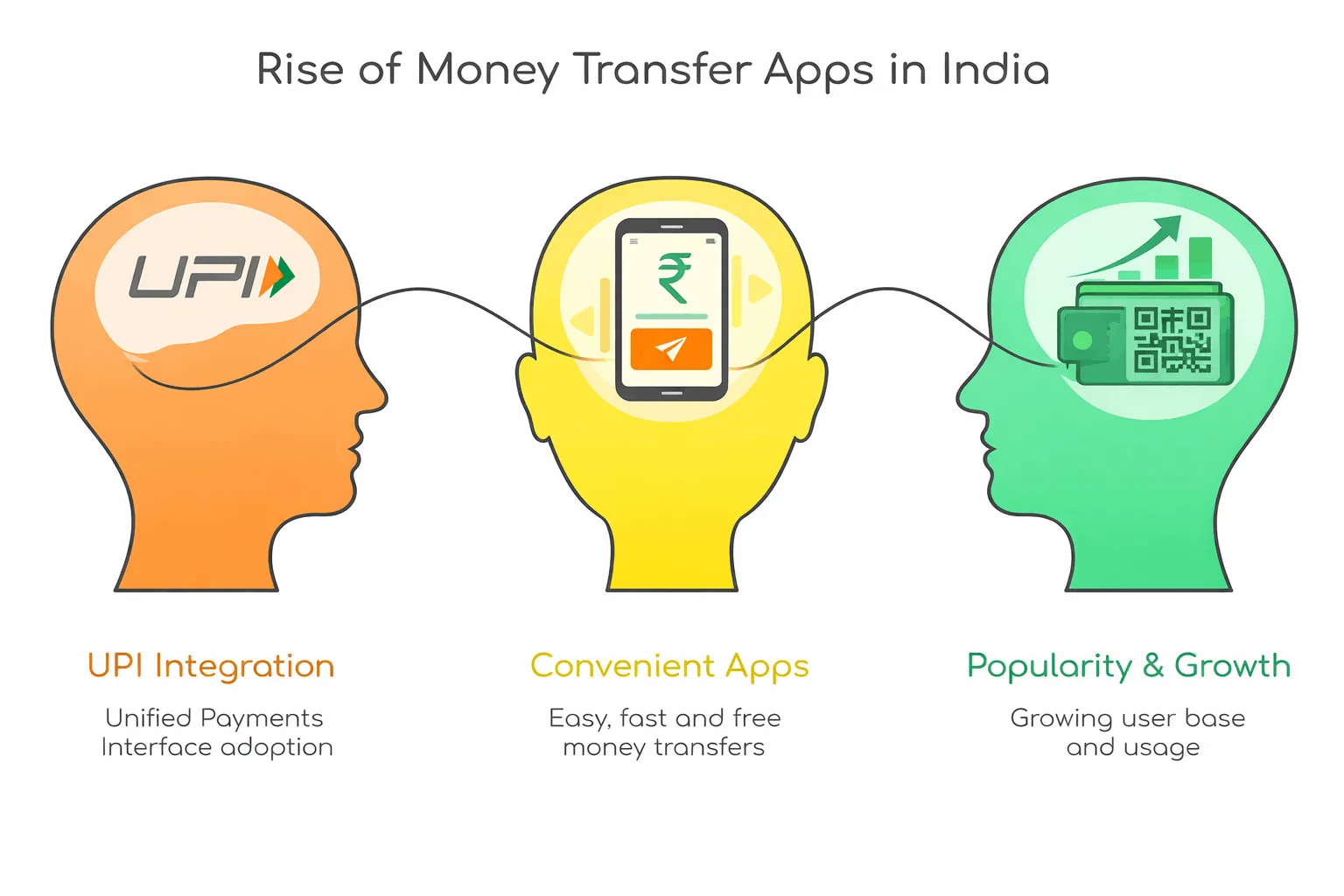
In India, that shift did not just happen gradually. It exploded with the introduction of the Unified Payments Interface (UPI). What started as a simple way to transfer money has now become the backbone of how India pays, sends, splits, and even lives financially.
What changed?
Before UPI, sending money meant:
- Visiting a bank
- Adding beneficiaries and waiting
- Paying transaction fees
- Dealing with delays
Now?
You scan a QR code, enter a UPI ID, or just tap a contact. Done in seconds.
That simplicity is exactly why UPI changed everything.
Scale is massive (and still growing)...
UPI is not just popular. It dominates.
- It accounts for over 80-85% of India’s total digital payment volume
- Transactions grew from 10 billion in 2019 to over 228.5 billion in 2025
- The total transaction value crossed ₹299 lakh crore in 2025
- India now contributes nearly 49% of global real-time digital transactions, led by UPI
And here’s the interesting part.
UPI is not just growing in value. It is growing in frequency. Smaller, everyday transactions are shifting to digital, which means people are using it for everything.
Tea? UPI.
Auto ride? UPI.
Rent split? UPI.
Why did UPI work so well?
Well, the question should be,
Why did UPI succeed where many payment systems failed?
It’s because UPI solved real problems.
- Instant transfers → No waiting time
- Zero or minimal fees → No hesitation in usage
- Interoperability → Works across banks and apps
- Simple UX → Phone number or QR is enough
It removed friction completely.
Real-Life examples you see every day
Think about these situations…
- You are at a local chai stall. No POS machine, no card swipe. Just a QR code.
- You split dinner with friends. No cash exchange, just “send on UPI.”
- A small kirana store accepts payments digitally without any heavy infrastructure.
This is where UPI changed the game. It brought digital payments not just to urban users, but deep into small businesses and rural markets.
In fact, the drop in average transaction size shows that UPI is now used for daily, low-value purchases, not just big transfers.
Shift in user expectations
Now ask yourself:
Would you use an app that takes hours to transfer money?
Would you pay extra fees for something that should be instant?
Probably not!
UPI has completely reset user expectations.
People now expect:
- Real-time transfers
- Zero friction
- Full transparency
Anything slower feels outdated.
What’s next in growth towards 2030?
Even though UPI is already massive, the growth is far from over.
- Digital payments in India are already making up almost 100% of retail transaction volume
- Growth is now being driven by deeper adoption, not just new users
- UPI is expanding into cross-border payments, making global transfers easier
By 2030, India is expected to further strengthen its position as a global leader in real-time payments, with UPI at the center of that ecosystem.
UPI did not just introduce a new payment method. It changed behavior. It made digital payments feel normal. Effortless. Instant. And now the bigger question is- If UPI has already set the standard in India, how do you create a money transfer app that can match or exceed that experience? Because today, you are not competing with banks anymore. You are competing with UPI-level simplicity.
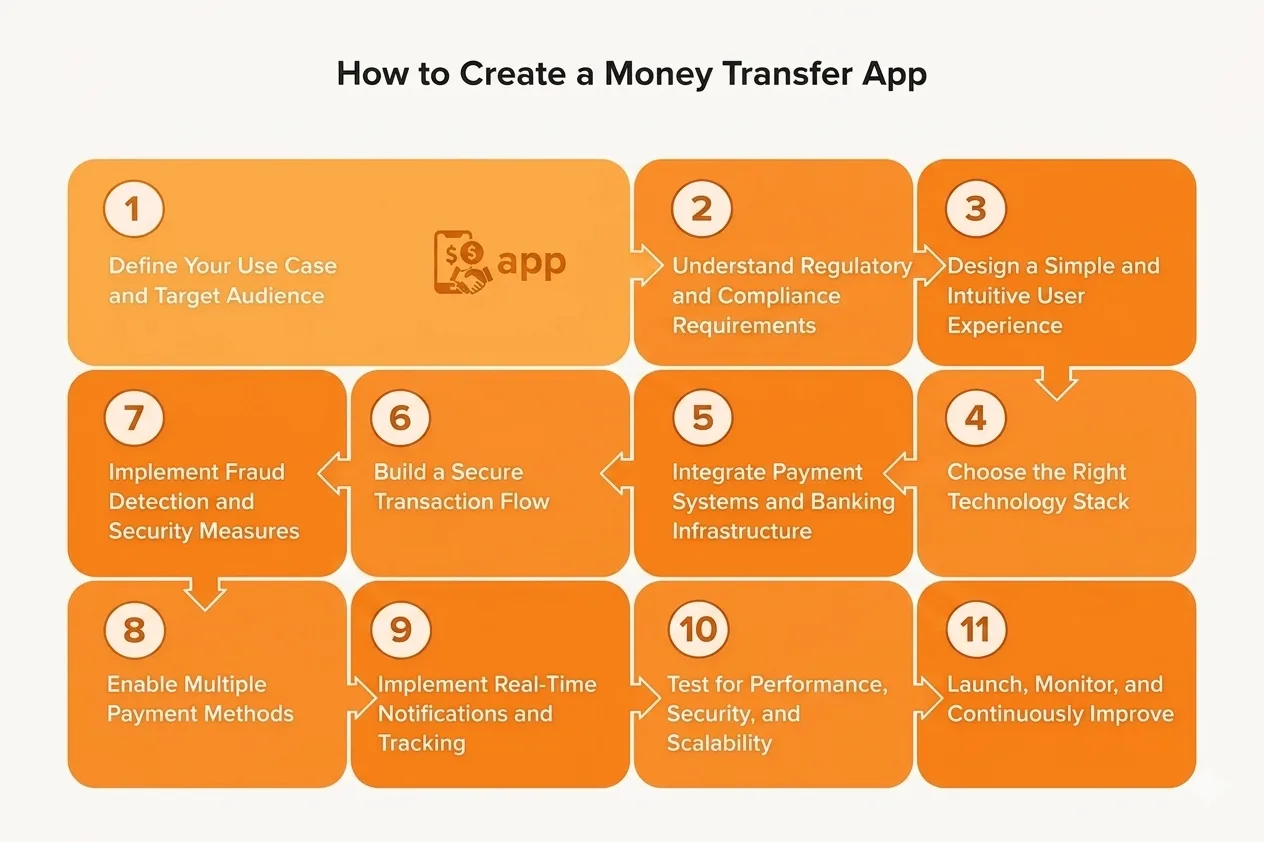
Steps to create a Money Transfer App
Building a money transfer app today is not just about enabling transactions. It is about creating an experience that is fast, secure, scalable, and trusted from day one. With rising user expectations and strict regulations, every step needs to be planned carefully.
Here is how you can approach building a money transfer app the right way…
1. Define Your Use Case and Target Audience
Start with clarity.
Are you building:
- A peer-to-peer payment apps for everyday users?
- A cross-border remittance platform?
- A business payment solution?
Understanding your users helps you design features, workflows, and even compliance requirements.
2. Understand Regulatory and Compliance Requirements
Money movement is highly regulated.
You need to align with:
- KYC (Know Your Customer)
- AML (Anti-Money Laundering)
- Local financial regulations
- Data protection standards
Getting this right early avoids major roadblocks later.
3. Design a Simple and Intuitive User Experience
If sending money feels complicated, users will drop off.
Focus on:
- Quick onboarding
- Easy contact selection or UPI ID entry
- Minimal steps to complete a transaction
- Clear transaction status and history
The goal is to make transfers feel effortless.
4. Choose the Right Technology Stack
Your tech foundation determines how well your app performs at scale.
This includes:
- Backend systems for transaction processing
- Secure databases
- APIs for integrations
- Cloud infrastructure for scalability
A strong tech stack ensures speed and reliability.
5. Integrate Payment Systems and Banking Infrastructure
To actually move money, your app needs to connect with:
- Banks and payment networks
- UPI or local payment systems
- Card networks and wallets
These integrations make real-time transfers possible.
6. Build a Secure Transaction Flow
Security is critical when dealing with financial data.
Your app should include:
- End-to-end encryption
- Secure authentication methods
- Transaction validation mechanisms
Every transaction must be protected without slowing down the experience.
7. Add AI-Driven Intelligence and Advanced Security
This is where modern apps stand out.
Embedding AI helps you:
- Detect fraud in real time by identifying unusual patterns
- Personalize user experience based on behavior
- Optimize transaction routing for better success rates
At the same time, advanced security layers like tokenization and biometric authentication ensure safer transactions with less friction.
8. Enable Multiple Payment Methods
Give users flexibility.
Support options like:
- Bank transfers, UPI payment gateway integrations
- Debit and credit cards
- Digital wallets
More choices mean higher adoption and better user experience.
9. Implement Real-Time Notifications and Tracking
Users want visibility.
Your app should provide:
- Instant transaction alerts
- Real-time status updates
- Clear transaction history
This builds trust and transparency.
10. Test for Performance, Security, and Scalability
Before launch, test everything.
Focus on:
- High transaction volumes
- Security vulnerabilities
- System reliability
- Integration stability
Even small issues can impact user trust.
11. Launch, Monitor, and Continuously Improve
Going live is just the beginning.
Post-launch, you need to:
- Monitor transactions in real time
- Fix issues quickly
- Add new features based on user feedback
- Scale infrastructure as usage grows
Creating a money transfer app is not just about building features. It is about building trust. At Antino, the approach focuses on combining strong technology, seamless user experience, and advanced security to create solutions that are not only functional but future-ready.
Because in today’s world, users do not just want to send money. They want it to be instant, simple, and completely reliable.
Cost to build a Money Transfer App
Building a money transfer app is not a fixed-cost project. It depends on how far you want to go, from a simple peer-to-peer app to a full-scale platform handling cross-border payments, compliance, and millions of transactions.
One thing is clear though. You are not just paying for development. You are investing in security, compliance, scalability, and user trust.
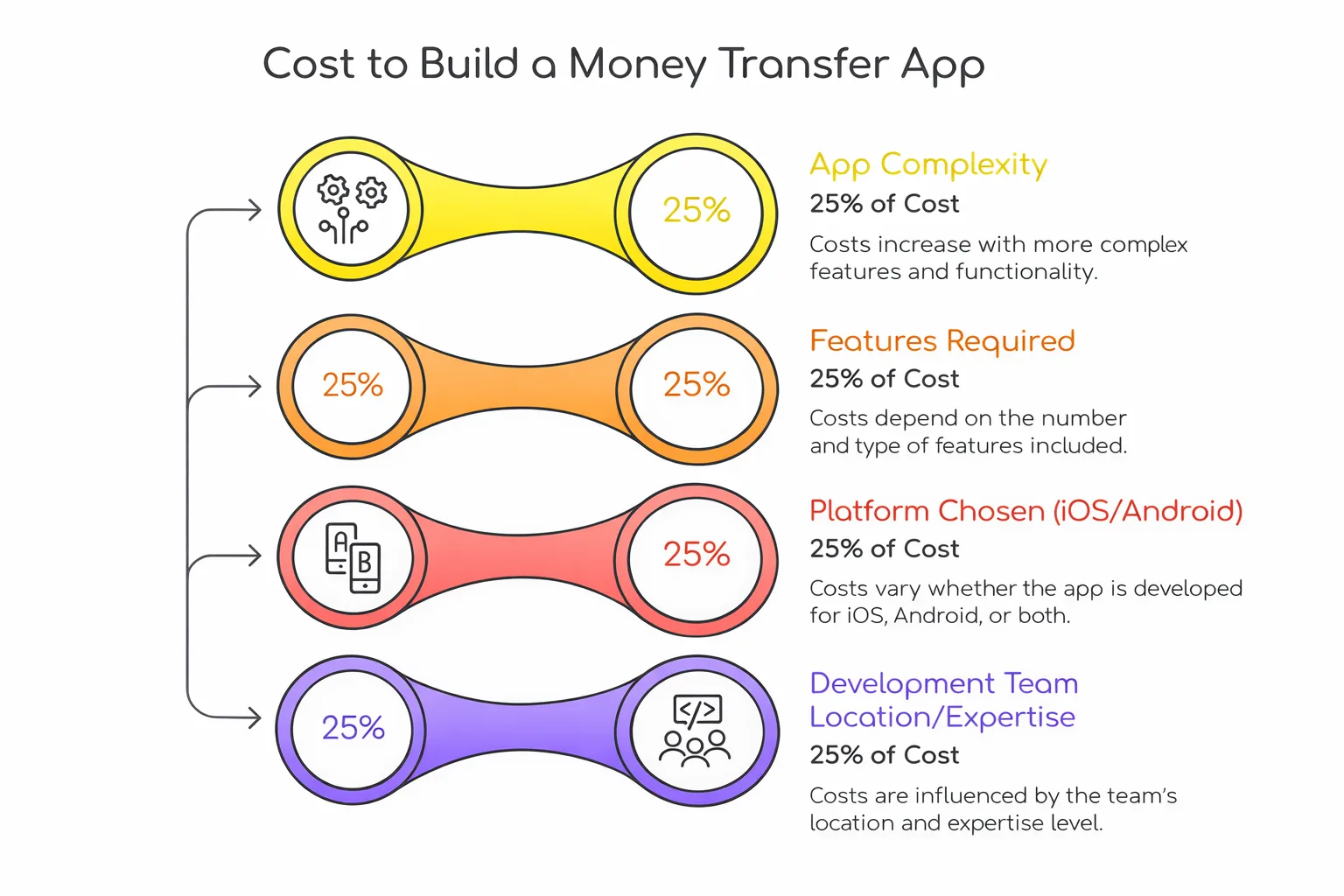
What actually drives the cost?
Before jumping into numbers, here is what really impacts your budget:
- Scope of the app
A basic P2P app costs far less than a multi-currency, global platform.
- Compliance requirements
KYC, AML, and regulatory integrations add both time and cost.
- Payment integrations
Connecting with banks, UPI, cards, or international rails increases complexity.
- Security layers
Encryption, fraud detection, and authentication systems are essential investments.
- AI capabilities
Features like fraud detection, smart routing, and personalization raise the overall cost.
- Scalability needs
Handling millions of users requires a stronger infrastructure.
Estimated Cost Breakdown
In 2026, most money transfer apps typically fall within this range:
- Basic apps: $40,000 - $100,000
- Mid-level apps: $100,000 - $250,000
- Advanced platforms: $250,000 - $400,000+
The final cost depends on how complex your product vision is.
Cost comparison based on complexity
| Level | What does it Include? | Estimated Cost (USD) | Timeline |
| Basic App | P2P transfers, simple UI, basic security, limited integrations | $40K - $100K | 2 - 4 months |
| Growth-Stage App | Multiple payment methods, KYC/AML, better security, reporting, scalable backend | $100K - $250K | 4 - 7 months |
| Advanced Platform | Cross-border transfers, AI fraud detection, real-time analytics, high scalability | $250K - $400K+ | 7 - 12+ months |
How can costs go up (or down)?
Costs increase when you:
- Expand to multiple countries and currencies
- Add advanced compliance layers
- Integrate multiple payment systems
- Use AI for fraud detection and automation
Costs can be optimized when you:
- Start with a focused MVP
- Scale features gradually
- Prioritize high-impact functionalities first
Hidden costs you should not ignore
Building the app is just step one. After launch, you will also spend on:
- KYC and AML verification services
- Payment processing and transaction fees
- Cloud infrastructure and scaling
- Maintenance, updates, and support
- Compliance audits and reporting
The cost of building a money transfer app is not just about development. It is about creating a system that people trust with their money. A smart approach is to start lean, validate your product, and then scale with the right features over time. Because in this space, it is not about who builds first. It is about who builds something that actually works at scale.
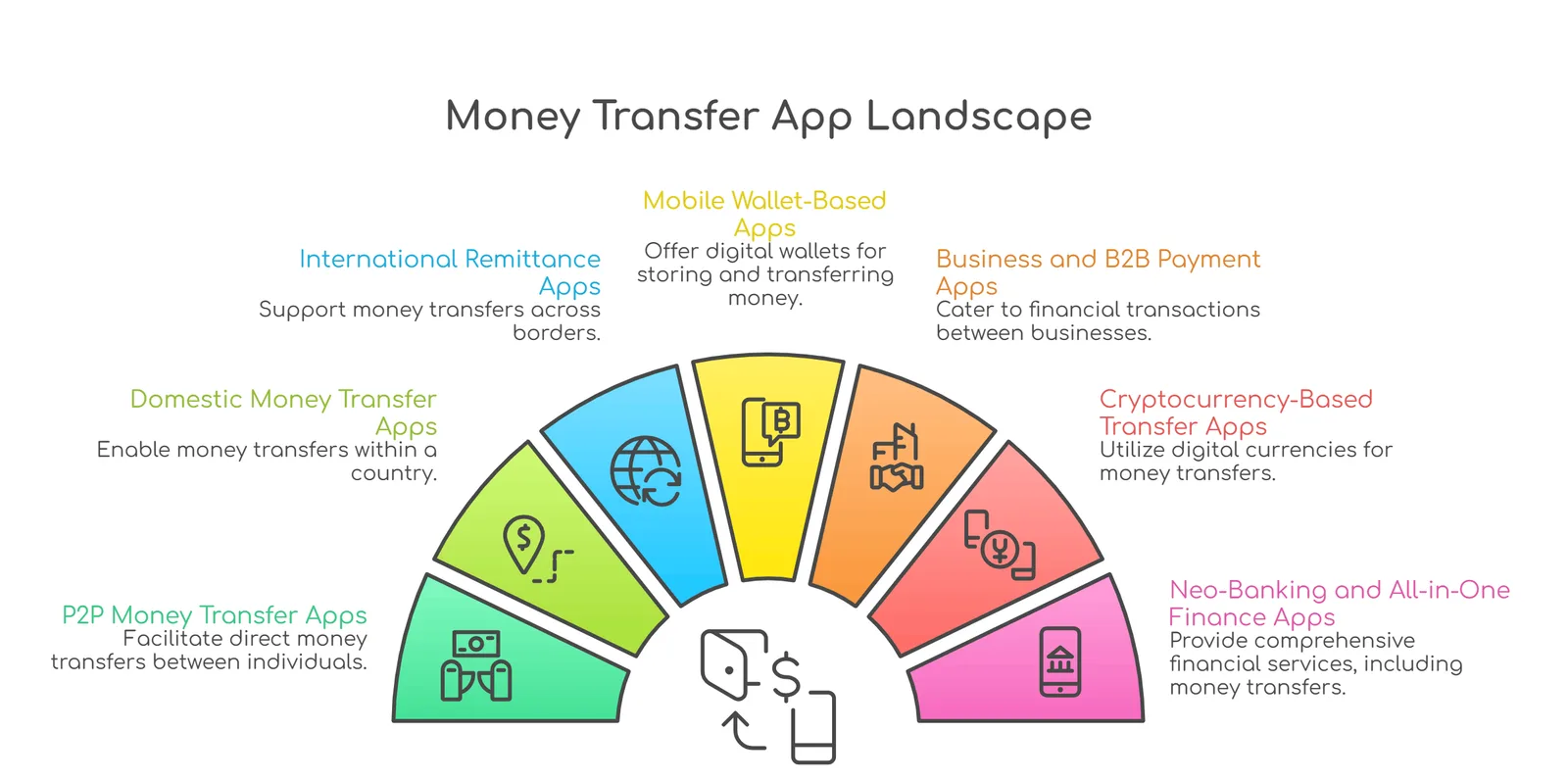
Types of Money Transfer Apps
Not all money transfer apps are built the same. Some are designed for quick everyday payments, while others handle cross-border remittances or business transactions. The type of app you build depends on your users, use case, and scale.
Let’s break down the major types of money transfer apps, along with real-world examples you already know.
1. Peer-to-Peer (P2P) Money Transfer Apps
These are the most commonly used apps for everyday transactions between individuals.
What they do:
Allow users to send and receive money instantly using phone numbers, UPI IDs, or linked bank accounts.
Key features:
- Instant transfers
- Contact-based payments
- QR code payments
- Transaction history
Examples:
- Google Pay
- PhonePe
- Venmo
Where they are used:
Splitting bills, paying rent, sending money to friends or family.
2. Domestic Money Transfer Apps
These apps focus on transferring money within a country, often integrated deeply with local banking systems.
What they do:
Enable users to transfer funds between banks quickly and securely.
Key features:
- Bank-to-bank transfers
- Real-time settlements
- Integration with national payment systems (like UPI)
Examples:
- Paytm
- BHIM
Where they are used:
Utility payments, business payments, local transactions.
3. International Remittance Apps
These apps are designed for cross-border money transfers.
What they do:
Allow users to send money across countries with currency conversion.
Key features:
- Multi-currency support
- Exchange rate transparency
- Faster global transfers
Examples:
- Wise
- Remitly
- Western Union
Where they are used:
Sending money to family abroad, freelancer payments, international business transactions.
4. Mobile Wallet-Based Apps
These apps store money digitally and allow users to transact without directly using a bank account every time.
What they do:
Let users load money into a wallet and use it for payments or transfers.
Key features:
- Wallet balance storage
- Quick payments without bank authorization
- Integration with merchants
Examples:
- Amazon Pay
- PayPal
Where they are used:
Online shopping, subscriptions, small daily payments.
5. Business and B2B Payment Apps
These apps are built for businesses to manage payments at scale.
What they do:
Handle bulk payments, vendor payouts, payroll, and invoicing.
Key features:
- Bulk transfers
- Payment tracking and reporting
- Integration with accounting systems
Examples:
- Stripe
- Razorpay
Where they are used:
Enterprise payments, vendor management, subscription billing.
6. Cryptocurrency-Based Transfer Apps
These apps use blockchain technology for transferring money.
What they do:
Enable users to send digital currencies globally without traditional banks.
Key features:
- Decentralized transactions
- Lower cross-border fees
- Faster international transfers
Examples:
- Coinbase
- Binance
Where they are used:
Crypto trading, global transfers, digital asset management.
7. Neo-Banking and All-in-One Finance Apps
These apps go beyond just money transfers and offer a complete financial ecosystem.
What they do:
Combine banking, payments, savings, and investments in one app.
Key features:
- Integrated financial services
- Smart insights and analytics
- Seamless money transfers
Examples:
- Revolut
- N26
Where they are used:
Managing overall finances along with payments.
The type of money transfer app you choose to build depends on your business goals and target audience. Are you solving for quick everyday payments? Or building a global financial platform?
Because today, users do not just want to send money. They want speed, transparency, flexibility, and a seamless experience across every transaction.
Must-Have Features of a Money Transfer App
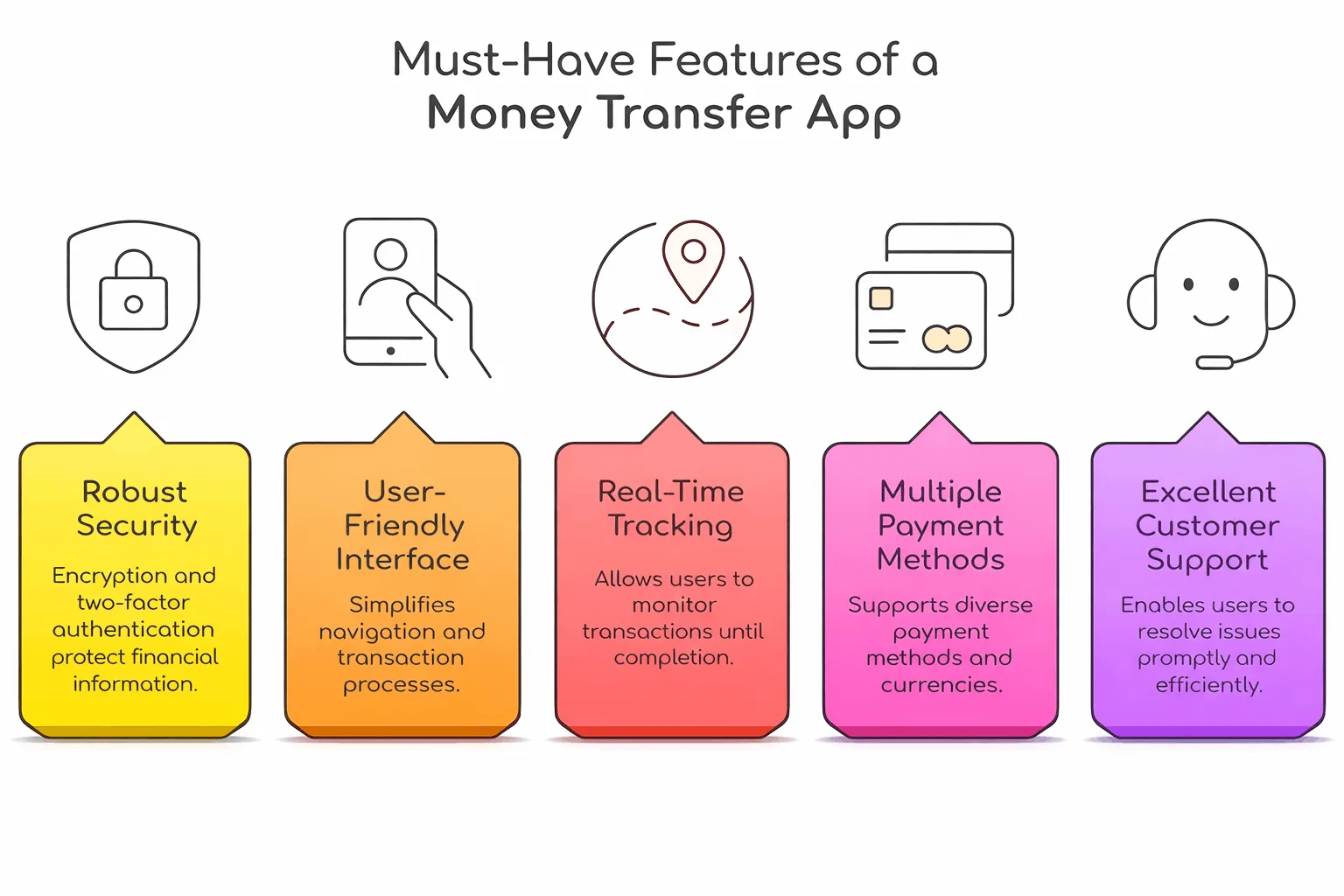
A money transfer app today is expected to do much more than just move money. Users want speed, transparency, security, and a smooth experience every single time. If even one of these feels off, they switch apps instantly.
So what does it actually take to build a money transfer app that users trust and keep coming back to?
Here are the must-have features you should not miss…
1. Quick and Simple Onboarding
First impressions matter.
Users should be able to:
- Sign up using phone number, email, or social login
- Complete KYC with minimal steps
- Start using the app without confusion
If onboarding feels long or complicated, most users drop off before even making their first transaction.
2. Secure User Authentication
Since financial data is involved, security needs to be strong but not annoying.
Include:
- OTP-based login
- Biometric authentication (fingerprint or face unlock)
- Multi-factor authentication
This ensures safety while keeping access quick.
3. Easy Money Transfer Flow
This is the core of your app.
Users should be able to:
- Send money using phone number, UPI ID, or bank details
- Scan QR codes for instant payments
- Transfer funds in just a few steps
The goal is simple: make sending money feel effortless.
4. Real-Time Transaction Processing
Nobody wants to wait for money to arrive.
Your app should support:
- Instant or near real-time transfers
- Live transaction status updates
- Immediate confirmations
Speed builds trust.
5. Multiple Payment Options
Different users prefer different payment methods.
Your app should support:
- Bank transfers
- UPI
- Debit/credit cards
- Digital wallets
More options = better adoption.
6. Transaction History and Tracking
Users want visibility.
Include:
- Detailed transaction history
- Filters for easy tracking
- Downloadable receipts
This helps users stay informed and in control.
7. Push Notifications and Alerts
Communication is key.
Notify users about:
- Successful transactions
- Failed or pending payments
- Security alerts
This keeps everything transparent.
8. Built-in Security Features
Security should be layered across the app.
Key features include:
- End-to-end encryption
- Tokenization of sensitive data
- Fraud detection systems
Users need to feel that their money is safe at all times.
9. AI-Powered Fraud Detection and Insights
This is where modern apps stand out.
AI can help:
- Detect suspicious transactions instantly
- Analyze user behavior patterns
- Reduce fraud risks without slowing down transactions
It works silently in the background but adds huge value.
10. Currency Conversion (For Global Apps)
If your app supports international transfers, this is essential.
Include:
- Real-time exchange rates
- Transparent fees
- Multi-currency support
This improves user confidence in cross-border payments.
11. In-App Chat or Support System
Users need quick help when something goes wrong.
Provide:
- Chat support or chatbot assistance
- Ticket-based issue tracking
- FAQs and help center
Fast support improves user retention.
12. Request Money Feature
It is not always about sending money.
Users should also be able to:
- Request payments from others
- Send reminders
- Split bills easily
This makes the app more useful in daily scenarios.
13. Contact Integration
Make payments more intuitive.
Allow users to:
- Sync phone contacts
- Send money directly without entering details
This reduces friction.
14. Admin Dashboard
For the business side, this is critical.
Include:
- User management
- Transaction monitoring
- Fraud tracking
- Reporting and analytics
This helps you manage and scale operations efficiently.
15. Scalability and Performance Optimization
Your app should grow with your users.
Ensure:
- Ability to handle high transaction volumes
- Fast load times
- Reliable infrastructure
Because even a small delay can impact trust.
A great money transfer app is not built by adding features randomly. It is built by understanding what users actually need and delivering it in the simplest way possible. At the end of the day, users do not care about how complex your backend is. They care about one thing. Can they send money instantly, safely, and without any hassle?
Why Enterprises prefer Antino for Money Transfer App Development?
Enterprises do not just need an app, they need a system that can handle scale, security, and compliance without slowing down growth. That is exactly where Antino steps in. We as a leading Fintech app development company helps building real-time transaction systems to integrating banking infrastructure and advanced security layers, the focus is always on creating solutions that are reliable and future-ready.
Whether it is handling high transaction volumes, embedding AI for fraud detection, or ensuring compliance across regions, Antino helps enterprises move faster without compromising on trust.
If you are planning to build a money transfer app that users actually rely on, Antino brings the right mix of strategy, technology, and execution. The goal is to create a seamless, secure, and scalable experience that grows with your business. Want to turn your idea into a high-performing payment platform? Let’s connect and make it happen!