AI agents are no longer a pilot-stage bet. As of 2026, 80% of enterprises have at least one production AI agent deployed. The global AI agents market has crossed $10.91 billion and is sprinting toward $52.62 billion by 2030. The cost-per-task economics are staggering: a human-handled customer support ticket costs $4.18 on average. An AI agent resolves the same ticket for $0.46. That is a 9x cost reduction, right there.
But here is the catch that most boardrooms miss: deploying AI agents and optimizing the cost of those agents are two completely different conversations. Only 23% of companies actually see measurable ROI from their AI agents, even as 97% of individual employees report productivity gains. The gap is not the technology. It is the absence of cost governance, smart architecture choices, and a clear optimization playbook.
This blog breaks down what AI agents are doing to your cost structure, 9 proven ways to keep them optimized, and what smart deployment looks like in India, the US, and the UAE right now.
AI Agents are already running your Business
Think about what happened the last time a customer emailed your support team at 2 a.m. Someone had to log in, check the ticket, find the right answer, and respond. Now imagine a piece of software that reads the query, pulls the customer's history from your CRM, cross-checks your policy documents, drafts a personalized reply, and closes the ticket before the person even finishes their coffee. That is an AI agent.
AI agents are autonomous software systems that perceive their environment, reason through multi-step tasks, take action across tools and APIs, and learn from outcomes without requiring a human in the loop for every decision. They are not chatbots. They are not simple automation scripts. Agentic AI is the next evolution beyond generative AI, where the system does not just respond to prompts but actually plans and executes.
And the scale of adoption has moved well past curiosity. Gartner's 2026 data shows that 80% of enterprises now have at least one production application embedding an AI agent, up from just 33% in 2024. McKinsey's 2026 Global AI Survey finds that knowledge workers using production AI agents recover a median of 6.4 hours per week per seat. Senior practitioners are saving 10 to 12 hours weekly. The productivity numbers are real.
What is less talked about in most executive discussions is the cost architecture underneath all of this. Yes, AI agents reduce operational costs. But they also introduce their own cost structure: LLM token consumption, infrastructure bills, orchestration overhead, integration maintenance, and governance layers. LLM API calls alone account for 70 to 85% of total AI agent operating costs.
And most teams default to the same premium frontier model for every single task, which, according to 2026 data from LockLLM, means they are overpaying by 40 to 85%.
The C-suite question now should be, "How do we deploy AI agents in a way that the unit economics actually work?"
Here’s something about the Procurement Agent for your knowledge
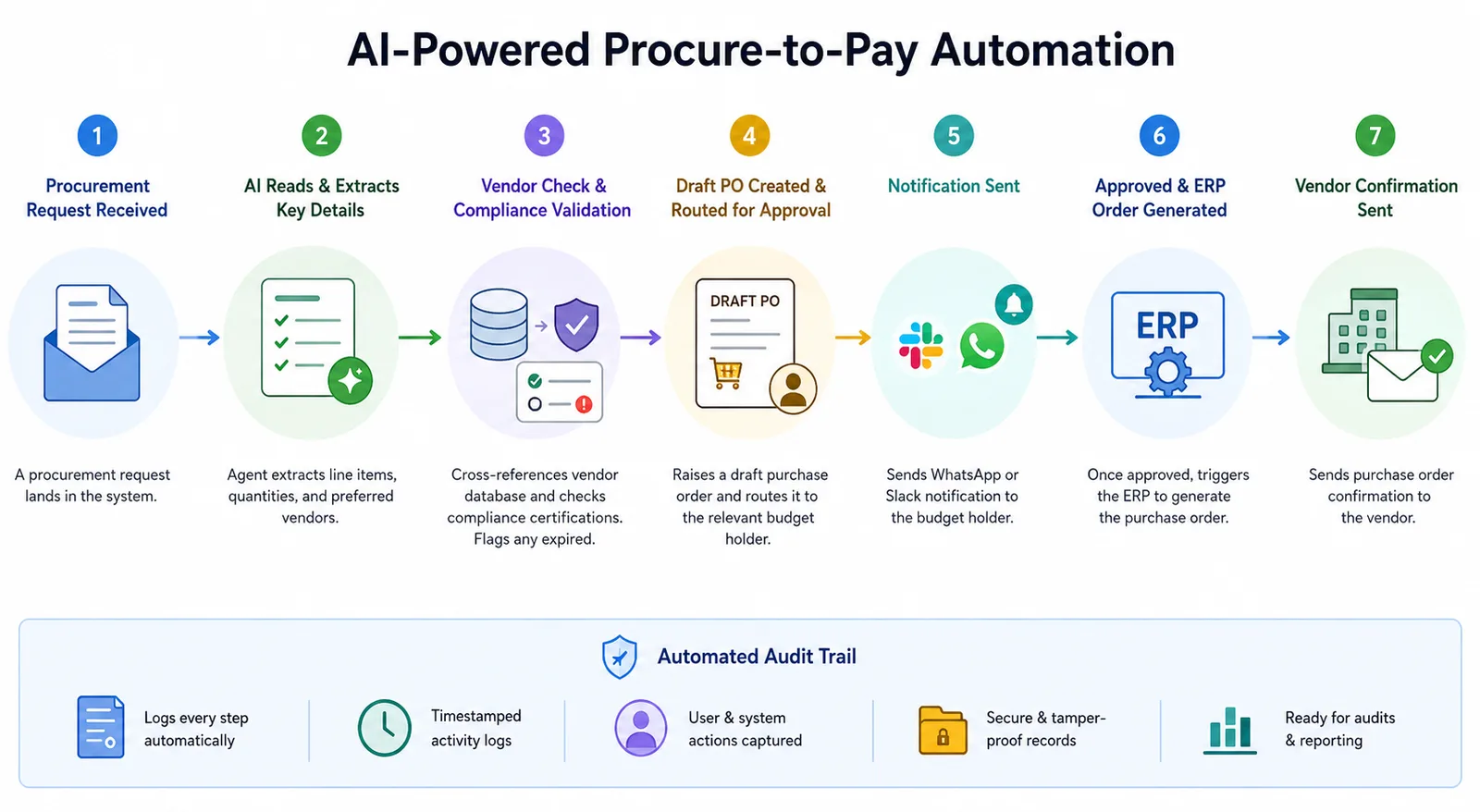
Take a procurement AI agent deployed at a mid-sized manufacturing firm. The agent's job is to manage vendor onboarding and purchase order approvals. Here is what it does autonomously:
- A procurement request lands in the system. The agent reads it, extracts line items, quantities, and preferred vendors.
- It cross-references the vendor database, checks compliance certifications, and flags any that have expired.
- It raises a draft purchase order, routes it to the relevant budget holder, and sends a WhatsApp or Slack notification.
- Once approved, it triggers the ERP to generate the order and sends a confirmation to the vendor.
- It logs everything in the audit trail without any manual entry.
Danfoss, the global manufacturing giant, deployed a similar procurement agent and automated 80% of transactional purchase order decisions. Response time dropped from 42 hours to near real-time.
Annual savings: $15 million. Payback period: 6 months.
This is not a futuristic case study. This is 2025-2026 production reality. The question is what it costs to keep that agent running efficiently at scale, and whether your organization is architecting it for long-term cost health.
Automating the manual work with AI agents | Is it reducing or overburdening expenses?
Let us be direct about this. AI agents do reduce costs. The data is unambiguous. A customer service AI agent resolves a contained ticket for $0.46 versus $4.18 for a human-handled one. A code review agent completes a routine pull request for $0.72 versus $48 of senior engineer time. The median payback period across AI agent deployments is 5.1 months (BCG and Forrester, 2026). Customer service agents hit positive ROI in 4.1 months on average.
Gartner projects that conversational AI alone will save $80 billion in contact-center labor costs globally by the end of 2026. Companies investing in AI-powered support see average returns of $3.50 for every $1 spent, with leading organizations hitting up to 8x ROI.
So yes, on a per-task basis, AI agents are dramatically cheaper than humans for high-volume, repeatable work. But here is where leadership teams get surprised.
The hidden cost stack nobody talks about
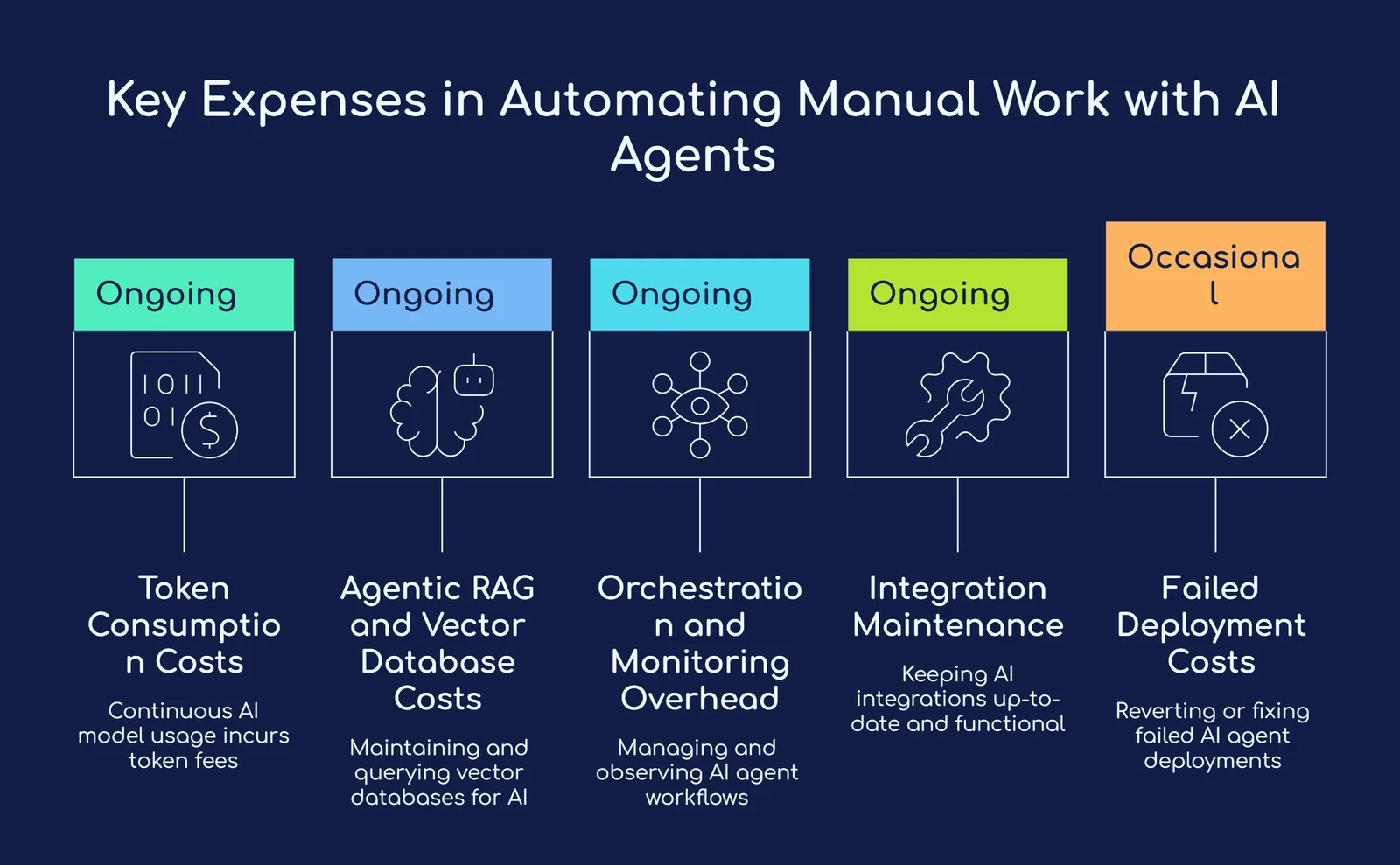
When you deploy an AI agent at scale, you are not just paying for the task it completes. You are paying for the entire operational infrastructure that keeps it running. And those costs are easy to ignore until your AWS bill doubles.
- Token consumption costs: Advanced reasoning, multi-step planning, and tool usage dramatically increase token consumption. A well-architected agent that routes simple tasks to a lighter model and complex tasks to a frontier model can cut costs by 60 to 80%. An unoptimized agent that uses GPT-4-class compute for everything overpays by up to 85%.
- Agentic RAG and vector database costs: Persistent memory architectures using Retrieval-Augmented Generation (RAG) and vector databases have become standard in 2026. They add infrastructure costs that teams routinely underestimate during the build phase.
- Orchestration and monitoring overhead: Multi-agent systems require coordination layers that introduce additional compute and engineering hours. Without observability tooling, you cannot even see where the waste is coming from.
- Integration maintenance: Every API your agent connects to, every CRM, ERP, or ticketing system, requires ongoing maintenance. Connections break. APIs deprecate. Someone has to fix them.
- Failed deployment costs: The average failed enterprise AI agent project costs $2.1 million in sunk costs for Fortune 1000 companies (2026 data). 88% of AI agents never reach production, with the primary culprits being infrastructure gaps (41%), governance and security barriers (38%), and ROI measurement failures (33%).
Only 41% of agent rollouts cross positive ROI within 12 months, and 19% never reach payback at all, according to Gartner's Agentic AI Pulse 2026. The reason is almost never agent capability. It is evaluation drift, governance gaps, and unmeasured rework. In other words, it is a cost management failure, not a technology failure.
The upshot for C-suite decision-makers is that AI agents are a net cost reducer when built right. They become a net cost adder when deployed without a cost optimization layer. The difference between the two is not technology. It is an architectural discipline.
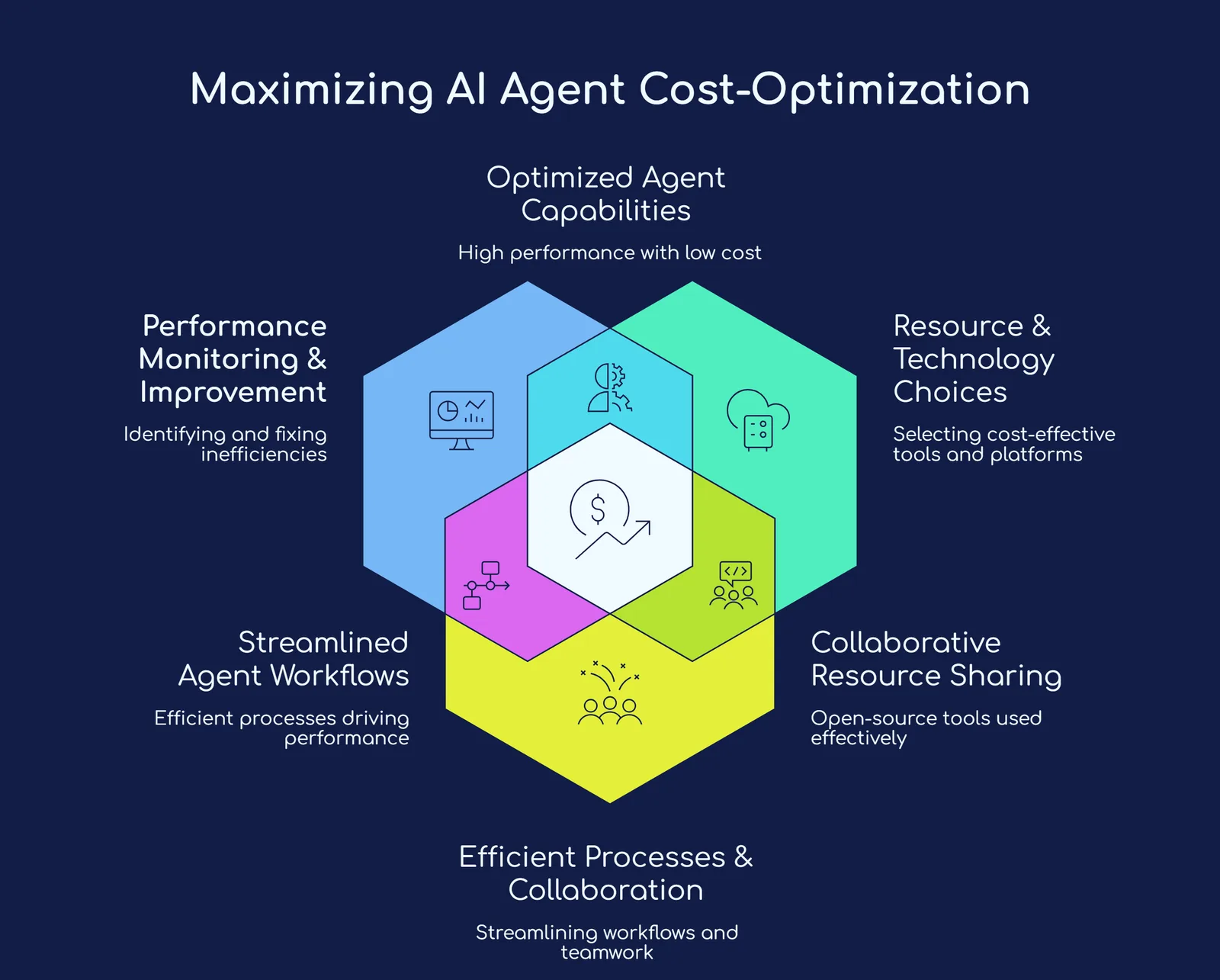
9 ways to keep your AI agents cost-optimized
These are not theoretical suggestions. Each of the following is backed by production deployment data from 2025 and 2026 enterprise rollouts.
1. Route Tasks to the Right Model
This is the single highest-leverage optimization available to any team running AI agents at scale. The idea is straightforward: not every task needs a frontier model. Routing easy, structured tasks (FAQ lookups, data extraction, simple classification) to a lighter, cheaper model while reserving premium compute for complex reasoning tasks can cut LLM costs by 60 to 80%.
The data from 2026 says that moving 70% of requests from GPT-4-class to GPT-3.5-class models reduces LLM costs by approximately 60% with less than 5% quality regression. Teams implementing multi-model routing in production are averaging 55 to 65% cost reduction. With Claude 4.5 Haiku at $0.80/1M tokens and Gemini 3 Flash at $0.10/1M tokens now available, the economics of intelligent routing are more compelling than ever.
The action item is to build a routing layer that classifies incoming tasks by complexity before sending them to a model. It is one of the most impactful engineering decisions you can make. These architectural decisions are much easier to make when you have a clear framework for building AI agents, from selecting the right reasoning model to designing memory, orchestration, and tool integrations.
2. Use Semantic Caching to Stop Paying for the Same Answer Twice
In high-volume deployments, a significant percentage of queries are semantically identical even if worded differently. "What are your shipping charges?" and "How much does delivery cost?" are the same question. Semantic caching stores the LLM's response to the first version and retrieves it instantly for subsequent similar queries without burning any tokens.
For customer service, HR, and internal knowledge agents that handle high volumes of repeated intents, well-architected caching can reduce token spend by 30 to 50%. The key architectural rule is to design your prompts to be cache-friendly. Personalization tokens, rotating user IDs, and timestamps at the front of a prompt destroy cache hit rates. Keep the cacheable part of your prompt stable.
3. Optimize Memory Architecture to Avoid Context Bloat
Token cost scales with context window length. Agents that carry their entire conversation history or load full documents into every LLM call are burning money on irrelevant context. Smart memory management separates what the agent needs right now (working memory) from what it can retrieve on demand (long-term memory via RAG).
Practical steps include: summarizing older conversation turns instead of keeping them verbatim, chunking documents efficiently so retrieval pulls only the relevant paragraph rather than the entire policy manual, and setting hard token limits per agent run with escalation triggers rather than letting chains run unconstrained.
4. Use Batch Processing for Non-Real-Time Workloads
Not everything needs to happen in real time. Nightly report generation, document summarization, data enrichment, and compliance checks are all tasks that can be batched. Batch API pricing on Anthropic and OpenAI platforms offers roughly 50% cost reduction versus synchronous API calls for the same volume.
The discipline here is identifying which workflows in your agent pipeline are latency-sensitive and which are not. Marketing content generation, invoice data extraction, and compliance document review do not need to run in real time. Shift those workloads to batch and watch the cost line drop.
5. Build Evaluation Loops and Monitor for Drift
One of the most underappreciated sources of runaway AI agent cost is evaluation drift, where agent performance degrades silently over time as data, user behavior, or underlying models shift. An agent that was resolving 70% of tickets autonomously in January may have slipped to 50% by April, meaning your human support team is quietly picking up the slack, and you are paying double.
Gartner's Agentic AI Pulse 2026 cites evaluation drift as one of the primary reasons 19% of deployments never reach payback. The fix is an automated evaluation pipeline that continuously tests a sample of agent outputs against ground truth, flags regressions, and triggers retraining or prompt updates. Teams that build this from day one avoid expensive surprises six months in.
6. Start with High-Volume, High-Repeatability Use Cases
The fastest path to positive ROI from AI agents is not starting with the most complex or exciting use case. It is starting with the one that has the highest volume of repetitive tasks and the clearest definition of done. Customer service ticket resolution, HR leave management, invoice processing, and IT helpdesk triaging are all examples of workflows where the agent can hit consistent resolution rates quickly.
Bain's Agentic AI Benchmark 2026 shows that customer service agents reach payback in 4.1 months, SDR agents in 3.4 months, and finance and operations agents in 8.9 months. The principle is simple: the more a task repeats, the more the cost savings compound. Start there before tackling the complex, long-tail workflows.
7. Right-Size Your Infrastructure with Cloud Cost Management
AI agent infrastructure costs, covering compute, vector databases, embedding models, and observability tooling, grow fast when traffic scales. The biggest lever in this layer is picking an inference engine that scales capacity with request volume, instead of reserving fixed GPU pools that sit idle between traffic bursts. The most common mistake is over-provisioning from day one: spinning up large-scale infrastructure for a deployment that is still running 1,000 requests per day.
Practical steps: use autoscaling compute rather than fixed instances, choose serverless or consumption-based vector databases for early-stage agents, monitor embedding costs separately since they are often an invisible contributor to infrastructure bills, and run regular cost attribution reports that break down spend by workflow, model, and team so leadership can see exactly where the money is going.
8. Use Vendor-Built Agents for Standard Use Cases, Custom Builds for Differentiation
Here is a strategic cost decision that many organizations get wrong: building custom AI solutions for every use case when vendor-built solutions already exist. Vendor-deployed agents, including Salesforce Agentforce, Microsoft Copilot Studio, and IBM watsonx Orchestrate, reach positive ROI 2.4 times faster than custom builds, per Bain's 2026 benchmark.
The smart framework: use managed platforms for standard use cases like customer service, document processing, and HR workflows where the business logic is not a competitive differentiator. Reserve custom builds for workflows where your proprietary data, unique processes, or competitive differentiation actually justifies the higher upfront investment. This hybrid approach reduces time-to-value while keeping costs predictable.
9. Build a Governance Layer Before You Scale
Only 21% of companies have a mature governance model for autonomous AI agents as of 2026. The other 79% are deploying agents without the infrastructure to manage them safely at scale. This is not just a compliance risk. It is a cost risk.
Ungoverned agents make mistakes. They hallucinate, they take wrong actions, they trigger workflows they should not. And human teams spend time fixing those errors, which erases the cost savings the agent was supposed to generate in the first place. Governance includes defining which decisions an agent can make autonomously, which require a human checkpoint, which data it can access, and how outputs are logged and audited.
With AI compliance spending projected to hit $5 billion globally by 2027, as fragmented AI regulations govern half the world's economies, building a governance layer now is both a cost-optimization and a future-proofing move.
What does this look like across India, the US, & the UAE Markets in 2026?
AI agent deployment patterns vary by geography, regulatory environment, and industry concentration. Here is what the 2026 landscape looks like across three major markets.
India
India's financial services sector is moving fast. The India FinTech Forum's Fintech Trends 2026 report called out Agentic AI as the defining shift of 2025, where AI agents moved from hype to deployment across BFSI operations, compliance, and customer experience.
- HDFC Bank's EVA (Electronic Virtual Assistant) is one of the most deployed conversational AI agents in Indian banking, handling over 10 million interactions monthly as of 2024. After upgrading with generative AI, EVA now resolves queries across lost cards, bill disputes, and loan inquiries, often in regional languages. HDFC reported a 30% drop in call center costs and a 25% reduction in customer complaints.
- SBI's YONO platform uses AI agents to analyze transaction histories and offer tailored financial products. By 2024, YONO's AI agents had slashed loan approval times to minutes for pre-qualified users, and SBI reported a 20% rise in digital lending volume as a direct result.
- Kotak Mahindra Bank deployed an AI-driven KYC agent that completes customer onboarding in minutes by integrating facial recognition, document verification, and real-time data checks. Onboarding time dropped 60%, and digital account activations rose 25%.
India now contributes 16% of the world's AI talent, according to the India Skills Report 2026, and is projected to grow to 1.25 million AI professionals by 2027. That talent base is a significant cost advantage for enterprises building AI agents locally, where development costs for a mid-tier agent can be as low as Rs. 8 to 15 lakhs for an MVP and Rs. 40 lakhs and above for enterprise-grade systems.
United States
The US is both the largest market for AI agent deployment and the source of most production-grade ROI benchmarks. Successful US deployments deliver an average 192% ROI, higher than the global average of 171%, primarily because the labor cost differential makes the per-task savings more dramatic.
- Telus, operating across North American markets, deployed AI agents used by 57,000 employees daily. Each interaction saves 40 minutes of work. The aggregate productivity gain is 38,000 hours monthly, an extraordinary figure that translates directly to operational cost reduction at scale.
- In healthcare, Accenture's 2025 analysis projected AI-driven savings of up to $150 billion annually in the US healthcare system by 2026, driven largely by agentic automation of administrative, diagnostic, and compliance workflows. 68% of healthcare organizations already use AI agents in some capacity.
- Amazon deployed AI agents through Amazon Q Developer to modernize thousands of legacy Java applications significantly faster than traditional timelines. Genentech built multi-agent systems on AWS to automate complex pharmaceutical research workflows, with individual agents handling literature review, experimental design, regulatory documentation, and results analysis.
UAE
The UAE's AI story in 2026 is unlike any other market in the world: it is a government-driven mandate. In May 2026, Dubai's Crown Prince directed the emirate's entire private sector to transition to agentic AI within two years. The Dubai Chamber of Commerce was tasked with administering training tracks, establishing government-funded AI incubators, and creating dedicated investment vehicles to support the transition.
By late May 2026, the UAE federal cabinet had already trained 80,000 employees on AI and deployed four operational government AI agents covering Procurement, Tax Auditing, Customer Happiness, and Technical Support. Abu Dhabi committed AED 13 billion ($3.5 billion) to its Digital Strategy 2025 to 2027 with a target of becoming the world's first fully AI-native government.
For UAE enterprise leaders, the deployment data is compelling. Companies deploying AI agents in 2025 to 2026 report 60 to 80% reduction in customer service response times, 30 to 50% cost savings on operational tasks handled by AI, and 20 to 35% improvement in customer satisfaction scores. Some organizations report a single AI agent handling the equivalent work of up to 100 people, saving tens of thousands of dirhams monthly.
Dubai-based financial institutions in the DIFC and ADGM are implementing AI agents for regulatory reporting, automated KYC and AML processing, and trade finance documentation automation. The government is setting the standard; the private sector is now racing to meet it.
How can Antino help you build custom AI agents for your use case?
Most organizations sit at one of three inflection points when it comes to AI agents. Either they have not started and are trying to figure out where to begin, they have deployed a proof of concept and are struggling to get it to production scale, or they are in production and seeing costs creep up without a clear picture of why.
Antino works at all three. As an AI consulting and digital transformation company that has built production-grade systems for enterprises across industries, Antino brings the architectural discipline that the AI agent market currently lacks in most build shops.
What makes Antino different in AI Agent Development?
- Use-case-first approach: Antino does not start with the technology. Every engagement starts with mapping the business workflow, identifying the high-volume repetitive tasks that will deliver the fastest ROI, and designing agent architecture around business outcomes rather than model capabilities.
- Cost-aware architecture: From day one of the build, Antino architects for cost efficiency, including multi-model routing, semantic caching strategy, memory architecture, and batch processing identification. This is not retrofitted after deployment. It is built in.
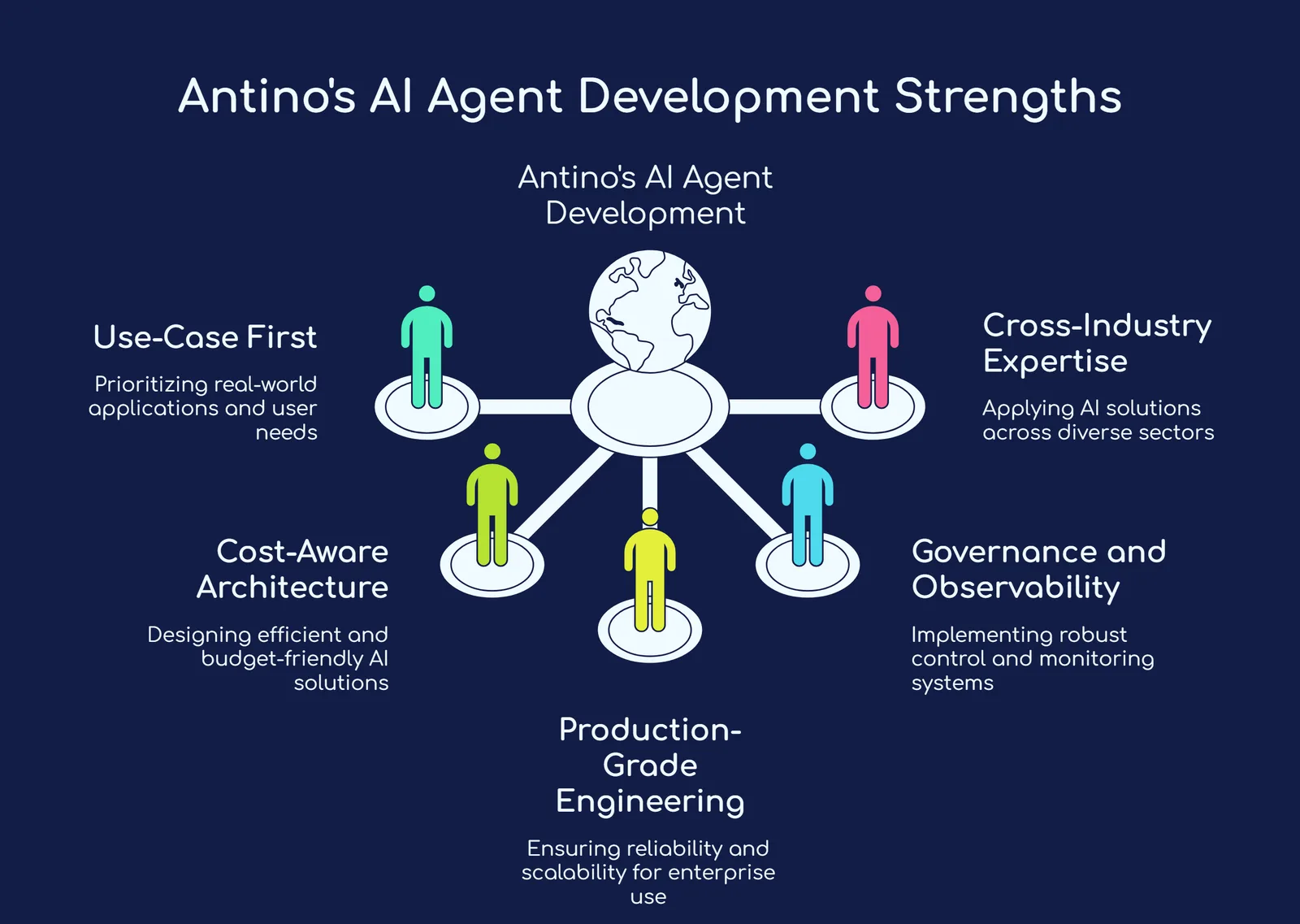
- Production-grade engineering: Antino builds agents that integrate deeply with existing enterprise systems, including CRMs, ERPs, support platforms, and data infrastructure, rather than standalone prototypes that cannot connect to the real business.
- Governance and observability: Every agent Antino delivers includes evaluation pipelines, monitoring dashboards, human-in-the-loop checkpoints, and audit trail logging. The governance layer is not optional. It is part of the product.
- Cross-industry expertise: From BFSI and healthcare to retail, logistics, and SaaS, Antino has delivered agentic AI implementations across verticals, meaning the team brings pattern recognition from production deployments that most build-from-scratch efforts take 12 months to accumulate on their own.
Whether you are a CTO looking to get your first agent into production, a COO trying to understand why your current agent deployment is not hitting ROI targets, or a CEO who wants a clear-eyed view of what agentic AI means for your cost structure over the next 24 months, Antino builds for outcomes, not demos.
The right AI agent for your business is not the most sophisticated one. It is the one that solves the right problem at the right cost with the right architecture to scale. Contact our AI experts!
FAQs
Do AI Agents Really Help in Cutting Costs Across Departments?
Yes, but with an important qualifier. AI agents deliver measurable cost reduction when deployed in the right workflows with proper architecture and ongoing optimization. The data is consistent: a 9x per-task cost reduction in customer service, a 66x reduction in code review, and a median payback period of 5.1 months across deployments.
The departments seeing the fastest cost impact in 2026 are customer service and support, IT helpdesk and internal ticketing, HR operations including onboarding and leave management, finance functions including invoice processing and reconciliation, and sales operations including lead qualification and CRM maintenance.
The qualifier is that departments seeing cost reduction are the ones that started with clear, high-volume use cases, built governance from day one, and have cost monitoring in place. Departments that deployed agents without these foundations are often paying more in rework and maintenance than they are saving in automation.
The short answer is yes. But the real question is whether your deployment is set up to capture those savings or leave them on the table.
Should We Deploy AI Agents in Our Business Process?
If you have high-volume, repetitive workflows with defined inputs and outputs, yes. Immediately. The cost economics are favorable enough, and the competitive pressure is strong enough that waiting is now the higher-risk position.
As of Q1 2026, 80% of enterprises have at least one production AI agent deployed. In markets like the UAE, AI agent adoption has become a government-mandated priority. In India, the BFSI sector has moved from pilot to production at scale. In the US, the cost savings data from production deployments is now robust enough that the business case builds itself.
The practical framework for deciding where to start:
- Identify the three to five workflows in your organization with the highest volume of repetitive tasks.
- Calculate your current cost per task for each (fully loaded labor cost divided by monthly task volume).
- Model the AI agent equivalent at $0.46 to $2.00 per resolution depending on complexity.
- Pick the workflow with the highest potential cost delta and the clearest definition of done.
- Build a governed pilot with measurable KPIs and a clear path to production.
The honest answer to "should we deploy AI agents?" is: if you are not at least piloting them by the end of 2026, you will be explaining the gap to your board in 2027.
Bottom Line for the C-Suite
AI agents work. The cost economics are real. The global deployments are proving it at scale, from HDFC Bank handling 10 million monthly interactions to UAE government agencies running four live agentic AI systems across procurement, tax, and citizen services.
But the gap between organizations that capture those savings and those that do not is almost entirely a cost optimization and governance story. Multi-model routing, semantic caching, memory architecture, batch processing, evaluation pipelines, and a governed deployment approach are not technical nice-to-haves. They are the difference between 171% ROI and a $2.1 million sunk cost.
The global AI agents market hit $10.91 billion in 2026 and is moving toward $52.62 billion by 2030. The organizations building cost-optimized agentic AI infrastructure now are the ones that will own the operational efficiency advantage in the years ahead.